West Bengal — Rabindranath Tagore’s Bengal, the Bengal of Durga Puja’s ten million devotees, of Satyajit Ray’s cinema, of the mustard-yellow Howrah Bridge and the black-and-yellow taxis of Kolkata, of Rasgulla and Mishti Doi and the sublime clarity of Bengali intellectual life — is a state where traditional dress carries a specific aesthetic philosophy that distinguishes it from every other region of India. The Bengali approach to dress is characterised by two qualities in tension: an almost spiritual preference for simplicity and restraint in daily dress, and an absolute refusal to compromise on the quality and character of the material itself. A Bengali woman in a plain white Tant cotton saree with a red border on a summer afternoon, or a Bengali man in a white Panjabi and dhoti at Durga Puja — these are not austere choices made through lack of options but confident aesthetic declarations by a culture that has decided that the purity of the material, the quality of the weave, and the precision of the drape are more important than elaboration.
This aesthetic philosophy produced, over centuries, the world’s most refined muslin tradition (the Jamdani, recognised by UNESCO as an Intangible Cultural Heritage of Humanity), the Baluchari silk saree whose woven narrative panels tell mythological stories in thread, the Tant cotton saree whose crisp, starched lightness is perfectly calibrated for Bengal’s hot, humid climate, and the Kantha embroidery tradition whose running stitch recycling of old cloth into new art combines economy with the most expressive visual storytelling. All of these are expressions of the same underlying Bengali aesthetic sensibility: the conviction that the finest things are made with the greatest skill from the best materials, and that restraint in form allows the quality of the material to speak for itself.
Traditional Dress of West Bengal Quick Comparison Table
| Garment | Worn By | Fabric / Tradition | Occasion |
| Dhoti and Panjabi | Men | Cotton, Silk, Tussar | Festivals, Weddings, Pujas |
| Panjabi (Kurta) | Men | Cotton, Silk, Tussar | Daily, Festivals |
| Shawl | Men | Wool, Silk | Formal, Winter |
| Topor (groom’s headgear) | Men (grooms) | Shola pith | Weddings |
| Tant Saree | Women | Cotton (handloom) | Daily, Festivals |
| Garad Saree | Women | White Silk with red border | Weddings, Durga Puja |
| Jamdani Saree | Women | Fine Muslin | Weddings, Formal events |
| Baluchari Saree | Women | Silk (narrative motifs) | Weddings, Ceremonies |
| Kantha Embroidered Saree | Women | Cotton, Silk | Festivals, Semi-formal |
| Murshidabad Silk Saree | Women | Silk (bright batik) | Festivals, Weddings |
| Tussar Silk Saree | Women | Tussar Silk | Festivals, Semi-formal |
| Shakha-Pola Bangles | Married Women | Conch shell + coral | Daily (marital marker) |
The Bengali Saree — Draping as Identity
Bengali women drape sarees in a specific manner — the Bengali draping style — that is immediately distinguishable from other Indian regional saree draping conventions. The defining characteristic is the manner in which the pleats at the front are tucked into the petticoat without pinning (in many traditional families) and the pallu (Anchol in Bengali) is brought around the left side of the body and draped over the left shoulder, often with the Anchol spread deliberately wide over the shoulder and back rather than pinned tightly. The Bengali draping also tends to leave the saree’s lower border clearly visible, and many Bengali women deliberately let the Anchol fall freely rather than securing it with pins — a style that requires both skill in draping and confidence that the cloth will stay in place.
This draping style is not merely aesthetic preference but cultural identity — a Bengali woman draped in the unmistakeable way that Bengali women have draped sarees for generations is making a declaration of cultural continuity as much as a fashion choice.
The Panjabi — Bengal’s Specific Male Garment Name
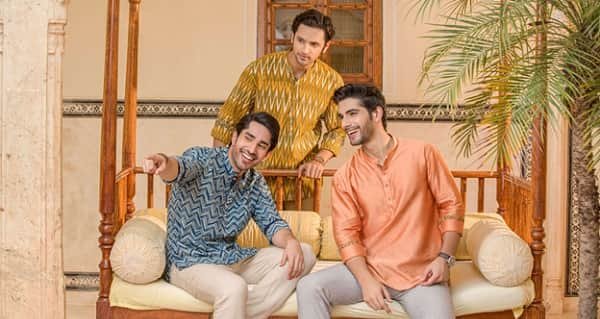
Before describing individual garments, the Bengali naming convention deserves mention. The garment that the rest of North India calls a Kurta is called a Panjabi in Bengal — a name whose origin is traced to the seventeenth century when Punjabi merchants and traders (Khatri Punjabis who had settled in Bengal as zamindars, particularly in today’s Bardhaman district) wore a specific style of long shirt that Bengal adopted and made its own. The Bengali Panjabi differs from the standard kurta in its fabric — traditionally Bengali handloom fabrics like Tussar silk, muga-silk, cotton-silk, and Garad silk rather than the plains cotton that a North Indian kurta might use — and in its construction detail, with Kantha embroidery at the collar, buttonholes, and cuffs being the most distinctively Bengali addition.
Traditional Dress of West Bengal for Men
1. Dhoti and Panjabi — The Classic Bengali Male Ensemble
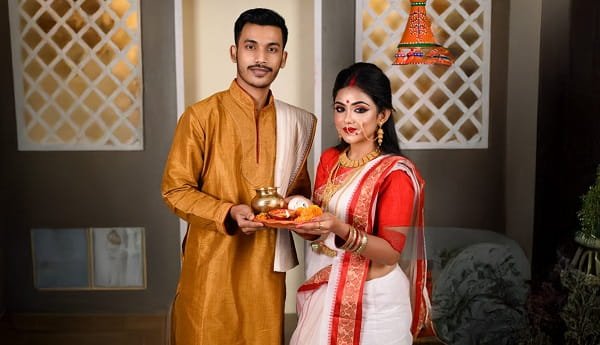
The Dhoti and Panjabi is the definitive traditional male dress of West Bengal — the ensemble that Bengali men wear at Durga Puja, at weddings, at cultural events, and at any occasion where the complete expression of Bengali cultural identity is desired. Together, they constitute something so specifically Bengali that seeing the combination immediately evokes Bengal the way no other Indian state’s male dress quite evokes its specific place.
The Bengali Dhoti is a white or off-white cotton cloth — considerably whiter, crisper, and more precisely starched than the casual dhotis of many other regions — draped around the waist and legs in the Bengali style that differs slightly from other Indian dhoti-draping conventions. The surplus cloth at the front is arranged in a specific series of folds and tucks that are the Bengal-specific way, and the overall impression is of a garment that is both entirely simple and entirely elegant. Silk Dhotis replace cotton for the most important occasions — weddings, Saraswati Puja (Bengal’s most fashion-conscious festival, when young women appear in the finest possible Basanta-Panchami yellow sarees and men in their best traditional dress), and the grandest days of Durga Puja.
The Panjabi worn with the Dhoti is in Bengali handloom fabric — Tussar silk for semi-formal occasions, Garad silk in cream and honey tones for weddings, fine cotton with Kantha embroidery at collar and buttonholes for everyday festivals. The combination’s visual restraint — white dhoti, cream or off-white Panjabi — is the Bengali male equivalent of the white-and-gold philosophy of Tamil Nadu or Kerala, though arrived at through entirely different cultural routes.
2. Topor — The Bengali Groom’s Headgear
No element of West Bengal’s traditional male dress is more immediately and more uniquely Bengali than the Topor — the conical white headgear worn by Bengali Hindu grooms at their wedding ceremony. Made from shola pith (a light, milky-white sponge-wood harvested from aquatic plants, worked by artisans called Malakars into the traditional conical form with elaborate decorative cutwork and embellishments), the Topor’s distinctive shape makes the Bengali groom unmistakeable among Indian grooms from any other state. It is a symbol of auspiciousness and traditionally royal status — the word connects to the concept of a crown — and wearing it is so specifically Bengali that the Topor alone can identify the ceremony as a Bengali Hindu wedding to any observer.
The Topor is worn only once, for the wedding ceremony, and is then preserved as a keepsake by many families. Its making is the specific craft of the Malakar artisan community, and the intricacy of the shola pith carving and decoration varies from the simplest functional forms to elaborate architectural confections decorated with flowers and figures.
3. Shawl
Bengali men wear shawls — in fine wool for winter, in silk for the cooler festive occasions — draped over the Panjabi at formal events, adding warmth and an element of formal dignity to the Dhoti-Panjabi ensemble. The shawl’s colour typically contrasts the white or cream of the Panjabi — a deep red, gold, or dark border on a lighter ground is the most characteristic Bengali formal shawl aesthetic.
Traditional Dress of West Bengal for Women
1. Tant Saree — The Everyday Bengali Saree
The Tant saree is the most widely worn, most beloved, and most democratically shared saree in West Bengal — the cotton handloom saree woven primarily in Hooghly and Nadia districts on the Tant (handloom) and named for the loom itself. The Tant saree’s distinctive qualities are its extraordinary lightness, its characteristic crispness when starched, and its specific construction — a cotton body with a distinctive border (often in contrasting colour) and a decorative Anchol (pallu) featuring floral, paisley, or geometric motifs woven in thread of a contrasting colour or in extra-weft supplementary weaving.
Tant sarees are perfectly adapted to Bengal’s hot and humid climate — the cotton is breathable, the light weight prevents heat accumulation, and the crispness achieved by starching the fabric means it drapes cleanly despite the humidity that would make many other sarees limp and unmanageable. Bengali women wearing a well-starched Tant saree on a Kolkata summer afternoon are wearing the most practically intelligent garment possible for their environment.
The colour vocabulary of Tant sarees is democratic and joyful — red borders on white ground (the most traditional), blue and white, green and white, or multicoloured borders on cream ground — available in a range of prices from the most accessible to the collector’s pieces produced by master weavers in Shantipur and Dhaniakhali.
2. Garad Saree — The Sacred White Silk
The Garad (also written Geerad or Garad) is the most sacred saree in Bengali women’s religious dress — the traditional white silk saree with a deep red border, undyed in the body, worn for the most important Hindu religious occasions and carrying profound spiritual significance in the Bengali Hindu tradition. The red border on the undyed white silk creates the visual signature of the Garad — stark, pure, and powerful in its simplicity. Garad sarees are the mandatory dress for married Bengali Hindu women at Durga Puja’s most sacred moments — the Saptami (seventh day) puja, the married women’s Sindur Khela ceremony on Vijaya Dashami, and major religious rituals throughout the year.
The companion saree to the Garad is the Korial — the same basic form (white or off-white silk) but with small buti (dot or flower motifs) scattered across the body in gold thread, creating a richer, more elaborated surface while maintaining the same colour philosophy. Together, Garad and Korial constitute the religious and ceremonial saree vocabulary of the Bengali Hindu tradition, paired with the essential accessories of conch-shell bangles (Shakha) and red lac bangles (Pola).
3. Jamdani Saree — UNESCO Heritage
The Jamdani saree is one of the most internationally celebrated of all Indian textiles — a fine muslin saree woven using the supplementary discontinuous weft technique that inserts individual coloured or metallic threads into the warp to create motifs that appear to float on the sheer fabric ground. Its origins are traced to the Dhaka muslin tradition (now in Bangladesh) that was considered the finest fabric in the world during the Mughal period — the legendary “woven air” or “running water” muslin that was so fine that European visitors to the Mughal court reportedly were unable to see it when it was folded. UNESCO inscribed Jamdani weaving as an Intangible Cultural Heritage of Humanity in 2013.
In West Bengal, Jamdani sarees are produced primarily in the Nadia and Burdwan districts, maintaining the technique if not the extreme fineness of the original Dhaka Jamdanis. The characteristic Jamdani motifs — the Panna Hazar (thousand emeralds), geometric flowers, and abstract leaf and vine patterns — are created by the weaver inserting supplementary weft threads individually with a wooden needle, without any mechanical pattern-setting system. Each motif is built thread by thread from the weaver’s memory of the design, making the finished saree a genuine work of artisanal intelligence.
Jamdani sarees are among the most expensive and most coveted of Bengali sarees — treated as heirlooms by the families who own them, brought out for the most important ceremonies, and frequently passed from mother to daughter as the most precious textile inheritance in the family.
4. Baluchari Saree — The Narrative Silk
The Baluchari saree is the most narratively ambitious textile tradition in West Bengal — a silk saree woven in Bishnupur (Bankura district) in which the borders and pallu carry woven panels depicting scenes from Hindu mythology, the Ramayana, the Mahabharata, and scenes of courtly life, in a visual programme so elaborate that each saree functions as a portable illustrated manuscript. The technique uses supplementary weft threads in multiple silk colours to build the pictorial panels, with the figures rendered in a style that combines the visual vocabulary of Kalighat painting, Bishnupur terracotta temple decoration, and the courtly aesthetics of Murshidabad silk tradition.
The Baluchari tradition died out in the late nineteenth century and was revived in the mid-twentieth century — the revival specifically credited to the efforts of artisan researcher Subho Tagore and the weavers of Bishnupur who reconstructed the technique from surviving examples. Contemporary Baluchari sarees carry the same narrative programme as the historical originals but with a wider range of design sources, including scenes from contemporary culture alongside the traditional mythological subjects.
A Baluchari saree takes a skilled weaver weeks to complete. The pallu — where the most elaborate narrative panels are concentrated — may contain dozens of individual figures in a single scene, each rendered in individual supplementary weft threads. These sarees are worn at weddings and the most important ceremonies, and owning a fine Baluchari is a matter of considerable cultural pride for Bengali families.
5. Kantha Embroidered Saree
The Kantha embroidery tradition is one of Bengal’s most distinctive and most philosophically interesting textile arts — an embroidery technique that originated in the practice of stitching together layers of worn-out sarees and dhotis with a simple running stitch to create quilted blankets (also called Kantha), which were then decorated with embroidered motifs. The technique of repurposing old cloth — the ultimate sustainable textile practice — was originally a domestic necessity and became an art form of extraordinary richness.
Contemporary Kantha embroidery on sarees uses the same running stitch (the Kantha stitch, named for itself) to embroider motifs onto fabric, covering the saree’s surface with dense, rhythmic patterns of fish, birds, lotuses, trees, village scenes, and abstract geometric forms in a colour palette that ranges from the traditional terracotta, deep green, and indigo of the old natural dyes to the more vivid contemporary palette. Kantha sarees are produced primarily in Murshidabad district and have achieved national and international recognition as one of India’s most creative contemporary textile art forms.
Married Bengali Women’s Symbols
No discussion of Bengali women’s traditional dress is complete without the Shakha-Pola — the pair of bangles that are the most important marital symbol in the Bengali Hindu tradition. The Shakha is a white bangle made from conch shell; the Pola is a red bangle made from red coral or lac (a natural resin). The two bangles together — white and red on the wrist — are the most immediately visible marital marker for a Bengali Hindu woman, worn continuously after marriage as the equivalent of the sindoor in the parting of the hair and the Mangalsutra around the neck. At Durga Puja’s Sindur Khela ceremony, married women apply sindoor to each other’s partings as a group ritual of marital celebration — the Shakha-Pola on every wrist, the red sindoor in every parting, the Garad or Tant saree on every body.
Durga Puja — Bengal’s Greatest Fashion Moment
The ten days of Durga Puja constitute the single most important dress occasion in West Bengal’s cultural calendar — an event in which every Bengali Hindu woman aspires to wear her finest traditional dress, particularly on the five main days of the Puja from Saptami to Bijoya Dashami. The Garad or Korial saree for Saptami (the first day of the Goddess’s formal worship), the Tant saree in specific colours for specific days, the finest Jamdani or Baluchari for the most public days when the Kolkata streets are thronged with worshippers — the Durga Puja dress protocol is discussed, planned, and shopped for months in advance. The New Market, Gariahat, and Dakshinapan shopping areas of Kolkata see the year’s greatest saree shopping rush in the weeks before Puja.
FAQs
Q: What is the Tant saree and why is it ideal for Bengal’s climate?
A: The Tant is a cotton handloom saree woven primarily in Hooghly and Nadia districts. Its extraordinary lightness, breathability, and signature crispness when starched make it perfectly adapted to Bengal’s hot and humid climate. Its woven decorative borders and Anchol (pallu) in contrasting thread create a garment of everyday elegance that is the most widely worn saree across West Bengal.
Q: What is the Jamdani saree and why has it received UNESCO recognition?
A: The Jamdani is a fine muslin saree woven using the supplementary discontinuous weft technique, in which individual coloured threads are inserted into the warp to create floating motifs. UNESCO recognised it as an Intangible Cultural Heritage in 2013. Originating in the Dhaka muslin tradition, it is produced in West Bengal’s Nadia and Burdwan districts and is considered one of the world’s most technically refined textile traditions.
Q: What makes the Baluchari saree unique among Indian sarees?
A: The Baluchari’s woven pallu and borders carry narrative panels depicting mythological scenes from the Ramayana, Mahabharata, and courtly life — rendered in supplementary silk weft threads in a pictorial style that makes each saree a wearable illustrated manuscript. The technique died out and was revived in the twentieth century. A single Baluchari saree can take weeks to weave.
Q: What is the Topor and why is it significant?
A: The Topor is the conical white headgear made from shola pith worn by Bengali Hindu grooms at their wedding ceremony. Made by the Malakar artisan community, its distinctive conical shape makes the Bengali groom immediately identifiable. It symbolises auspiciousness and royalty and is worn only once, then preserved.
Q: What are Shakha-Pola and why are they the most important symbols in Bengali women’s traditional dress?
A: Shakha-Pola is the pair of bangles — Shakha (white conch shell) and Pola (red coral or lac) — worn continuously by married Bengali Hindu women as the primary visible marital symbol. The white-and-red combination on the wrist is the most immediately recognisable sign of a married Bengali woman and participates centrally in the Durga Puja Sindur Khela ceremony.