Assam — the Gateway to the Northeast, a state of extraordinary natural beauty, the only home of the one-horned rhinoceros, the world’s largest river island, and the birthplace of some of India’s most celebrated silk traditions — is a state where traditional clothing carries a cultural weight and an artisanal depth that places it among the finest textile traditions in all of Asia. The state’s extraordinary silk heritage, encompassing three unique silk varieties found nowhere else in the world in this combination — Muga, Eri, and Pat — has been woven for thousands of years by Assamese artisans whose skill has been passed from generation to generation in the handloom villages that dot the Brahmaputra valley.
Assam’s traditional dress is simultaneously simple and sophisticated. The forms themselves — the wraparound Mekhela Chador for women, the Dhoti and Gamosa for men — are structurally elegant in their simplicity. The sophistication lies entirely in the fabric: a Mekhela Chador woven from golden Muga silk, the only natural golden silk produced anywhere in the world, transforms a simple two-piece draping arrangement into one of the most luxurious garments imaginable. This combination of structural simplicity and material magnificence defines the Assamese clothing tradition and sets it apart from the embroidery-dependent richness of North Indian dress or the elaborate weaving complexity of South Indian silk traditions.
The Silk of Assam — Foundation of the Textile Tradition
Before describing specific garments, Assam’s three unique silks require understanding because they define the quality and character of the state’s most celebrated traditional dress.
Muga silk is the most prized and most exclusive silk in the world, produced only in Assam from the silk of the Antheraea assamensis silkworm that feeds on specific trees in Assam’s forests. Muga silk’s defining characteristic is its naturally golden sheen — it does not need to be dyed gold because it emerges from the cocoon already carrying that warmth and luminosity. This natural gold deepens rather than fades with age and washing, making antique Muga silk garments more beautiful over time. Muga silk has received Geographical Indication protection, confirming its exclusive Assam origin.
Pat silk is a finer, glossier variety produced from the Bombyx textor silkworm, typically dyed in vibrant festival colours and used for the most elaborate ceremonial Mekhela Chadors and for the finest sarees that Assam produces for special occasions.
Eri silk is produced from the Samia cynthia ricini silkworm and is characterised by its soft, warm, matte texture — significantly different in feel and appearance from the lustre of Muga and Pat. Eri silk is warmer than the other two varieties and is commonly used in shawls, winter garments, and comfortable everyday wear. The town of Sualkuchi, approximately 35 kilometres from Guwahati, is the epicentre of Assam’s silk weaving industry, referred to as the Silk Heaven of India, where generations of weavers have produced Mekhela Chadors of international renown.
Traditional Dress of Assam for Men
1. Dhoti (Suria)
The Dhoti — called Suria or Dhuti in Assamese — is the primary traditional lower garment for men in Assam, a long rectangular piece of unsewn cloth typically white or cream in colour, wrapped around the waist and legs. In Assam, the Dhoti is culturally significant not merely as practical lower-body clothing but as a marker of ritual purity — elderly men wear it for daily prayers and temple visits, and it becomes the ceremonial garment of choice for important religious and cultural functions. For formal occasions and festivals, especially during Bihu, men wear Dhoti paired with the Gamosa in the specific combination that has become the visual symbol of Assamese male identity. Silk Dhotis are worn for very special occasions, including weddings.
2. Gamosa
The Gamosa is unquestionably the most culturally charged single garment in Assam — a rectangular piece of white cloth with a red border on three sides and woven motifs on the fourth, that functions simultaneously as a practical cloth, a symbol of cultural identity, a token of respect, and a spiritual offering. The word Gamosa derives from the Kamrupi language and has historically been used to cover the Bhagavad Purana at the prayer altar, connecting it intimately to both domestic devotion and community ritual. Presenting a Gamosa is the Assamese act of highest honour — when dignitaries visit Assam, when students receive awards, when festivals are celebrated — the Gamosa is draped around the honoured person’s neck or presented as a formal offering of respect.
During the Bihu festival, the Gamosa takes on multiple roles: Bihu dancers wear it folded around their head as a headband, men drape it around their neck during the celebration, and it serves as a loincloth for certain traditional Bihu dance performances. In daily life in rural Assam, men hang the Gamosa around their neck as both a practical cloth and a constant visible connection to Assamese identity. The Gamosa is made from cotton for everyday use and from Pat silk for festive versions, with the quality of the weaving and the intricacy of the red border motifs indicating the care and craft invested in its production.
3. Tongali
The Tongali is a form of the Gamosa worn as a waistcoat — when the Gamosa is draped and tied around the upper body, it becomes the Tongali. This is particularly popular during the Bihu festival, where the combination of Tongali and Dhoti forms the complete traditional Bihu costume for Assamese men. Various modern styles of Tongali have developed over recent decades, making it a versatile festive garment with both traditional authenticity and contemporary styling variations.
4. Chola (Kurta / Shirt)
The Chola is the traditional upper garment for Assamese men, equivalent to a kurta or long shirt worn to cover the upper body above the Dhoti or Lungi. Historically, the concept of the shirt-like upper garment was introduced to Assam during the reign of King Rudra Singha, and the royals and high officials of the Ahom kingdom wore elaborate Cholas called Chapkan and Chauga. The Swargadeos — the ruling Ahom kings — wore multiple varieties of Chola including the Rupar Bridiya, Chengcola, Buku Chola, and Enga Chola, each with specific ceremonial applications. Contemporary Assamese men continue wearing Cholas, though now styled in accordance with modern fashion while maintaining their cultural function as the traditional upper garment.
5. Paguri — Traditional Turban
The Paguri or Pag is the traditional male headgear of Assam — a turban worn as a symbol of respect, dignity, and cultural identity. During the reign of the Ahom king Gadadhar Singha, a specific turban design called Phasau was introduced, and the tradition of wearing turbans for formal and ceremonial occasions has continued through Assamese history. The Paguri is worn during important ceremonies, religious events, and formal cultural functions, with the colour and style communicating the wearer’s social standing and the significance of the occasion.
6. Eri Silk Shawl
Assamese men wear Eri silk shawls for warmth during cooler seasons and as a mark of dignified traditional presentation during formal occasions. The Eri silk’s characteristic warmth and soft matte texture make it ideal for shawls that complement both formal and everyday traditional dress.
Traditional Dress of Assam for Women
1. Mekhela Chador
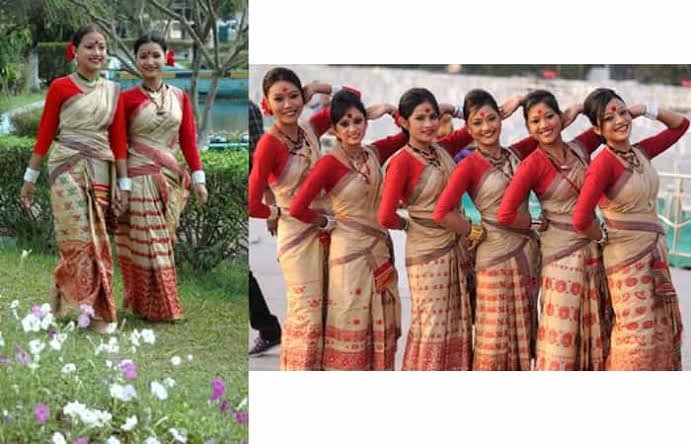
The Mekhela Chador is the quintessential traditional dress of Assamese women — the garment that defines Assamese feminine identity more completely than any other single element of the state’s culture. Worn by women of all ages except young children, the Mekhela Chador consists of two separate pieces of cloth that together create a garment that resembles but is fundamentally different from a saree.
The Mekhela is the lower piece — a cylindrical cloth wrapped around the body from the waist downward, tucked neatly on the right side of the waist after being folded into crisp pleats. It gives the lower body its full, elegant shape. The Chador (or Sador) is the upper piece — one end is tucked artfully into the upper portion of the Mekhela, and the other end is used to drape the upper body in a pallu-like style over the blouse. The specific draping technique uses triangular folds rather than the circular pleats of a saree, and this subtle difference in folding technique is the source of the Mekhela Chador’s distinctively fluid silhouette.
Historically, a third piece called the Riha — an unstitched cloth wrapped around the bust — was part of the traditional three-piece ensemble, replacing the blouse as the upper body covering. In contemporary practice, the Riha has been largely replaced by a fitted blouse, though it reappears in the most traditional ceremonial contexts, particularly in bridal dress. During the Bihu festival and at weddings, women wear the Mekhela Chador in Muga or Pat silk — typically in vibrant reds, deep golds, and rich natural tones — making it among the most visually spectacular traditional garments in all of Northeast India.
2. Riha
The Riha is the traditional unstitched cloth worn around the bust as part of the classic three-piece Mekhela-Chador-Riha ensemble of Assam. In formal traditional contexts and bridal ceremonies, the Riha serves as the ceremonially correct upper body covering, and its presence transforms the standard two-piece Mekhela Chador into the complete traditional ensemble. The bridal trousseau of an Assamese bride traditionally includes a Mekhela Chador paired with the Riha, making the three-piece combination the most culturally complete expression of traditional Assamese women’s dress.
3. Silk Sarees of Assam
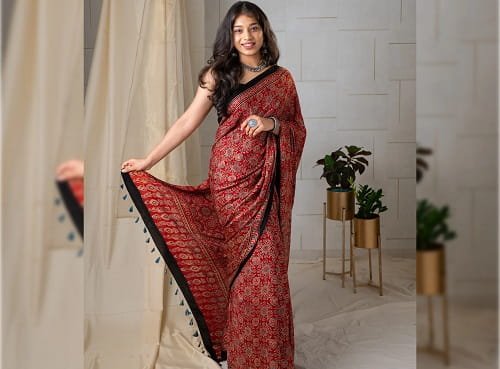
Beyond the Mekhela Chador, Assam’s women also wear silk sarees woven from the state’s three distinctive silk varieties. The Muga silk saree is among the most coveted traditional sarees in India — its natural golden sheen, durability, and unique beauty make it a statement garment for weddings and important celebrations. Sualkuchi sarees, woven in the silk village near Guwahati, are world-famous for their intricate handwoven patterns and their use of authentic Muga, Pat, and Eri silk.
Tribal Women’s Dress
4. Dokhna — Bodo Women’s Dress
The Bodo tribe, one of Assam’s largest and most historically significant tribal communities, has a distinctive women’s dress tradition centred around the Dokhna. The Dokhna is a wrap-around cloth worn in a specific Bodo style — tight, wrapped only once around the body, and tied at the waist — that distinguishes it immediately from the Mekhela Chador’s more elaborate cylindrical draping. Made in bright colours and patterns with the decorative Agor border work that is characteristic of Bodo weaving, the Dokhna is Assam’s most immediately recognisable tribal women’s garment. Significantly, a Dokhna without the Agor border decoration is specifically considered a bridal dress within Bodo tradition, making the presence or absence of the Agor an immediate marker of marital context.
5. Koum Kontong, Kambang, and Labok — Rabha Women’s Dress
The Rabha tribe’s women maintain one of Assam’s most distinctive tribal dress traditions. Their ensemble consists of three elements: the Koum Kontong, a skirt-like piece of cloth decorated with exquisite tribal patterns and motifs that covers the lower body; the Kambang, the upper body clothing; and the Labok, a waistband decorated with pearls and shells that both secures the dress and functions as the most visually elaborate accessory in the ensemble. The pearl and shell-worked Labok is particularly distinctive, reflecting the Rabha community’s aesthetic investment in accessories as markers of cultural identity and personal beauty.
6. Yakan Age-Gasar — Mishing Women’s Dress
The Mishing tribe’s women wear a version of the Mekhela Chador called the Yakan Age-Gasar, characteristically made in black rather than the lighter, more varied colours of mainstream Assamese Mekhela Chadors. The black Yakan Age-Gasar is paired with the vibrant coloured blouses for which Mishing women’s dress is known — the contrast between the deep black lower wrap and the brightly coloured upper blouse produces the signature visual identity of Mishing women’s traditional dress. During weddings and important celebrations, Mishing women’s colours become particularly vibrant.
Traditional Accessories and Headgear
The Jaapi — a large, conical hat woven from bamboo and the leaves of the tokoupa palm — is one of Assam’s most universally recognised cultural symbols. Worn by both men and women as practical sun protection in Assam’s agricultural fields, it appears elaborately decorated with red and white fabric for ceremonial and performance contexts. The decorated Jaapi appears in Bihu dance performances and cultural celebrations, functioning as a visual emblem of Assamese identity internationally.
Traditional Assamese jewellery — particularly in gold — carries enormous cultural significance. The Golpata (a thick necklace), the Doogdoogi (a chain necklace), and the Bena (earrings) are among the traditional jewellery forms that complete a woman’s ceremonial Mekhela Chador ensemble.
FAQs
Q1. What is the difference between a Mekhela Chador and a saree?
Though both are draped garments, they are structurally different. A saree is a single piece of cloth approximately five to nine yards long draped in one continuous motion. The Mekhela Chador is two separate pieces — the cylindrical Mekhela for the lower body and the Chador for the upper body — draped separately using triangular folds rather than the circular pleats of a saree.
Q2. What makes Muga silk special and why is it associated with Assam?
Muga silk is produced exclusively in Assam from the Antheraea assamensis silkworm and is the only naturally golden silk in the world. Its natural gold sheen deepens with age and washing, and it has received Geographical Indication protection confirming its exclusive Assam origin.
Q3. What is the cultural significance of the Gamosa?
The Gamosa is far more than a cloth — it is the most culturally charged object in Assam. It is used to honour dignitaries, to cover sacred scriptures at prayer altars, to serve as the Bihu dancer’s headband and loincloth, and as an everyday practical towel. Presenting a Gamosa is the highest form of respect in Assamese culture.
Q4. Where is the best place to buy authentic Mekhela Chadors?
Sualkuchi village, approximately 35 kilometres from Guwahati, is considered the Silk Heaven of India and is the most celebrated centre for authentic handwoven Mekhela Chadors in Assam. It is home to generations of weavers whose Muga, Pat, and Eri silk Mekhela Chadors are famous worldwide.
Q5. What do Bodo women wear at traditional weddings?
Bodo brides traditionally wear the Dokhna without the Agor border decoration — the absence of the Agor is the specific marker that identifies the garment as bridal dress within Bodo tradition.