Chhattisgarh — carved from the southern part of Madhya Pradesh in 2000 and widely known as the Rice Bowl of Central India — is a state where tribal heritage is not a footnote in the cultural story but its very core. More than 30 percent of Chhattisgarh’s population belongs to scheduled tribes, with communities like the Gonds, Oraons, Baigas, Halbas, Murias, Marias, and Abhuj Marias maintaining clothing traditions that connect directly to the forest ecosystems, agricultural cycles, and spiritual practices that have defined life in this landscape for centuries. The state’s ancient name Dakshin Kosala appears in the Ramayana — it is the homeland of Lord Rama’s mother Kaushalya — and the weight of this deep historical identity finds expression in the distinctive character of its traditional dress.
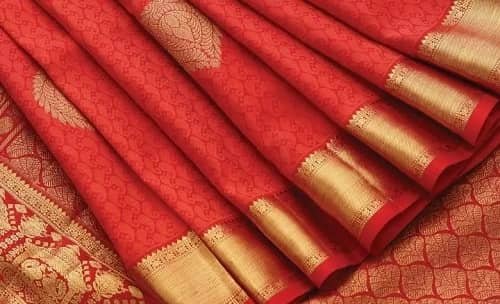
Chhattisgarh’s most celebrated and most commercially significant textile contribution to India is Kosa silk — a regional variant of Tussar silk produced from the silk of Antheraea paphia silkworms that feed on Arjun and Sal trees in the state’s forests. Woven primarily in the Champa, Raigarh, and Korba regions, Kosa silk’s distinguishing characteristic is its natural golden-brown to warm amber colour and its distinctively textured surface — slightly coarser than mulberry silk but extraordinarily rich in appearance. The Bastar region, home to some of India’s most extraordinary tribal arts and crafts, is where the most distinctive and most historically rooted textile traditions of the state survive in daily practice.
Traditional Dress of Chhattisgarh for Men
1. Dhoti (Kansbandhi)
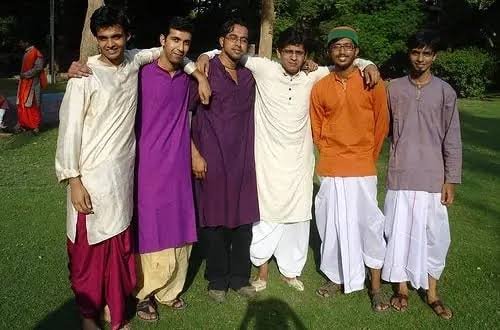
The Dhoti — called Kansbandhi in parts of Chhattisgarh — is the most foundational and most widely worn traditional lower garment for men across the state, a rectangular piece of unsewn cotton cloth wrapped around the waist and legs in the familiar Indian manner. In Chhattisgarh’s rural and tribal settings, the Dhoti is daily and ceremonial wear simultaneously — worn for agricultural work, for temple visits, for community gatherings, and for family religious rituals without requiring a separate formal version for different occasions. Cotton is the material of everyday Dhotis, making them practical for the state’s warm, humid climate.
2. Pichhori
The Pichhori is a shorter lower garment specific to Chhattisgarh’s male dress tradition — essentially a dhoti-style wrap that falls to approximately the knee rather than the full ankle length of a standard dhoti. Wrapped around the waist and tied securely, the Pichhori provides the maximum freedom of movement that daily work in agricultural and forest environments requires. It is the signature everyday lower garment of rural Chhattisgarhi men and tribal communities, distinguishing the state’s male dress tradition from the longer-dhoti conventions of northern and southern India.
3. Dulha Pichhori — Bridal Groom’s Garment
The Dulha Pichhori is the ceremonially elevated, ornamented version of the regular Pichhori, worn specifically by grooms on their wedding day. Decorated with embellishments, embroidery, and elaborate border work that transforms the simple everyday wrap into a statement ceremonial garment, the Dulha Pichhori gives the Chhattisgarhi wedding its distinctive male visual identity. The specific decorative treatment of the Dulha Pichhori varies by region and community within the state.
4. Kurta and Kosa Silk Kurta
The Kurta is the traditional upper garment paired with the Dhoti or Pichhori across Chhattisgarh — a long, loose shirt made from cotton for everyday use and from Kosa silk for formal, festival, and wedding occasions. The Kosa Silk Kurta is among the state’s most prized garments, its natural golden-brown hue and distinctively warm texture giving it an appearance of quiet luxury that needs no embellishment beyond the material itself. Artisans in the Champa and Korba regions are particularly celebrated for their Kosa silk weaving, and a well-made Kosa Silk Kurta is a garment that Chhattisgarhi families pass down through generations.
5. Angochha
The Angochha or Angocha is a narrow piece of thin cotton cloth used as a multipurpose accessory by men across Chhattisgarh — tied around the head as a practical protection against the intense heat of the state’s summers, draped around the neck as a modesty cloth or towel, or used as a simple wrap. The Angochha is the male counterpart of the broader chaddar, adapted for daily practical use in the field rather than the more formal appearance of a shoulder draping cloth. Tribal men, particularly those belonging to communities like the Abhuj Marias, Ghotuls, Halbas, and Murias, wear the Angochha regularly as head protection during agricultural work.
6. Chaddar and Shawl
The Chaddar is a broader piece of cloth worn by men draped over the shoulders, adding formality to the Dhoti-Kurta ensemble during religious ceremonies, community gatherings, and important social occasions. Like the Assamese Gamosa or the Andhra Angavastram, the Chaddar signals a transition from casual daily wear to the respectful presentation appropriate for ritual or formal contexts. It is gifted during special occasions and is considered a symbol of wisdom and dignity among elders.
The Shawl, woven from aal-dyed yarns — using the red dye extracted from the roots of the Indian Madder plant (Morinda citrifolia, called Aal in Chhattisgarhi) — is reserved for festivals and ceremonial occasions, its rich red colouring immediately marking it as a special-occasion garment within the community.
7. Pheta (Turban)
The Pheta is the traditional head covering or turban worn by Chhattisgarhi men at ceremonies, religious events, and festivals. Typically white for everyday ceremonial use, the Pheta can be dyed in various colours for special occasions, with the specific colour sometimes communicating social status, community affiliation, or the nature of the event being attended. Among tribal communities, the way the Pheta is tied can convey immediate social information to community members familiar with its visual codes.
Traditional Dress of Chhattisgarh for Women
1. Lugda (Pata Saree)
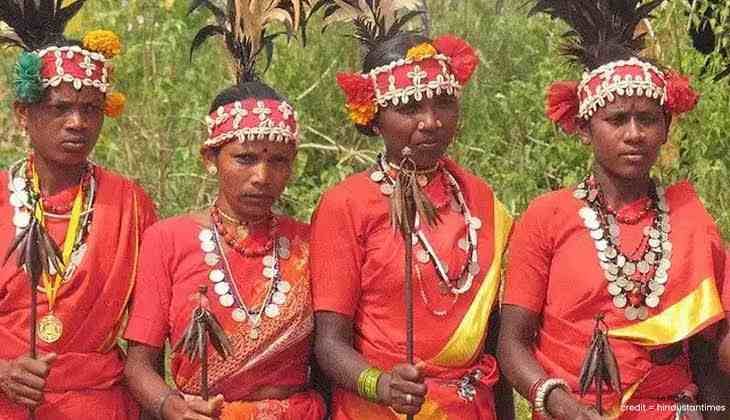
The Lugda is the primary traditional saree of Chhattisgarh’s women, particularly in rural and tribal communities, and the word itself functions as the state’s regional term for what the rest of India calls a saree. Made from cotton for daily use and from silk or finer fabrics for festivals, the Lugda is handwoven with tribal-inspired geometric motifs and natural dye colouring — red and green are particularly characteristic colour combinations, reflecting the visual sensibility of Chhattisgarh’s tribal textile tradition. The Lugda is worn with the Polkha blouse, and its specific draping style varies by tribe and region within the state.
In the Bastar region, where tribal weaving traditions are oldest and most intact, the Pata Saree — the local Bastar name for the wrapped cloth — is worn in two distinct styles that have been documented since pre-colonial times.
2. The Two Draping Styles — Ganthi Marna and Chendra
The Pata Saree (Lugda) in Chhattisgarh’s tribal communities is worn in two distinct regional draping styles that reflect different communities’ specific clothing conventions.
Ganthi Marna — meaning “to make a knot” — is the style preferred by the Maria and Muria tribes, in which the cloth is wrapped around the body and one end is tied at the right shoulder, leaving the knot visible as a characteristic stylistic element. This style is associated with the Marias and Murias, the higher-status tribes in Bastar’s social hierarchy, and it is worn without a petticoat underskirt.
Chendra style — a more fluid, movement-friendly draping method — is preferred for daily household activities and fieldwork because its specific draping arrangement allows greater ease of movement without the cloth loosening. Where the Ganthi Marna style is more formal and ceremonial, the Chendra style is the practical daily-wear adaptation.
3. Kachhora Style
The Kachhora is a tucked, snug draping of the Lugda/Pata that holds the cloth securely against the body without slipping or sagging during physical work — the style of choice for women engaged in agricultural labour, grinding grain, fetching water, or other physically active daily tasks. Younger tribal women in Chhattisgarh have increasingly adopted the Kachhora-style draping as their preferred daily wearing method.
4. Polkha (Blouse)
The Polkha is the traditional short blouse worn by Chhattisgarhi women as the upper garment to complement the Lugda. Made from cotton for everyday use and from silk for festival occasions, the Polkha is typically simple but can be decorated with delicate embroidery for ceremonial contexts. In tribal communities of the Bastar and Kanker districts, the Polkha often features tribal motif embroidery using natural dye thread that reflects the same visual vocabulary found in the Lugda itself.
5. Kosa Silk Saree
The Kosa Silk Saree is the most prized and most formal garment in Chhattisgarhi women’s traditional wardrobe — worn for weddings, religious ceremonies, and the most significant festivals as the garment that most completely expresses the state’s identity as a silk-producing culture. The Kosa Silk Saree’s natural golden-brown warmth, combined with its durability and the subtle sheen that Kosa silk develops with age and wearing, makes it a garment that women in Chhattisgarh often treasure for decades and pass down as family heritage. Its handwoven production in the Champa region by artisans who have perfected the Kosa weaving technique across generations gives each saree a slight individuality impossible to replicate industrially.
6. Odhani
The Odhani is the traditional head and shoulder scarf worn by women in Chhattisgarh, made from cotton or silk and decorated with embroidery, mirror work, and other embellishments according to the occasion and the wearer’s community tradition. Functionally, the Odhani covers the head for modesty and protection from the sun while visually completing the traditional ensemble. Its specific design varies by tribal community — the embroidery and motifs on an Odhani from a Gond community differ from those of a Halba or an Oraon community, making it a garment that carries tribal identification alongside its functional and aesthetic roles.
Traditional Jewellery
Women in Chhattisgarh, particularly from tribal communities, maintain extraordinary jewellery traditions that complement and complete the traditional dress. Silver is the primary metal of tribal jewellery — the Suta (a necklace of beads and silver coins), the Koundhi (a beaded necklace), Bali and Khunti (hoop and stud earrings), Kadha (silver arm bangles), Kundhi (silver waist chains), and the Bichhiya (silver toe rings worn by married women) together form the complete traditional jewellery ensemble. The Kardhan — a broad waist belt — has both ornamental and practical significance, historically recommended for young mothers to prevent post-pregnancy abdominal loosening. This practical intelligence embedded in jewellery is characteristically Chhattisgarhi.
FAQs
Q1. What is Kosa silk and why is it famous in Chhattisgarh?
Kosa silk is a regional variant of Tussar silk produced from the Antheraea paphia silkworm that feeds on Arjun and Sal trees in Chhattisgarh’s forests. Its natural golden-brown colour, distinctive textured surface, and warmth make it one of India’s most distinctive regional silk varieties, woven primarily in the Champa, Raigarh, and Korba regions.
Q2. What is the difference between the Lugda and a regular saree?
The Lugda is Chhattisgarh’s regional name for the saree, but it differs from mainstream Indian saree traditions in its specific draping styles (Ganthi Marna, Chendra, Kachhora), its handwoven tribal-motif designs, and its use of natural dyes and geometric patterns derived from tribal visual traditions.
Q3. What are the two main saree draping styles in tribal Chhattisgarh?
The two main styles are Ganthi Marna (knotted at the shoulder, preferred by Maria and Muria communities, associated with more formal occasions) and Chendra (a more fluid, movement-friendly style preferred for daily household and agricultural work).
Q4. What is the Pichhori and how does it differ from the Dulha Pichhori?
The Pichhori is the everyday knee-length lower wrap worn by Chhattisgarhi men, while the Dulha Pichhori is its ceremonially ornamented equivalent specifically worn by grooms on their wedding day, distinguished by its embellishments and border decoration.
Q5. What is the Aal dye used in Chhattisgarhi textiles?
Aal is the natural red dye extracted from the roots of the Indian Madder plant (Morinda citrifolia), used by Chhattisgarhi weavers to produce the characteristic deep red colour that appears in traditional shawls, saree borders, and ceremonial garments across the state’s tribal textile traditions.