Rajasthan — the Land of Kings, the vast desert state of Jaipur’s pink palaces, Jodhpur’s blue city, Jaisalmer’s golden sandstone fort, Udaipur’s lake palaces, and the mighty Aravalli hills — is the state whose traditional dress has most completely captured the world’s imagination as the image of India’s living colour and royal heritage. When international photographers, fashion houses, and tourism boards seek to represent the visual soul of Indian traditional dress, they almost inevitably turn to Rajasthan: the swirling red Bandhani Ghagra of a desert woman, the towering saffron Pagdi of a Rajput warrior, the mirror-work embroidery catching the Thar Desert sunlight, the block-printed cotton in geometric patterns dyed in madder and indigo. Rajasthan’s traditional dress is the most widely photographed, most internationally copied, and most commercially celebrated regional dress tradition in India.
This visual power comes from a specific combination of historical forces: the desert landscape’s harsh conditions that demanded colour as psychological affirmation of life’s vitality; the extraordinary patronage of the Rajput royal courts — Patiala’s equivalents among the Maharanas, Maharajas, and thakurs of Jaipur, Jodhpur, Udaipur, Bikaner, Jaisalmer, Kota, Bundi, and dozens of smaller principalities — who supported generations of artisans developing the most elaborate textile traditions; and the desert trade routes that brought dyes, fabrics, and techniques from across Asia into Rajasthan’s workshops. The result is a state whose textile traditions include Bandhani tie-dye, Leheriya wave-dye, Sanganeri block printing, Bagru natural-dye printing, Kota Doria weaving, Gota-Patti gold ribbon appliqué, and mirror work embroidery — each a complete world of artisanal achievement, each coexisting in a state whose dress is the most visually exuberant in India.
Quick Comparison Table
| Garment | Worn By | Fabric / Technique | Occasion |
| Dhoti | Men | Cotton | Daily, Religious |
| Kurta / Angarkha | Men | Cotton, Silk, Bandhani | Daily, Festivals |
| Safa / Pagdi (Turban) | Men | Cotton, Leheriya, Bandhani | Daily, Ceremonies |
| Patka (waistband) | Men | Silk, Brocade | Formal, Weddings |
| Kamarbandh (waistband) | Men | Silk, Metal | Formal, Weddings |
| Jama (historical coat) | Men | Silk | Mughal-Rajput era formal |
| Mojri / Jutis (footwear) | Both | Embroidered leather | Festivals, Weddings |
| Ghagra (long skirt) | Women | Cotton, Silk, Georgette | Daily, Festivals |
| Choli / Kanchli / Kurti | Women | Cotton, Silk | Daily, Festivals |
| Odhni / Chunari | Women | Cotton, Silk, Bandhani | Daily, Festivals |
| Rajputi Poshak | Rajput Women | Silk, Brocade | Royal/formal ceremonies |
| Bandhani Saree | Women | Cotton, Silk | Festivals, Weddings |
| Leheriya Saree / Odhni | Women | Cotton, Silk | Monsoon, Festivals |
Rajasthan’s Textile Traditions — The Language of the Cloth
Rajasthan’s traditional dress cannot be understood without understanding its textile traditions, because in Rajasthan the garment forms are secondary to the fabric. A Ghagra is just a flared skirt until the fabric is Bandhani — then it becomes a social document of the occasion, the community, and the region. A man’s Safa is just a cloth turban until it is Leheriya — then it is a seasonal statement and a regional identity marker. The textile is the story; the garment is merely its container.
Bandhani (Bandhej): The ancient tie-and-resist dyeing technique in which tiny sections of fabric are individually plucked, tied with thread, and then dyed — releasing the ties after dyeing to reveal patterns of undyed dots against the dyed ground. The resulting dotted patterns vary from simple single-colour versions to complex multi-colour designs in which the cloth passes through multiple dye baths with different ties applied and removed at each stage. Bandhani has roots possibly tracing to the Indus Valley Civilisation. In Rajasthan, it is primarily produced in Jaipur, Jodhpur, Bikaner, and surrounding areas, and is the most essential fabric for weddings and major festivals.
Leheriya: A specifically Rajasthani resist-dyeing technique in which the cloth is rolled diagonally before dyeing, producing the characteristic diagonal stripe pattern whose name means “waves.” The result — diagonal stripes of multiple colours that resemble water waves or wind-blown dunes — is unique to Rajasthan and particularly associated with Jaipur and Jodhpur. Leheriya is traditionally associated with the monsoon season, when the rains bring visual relief to the desert landscape and women wear wave-patterned clothes as a celebration of rain’s arrival.
Block Printing: Sanganer and Bagru, two towns near Jaipur, are India’s most celebrated hand block printing centres, each with its own distinct style. Sanganer’s prints tend toward fine, delicate floral and geometric patterns in lighter colours on white or cream ground. Bagru’s prints use natural dyes — primarily deep red from alizarin and black from iron — in bolder, more geometric designs on cotton.
Gota-Patti: Gold or silver ribbon (gota) appliquéd onto fabric surfaces in elaborate patterns — flowers, leaves, paisleys, geometric borders — producing a richly metallic surface that catches light dramatically. Gota-Patti is the essential embellishment for bridal and festival wear in Rajasthan, converting an ordinary fabric into a garment of visual opulence.
Traditional Dress of Rajasthan for Men
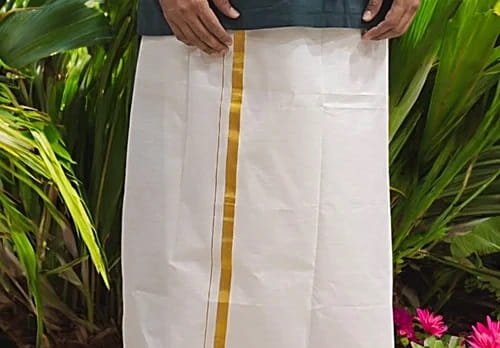
1. Dhoti
The Dhoti is the traditional lower garment for Rajasthani men — a piece of white or cream cotton cloth wrapped around the waist and legs in the manner common across India, with the specific Rajasthani convention involving the surplus cloth being tucked at the back rather than between the legs as in some other regional styles. For daily religious use and elder men’s everyday dress, the Dhoti remains in use across Rajasthan’s villages and towns, paired with a simple white cotton Kurta.
2. Kurta and Angarkha
The Kurta is the standard upper garment for Rajasthani men — a loose, long cotton tunic in white for daily use and in Bandhani, Leheriya, or embroidered fabric for festivals and ceremonies. The Angarkha is the distinctively Rajasthani version of the Kurta — a long outer coat with an inner chest panel that creates a double-layer front, typically tied with strings at the chest rather than having buttons. The Angarkha’s design suggests a military origin in garments that needed to protect the chest, and it remains the most aesthetically distinctive element of Rajasthani male traditional dress. At formal occasions, the Angarkha in mirror work or geometric embroidery creates an immediately royal visual impression. The length varies by occasion and regional convention — knee-length for everyday use, ankle-length for the most formal ceremonial contexts.
3. Safa / Pagdi — The Rajasthani Turban
The Safa (also called Pagdi) is the element of Rajasthani male traditional dress that carries the greatest social and symbolic weight — a long cloth wound around the head in styles that vary systematically by caste, region, occasion, and community, creating an immediately readable social text for those who know the conventions. Rajasthani turbans are among the most elaborate and most visually diverse in India: a single state contains dozens of distinct tying styles, each with its own name and its own specific social meaning.
The colour of the Rajasthani Safa carries explicit meaning: saffron (Kesariya) represents valour and sacrifice — the colour most associated with Rajput warrior heritage; white represents mourning or peace; yellow is associated with auspiciousness and spring festivals; red and pink appear at weddings. The specific combination of colour and tying style creates a turban that communicates the wearer’s region, caste, occasion, and social role to anyone familiar with the local conventions — making the Rajasthani turban the most information-dense garment item in the state’s dress system.
Leheriya Safas — turbans in the wave-dye technique — are particularly associated with Jaipur and Jodhpur and are the festive turban of choice for the monsoon season and during major festivals like Teej.
4. Patka and Kamarbandh — Waist Accessories
The Patka is a decorative waistband tied around the waist over the Angarkha or Dhoti — a strip of patterned fabric that cinches the garment at the waist and adds a layer of formal decoration to the male ensemble. The Kamarbandh is a more elaborate waist ornament — sometimes metal, sometimes embroidered fabric — worn for weddings and the most formal occasions, functioning as the male equivalent of a waist jewellery piece. Together, the Patka and Kamarbandh complete the full formal Rajasthani male dress by adding the waist emphasis that transforms the Dhoti-Angarkha-Safa combination into the complete royal aesthetic.
5. Jama — The Historical Court Garment
The Jama is the historical formal coat worn by Rajput royalty and nobles during the Mughal and immediately post-Mughal periods — a long, fitted outer garment tied under the arms with tapering flaps, producing a silhouette that is simultaneously martial and courtly. Historic Jamas in the museums of the Jaipur, Udaipur, and Jodhpur royal collections are among India’s finest examples of the textile art of their period — in rich silk brocades, embroidered with gold and silver thread, in the vibrant colours that Rajput courts favoured.
Traditional Dress of Rajasthan for Women
1. Ghagra (Lehenga)
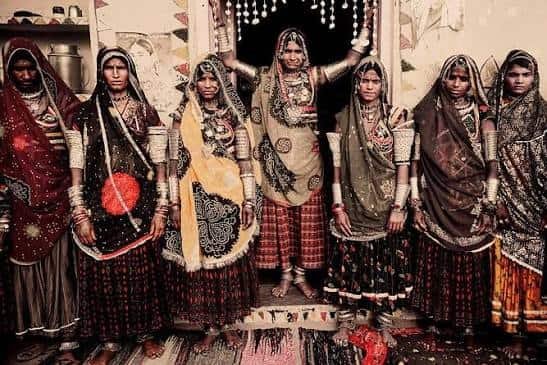
The Ghagra is the foundational traditional lower garment for Rajasthani women — a long, full, ankle-length skirt in multiple kalis (panels) that creates a dramatically flared silhouette when the wearer moves. The Ghagra’s full circumference allows the fabric to swirl and ripple with movement, creating the visual effect that defines Rajasthani women’s dress in every photograph, every film, and every memory of visiting the state. The breadth of available Ghagra fabrics, prints, and embellishments covers the entire range of Rajasthan’s textile traditions: plain cotton in dense Bandhani dots for everyday wear; Leheriya-striped georgette for monsoon festivals; heavily embroidered and mirror-worked silk for weddings; Gota-Patti decorated velvet for the most formal bridal occasions.
Different communities across Rajasthan favour different specific Ghagra styles. Rural women in cotton Ghagras in deep reds, maroons, and magentas with white Bandhani dots. Tribal women in bold printed cottons with wide contrast borders. Rajput women in heavier silk with elaborate zari borders and more coverage. Urban women in lighter georgette or chiffon Ghagras in contemporary colour combinations.
2. Choli (Kanchli / Kurti)
The Choli is the fitted blouse worn as the upper garment of the traditional Ghagra-Choli-Odhni ensemble — a short, fitted top that typically ends at or above the waist, leaving a section of the midriff exposed between the bottom edge of the Choli and the top of the Ghagra. The specific length of the Choli carries social meaning in Rajasthan’s complex social system — it varies by community, age, caste, and region, functioning as a visible indicator of the wearer’s social identity.
The Choli in Rajasthan is typically heavily embellished: mirror work, embroidery, Gota-Patti borders, and contrast trim are all common embellishments that transform the simple fitted blouse into a statement piece. The Kanchli is the specifically Rajput version of the upper blouse — typically more covered, with tie-up fastening at the back and sides, made from richer fabric with more elaborate embroidery reflecting the Rajput woman’s traditional association with royal restraint and dignified femininity.
3. Odhni (Chunari)
The Odhni — also called Chunari or Chunari — is the long veil or head covering that completes the Rajasthani women’s traditional ensemble, typically approximately two and a half to three metres long and one and a half to two metres wide. The Odhni serves multiple simultaneous functions: it covers the head and sometimes the face as a mark of modesty and respect (particularly in the presence of elders and in-laws in communities where purdah is observed); it protects against the desert sun and wind; and it functions as the most visually expressive element of the entire ensemble, carrying the most elaborate Bandhani work, Leheriya stripes, embroidered borders, and Gota-Patti decoration of any element in the outfit.
At weddings and major festivals, the Odhni is often the garment on which the greatest embellishment investment is concentrated — a heavily worked Odhni in red Bandhani with Gota-Patti border and sequin decoration can be among the most visually spectacular garments at any celebration.
4. Rajputi Poshak — The Royal Rajput Women’s Dress
The Rajputi Poshak is the specific traditional formal dress of Rajput women — the royal and landed class whose identity defines the historical self-conception of Rajasthan as the “Land of Kings.” The Poshak is a more completely covering ensemble than the standard Ghagra-Choli-Odhni, reflecting the Rajput community’s convention of greater female body coverage: it includes a longer Kurti (reaching closer to the knee), a full Ghagra of heavy silk or brocade, and an Odhni that is typically more modestly draped. The fabric quality in a Rajputi Poshak is significantly higher than in ordinary women’s dress — heavy silk, brocade, velvet, and zardozi (gold wire embroidery) are all appropriate for the most formal Rajputi occasions, and the jewellery worn with the Poshak is typically the most elaborate Kundan, Meenakari, and polki diamond work that Rajasthani goldsmithing produces.
5. Bandhani Saree
The Bandhani Saree of Rajasthan — produced primarily in Jaipur, Jodhpur, and the Shekhawati region — is the major saree tradition of the state. Unlike the standard six-yard saree of most Indian states, the Rajasthani Bandhani saree is worn in a regional style that sometimes brings the pallu forward in the Gujarati manner rather than the conventional left-shoulder draping, and it is invariably the Bandhani tie-dye technique that defines the fabric’s visual character — the specific dotted patterns in red, yellow, green, or multi-colour on a contrasting ground communicating the occasion, the community, and the season for which it was produced.
6. Leheriya Saree and Odhni
The Leheriya is the wave-dye technique that produces diagonal stripes in multiple colours — and Leheriya sarees and Odhnis are the definitive festive garments of the monsoon season in Rajasthan, particularly in the Jaipur and Jodhpur regions where the technique is most concentrated. During Teej — the monsoon women’s festival celebrating the arrival of rains — women across Rajasthan wear Leheriya sarees and Odhnis, their wave-patterned diagonal stripes visually echoing the rain’s diagonal fall that the festival celebrates.
Tribal Women’s Traditional Dress
Rajasthan’s tribal communities — the Bhil, Garasia, Rabari, Meghwal, and others — maintain their own dress traditions that sit alongside but distinct from the mainstream Rajasthani Ghagra-Choli-Odhni system. The Bhil community’s women wear the Pachewara — a five-piece ensemble including Ghagra, Choli, Odhna, Bichhwe (coat), and Kanchli — in colours and embellishments specific to their tribal identity. The Rabari women’s traditional headdress, the Phetiya, is a specifically Rabari identity marker worn with their elaborate mirror-work embroidered dress. The Meghwal community produces some of Rajasthan’s finest leather footwear and beadwork, worn as an integral part of their own specific dress tradition.
Traditional Jewellery
Rajasthani women’s jewellery is among the most elaborate and most internationally celebrated in India. The complete traditional ensemble for a Rajasthani bride involves: the Rakhri or Bor Tikka (head ornament), the Nath (large nose ring, often so large it connects to the ear by a chain), the Timaniyaan (choker necklace), the Hasli (rigid neck ring), the Bajuband (upper arm ornament), the Kamarbandh (waist chain), the Chura (bangles), the Payal (anklets), and the Bichhua (toe rings). The primary metals are gold for formal occasions and silver for everyday use — Rajasthani silver jewellery is renowned for its weight, its craft quality, and its role in representing family wealth in wearable form.
FAQs
Q1. What are the most famous textile traditions of Rajasthan?
The most celebrated are Bandhani (tie-and-resist dyeing producing dotted patterns), Leheriya (diagonal wave-patterned resist dyeing, specific to Rajasthan), Sanganeri and Bagru block printing, Gota-Patti (gold ribbon appliqué), and Kota Doria (lightweight woven fabric from Kota with distinctive square-check pattern).
Q2. What is the Rajputi Poshak?
The Rajputi Poshak is the traditional formal dress of Rajput women — a more completely covering version of the Ghagra-Choli-Odhni ensemble made from high-quality silk, brocade, or velvet with elaborate zardozi embroidery, reflecting the Rajput woman’s historically elevated social position.
Q3. Why do Rajasthani turbans (Safas) have so many colour variations?
The colour and tying style of a Rajasthani Safa carries specific social information: saffron signifies valour, white indicates mourning or peace, yellow is auspicious, red is for weddings. The specific tying style communicates the wearer’s region, caste, and the nature of the occasion — making the turban Rajasthan’s most information-dense traditional garment.
Q4. What is Leheriya and why is it associated with the monsoon?
Leheriya is a Rajasthani resist-dyeing technique producing diagonal stripes resembling waves, named after the Hindi/Rajasthani word for waves. It is particularly associated with the Teej festival and the monsoon season — women wearing wave-patterned clothes as a visual celebration of rain’s arrival in the desert landscape.
Q5. What is the significance of Gota-Patti embroidery in Rajasthani dress?
Gota-Patti involves applying small strips of gold or silver ribbon (gota) onto fabric in floral and geometric designs. It is the essential embellishment for Rajasthani bridal and festival wear, transforming plain fabric into visually opulent garments that catch light dramatically — particularly spectacular in the Ghagra, Choli, and Odhni at weddings.