Andhra Pradesh, often called the Kohinoor of India for its extraordinary weaving and textile heritage, is a state where clothing is never merely functional — it is an expression of identity, regional pride, cultural continuity, and artisanal tradition that stretches back over three thousand years. Situated along the southeastern coast of India, flanked by the fertile plains of the Godavari and Krishna rivers, Andhra Pradesh has developed a clothing culture that blends the practical requirements of a tropical climate with the aesthetic sophistication of one of the subcontinent’s richest textile traditions. The state’s handloom sector is globally celebrated, its silk weaving centres are among the finest in Asia, and its distinctive draping styles — particularly the Nivi style of wearing a saree, which originated here and spread across India — have shaped how the entire country understands feminine dress.
Understanding the traditional dress of Andhra Pradesh requires looking at both the everyday garments that people in rural and semi-urban settings still wear daily, and the ceremonial and festive dress that comes out for weddings, religious festivals, puberty rituals, and special occasions. Historically, before the fourteenth century, women in Andhra Pradesh wore dhotis like men, but the garment gradually lengthened and evolved — an additional shoulder cloth was added, the pieces stitched together, and the modern saree emerged from this centuries-long transformation. The result is a textile tradition of extraordinary depth, expressed through the categories below.
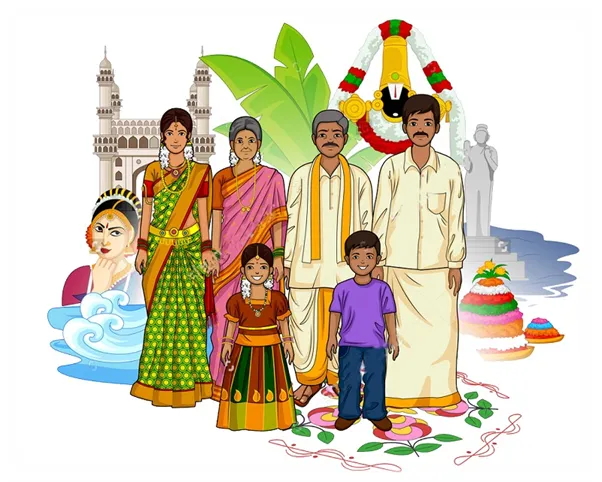
Traditional Dress of Andhra Pradesh for Men
1. Dhoti (Panche / Veshti)
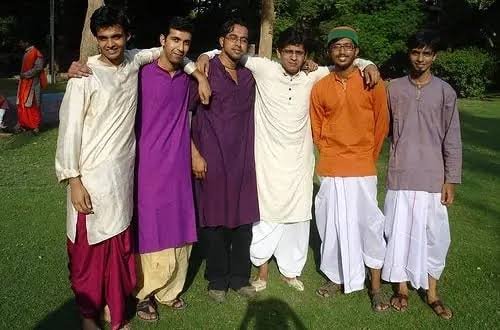
The dhoti — called Panche or Veshti in Telugu — is the most fundamental and most culturally significant garment in Andhra Pradesh’s male traditional wardrobe. A long, rectangular piece of unsewn cloth, typically white or cream in colour and made of cotton, the dhoti is wrapped around the waist and legs without any stitching, making it exceptionally comfortable in the state’s hot and humid tropical climate. The manner of wearing varies by context: for casual daily wear, it is folded to knee length, allowing freedom of movement; for formal, religious, or ceremonial occasions, it is left at full ankle length, signalling respect and gravity. On very special occasions — weddings, temple visits, major festivals — men wear silk dhotis with gold or zari borders, garments that are sometimes passed down through families as heirlooms. The dhoti’s whiteness carries symbolic meaning in Telugu culture, representing purity, simplicity, and devotion, which is why it remains the preferred dress for temple visits and religious rituals even among men who wear modern clothing in daily professional life.
2. Kurta
Worn as the upper garment paired with the dhoti or lungi, the kurta in Andhra Pradesh is traditionally a loose, long shirt falling to or below the knee, made from cotton for everyday wear and silk or embroidered fabric for festivals and weddings. The cotton kurta is the workhorse garment of daily life in Andhra’s villages and small towns — simple in its cut, comfortable against the skin in warm weather, and available in plain white, cream, or very light colours that deflect the region’s intense sun. For festive and ceremonial occasions, kurtas shift dramatically in character: silk kurtas in rich cream, deep maroon, bright yellow, and saffron appear at weddings and festivals, sometimes featuring zari borders or subtle embroidery at the neckline and sleeve edges. The sleeve length varies by personal preference and occasion — full sleeves for formal events, half or three-quarter sleeves for everyday wear.
3. Lungi
The lungi is the everyday alternative to the dhoti, particularly popular among working men and those in coastal and semi-urban areas of Andhra Pradesh. Unlike the dhoti, which is draped from a rectangular piece of unsewn cloth, the lungi is sewn into a tube shape that is simply stepped into, pulled up to the waist, and folded over at the top — making it significantly easier to put on and adjust than the dhoti’s more elaborate draping. This ease of use has made the lungi the dominant daily garment for a large proportion of Andhra’s male population, worn with a simple shirt rather than a kurta in most everyday contexts. It is available in checked, striped, and plain patterns across a range of colours, with the all-white or cream variants favoured for more formal settings and coloured checks preferred for daily use.
4. Angavastram
The angavastram is a long cloth — similar in form to a shawl or stole — traditionally worn by men draped over the shoulders across the dhoti-and-kurta ensemble. It serves both practical and symbolic functions: practically, it provides an additional layer of warmth during cooler evenings and modestly covers the upper body when needed; symbolically, it signals formal or ceremonial status. At weddings, the angavastram worn by the groom is often a silk cloth with a gold-embroidered border, and elderly men and priests frequently wear it during religious ceremonies as a mark of devotion and respect. Village elders, priests, and men in formal traditional settings are the most consistent wearers of the angavastram in contemporary Andhra Pradesh.
5. Shirt (with Dhoti or Lungi)
In the modern daily reality of Andhra Pradesh, many men — particularly in towns, semi-urban areas, and among younger generations — combine traditional lower garments with shirts rather than kurtas. A white or checked formal shirt paired with a dhoti is a distinctly South Indian adaptation that bridges traditional lower-body dress with contemporary upper-body fashion, and it is extremely common at family functions, office environments with traditional dress expectations, and everyday casual wear across the state.
6. Muslim Men’s Traditional Dress
Muslim men in Andhra Pradesh, who form a significant portion of the state’s population particularly in areas like Nellore, Kurnool, and Kadapa districts, typically wear pajama-kurta combinations rather than the dhoti, reflecting the distinct cultural influence of Islamic dress traditions. A fez cap — the cylindrical red cap historically associated with Muslim identity in the subcontinent — is worn by some traditional Muslim men in the state, though this is increasingly seen among older generations rather than the young. The kurta worn in this tradition is often longer and more loosely cut than its Hindu counterpart.
Traditional Dress of Andhra Pradesh for Women
1. Saree (The Nivi Style)
The saree is not merely the primary traditional garment of Andhra Pradesh women — it is the cultural emblem of Telugu womanhood and the canvas on which the state’s extraordinary handloom tradition expresses itself most completely. Andhra Pradesh women wear sarees that are typically five to nine yards in length, draped over a fitted blouse on the upper body and a petticoat underskirt that gives the pleats their body and structure. The specific draping method that originated in Andhra Pradesh and subsequently spread across the entire country is called the Nivi style — a method in which the saree is wrapped around the lower body, pleated neatly at the front, and the pallu (the decorative trailing end) is drawn across the body and placed over the left shoulder, allowing it to fall gracefully behind. This elegant, practical draping technique has become the standard way that women across India wear sarees, making Andhra Pradesh the originator of the country’s most widespread clothing tradition.
For daily wear, women prefer cotton sarees in lighter colours with simple borders — practical against the heat and comfortable for a full day’s work. For festivals, weddings, temple visits, and important social occasions, silk sarees in vibrant colours with elaborate zari (gold thread) borders and pallu decoration are worn. The specific types of sarees produced in Andhra Pradesh are among the most celebrated in all of India.
2. Dharmavaram Silk Saree
Dharmavaram, a town in the Satya Sai district of Andhra Pradesh, is famous for producing some of India’s finest and most opulent silk sarees. Dharmavaram silk sarees are characterised by their brilliant colours — typically rich contrasts of maroon, red, green, purple, and gold — and their heavy zari borders and pallus woven with gold or silver thread in traditional temple and nature-inspired motifs. These sarees are considered the quintessential bridal saree in Telugu culture: the bride at an Andhra wedding almost always wears a Dharmavaram silk saree in red, the traditional colour of marriage in the region, decorated with the elaborate gold brocade that gives the garment both its beauty and its symbolic weight. Dharmavaram sarees are brocaded and decorated with gold plating work that catches light dramatically, making them the definitive ceremonial garment for the most significant occasions in a Telugu woman’s life.
3. Pochampally Ikat Saree
Pochampally, a village in the Yadadri Bhuvanagiri district, has given its name to one of India’s most internationally recognised textile traditions — the Pochampally Ikat. Ikat is a dyeing technique in which the threads themselves are resist-dyed before weaving, creating patterns that bleed softly at the edges in a way that is immediately distinctive from other weaving traditions. The Pochampally Ikat saree is characterised by its geometric, diamond-shaped, and chevron patterns rendered in vibrant colour combinations — jewel tones of teal, royal blue, deep red, and golden yellow are particularly associated with this tradition. The Pochampally Ikat received a Geographical Indication (GI) tag from the Government of India, protecting its authentic origin, and these sarees are worn across the year for festivals, family occasions, and as statement traditional garments by women across India who value handloom craftsmanship.
4. Mangalgiri Cotton Saree
Mangalgiri, a town on the banks of the Krishna river near Vijayawada, produces cotton sarees of extraordinary fineness that have been woven in the region for centuries. The Mangalgiri saree is known for its distinctively crisp cotton fabric, typically white or cream with colourful borders woven in traditional nizam bands and thread work, and it is the practical everyday saree preferred by women across the state for its comfort in the warm climate and its understated elegance. Unlike the more elaborate silk sarees of Dharmavaram, the Mangalgiri cotton saree is the democratic garment of daily life — worn equally by village women doing household work and by urban professionals in office settings. It also carries Geographical Indication protection.
5. Uppada Jamdani Saree
Uppada, a fishing village in the East Godavari district on Andhra’s coastline, produces one of India’s most technically refined and most delicate sarees — the Uppada Jamdani. Woven on traditional pit looms using extremely fine silk or a combination of silk and cotton, the Uppada saree is characterised by its featherlight weight and the intricate floral and paisley motifs woven directly into the fabric using the supplementary weft technique. The Uppada saree’s defining quality is its simultaneous lightness and richness — the fabric drapes with an extraordinary fluidity while the woven patterns give it an elaborate appearance that commands attention. It has become highly sought after among saree connoisseurs across India and internationally.
6. Venkatagiri Saree
Venkatagiri, a small town in Nellore district, produces fine cotton and silk sarees known for their delicate zari work and refined floral motifs. Venkatagiri sarees have historically been associated with the royal families of the region and were worn by aristocratic Telugu women for generations. The sarees are known for their lightweight quality, intricate border designs, and the characteristic small, repeating floral motifs across the body of the saree. They carry GI tag protection and remain highly regarded in the handloom saree market.
7. Gadwal Saree
The Gadwal saree, from Gadwal town in what is now Telangana but historically part of the broader Telugu cultural textile tradition, is distinguished by its distinctive combination of cotton body with silk border and pallu — a technically demanding weaving combination that produces a saree which is comfortable against the body in the cotton sections while being visually opulent in the silk areas. The contrast between the plainly woven cotton body and the zari-worked silk pallu is the defining visual signature of the Gadwal saree, making it both practically comfortable and aesthetically ceremonial.
8. Kalamkari Fabric
Kalamkari — meaning “pen work” in Telugu, from kalam (pen) and kari (work) — is one of Andhra Pradesh’s most celebrated textile art traditions, originating in Srikalahasti and Machilipatnam. Kalamkari fabrics are produced through hand-painting or block-printing using natural dyes derived from plants, minerals, and natural sources, with the designs traditionally depicting mythological scenes, Hindu deities, the Mahabharata and Ramayana stories, temple motifs, and intricate floral and animal patterns. The Srikalahasti style is entirely hand-drawn using a bamboo pen, while the Machilipatnam style uses carved wooden blocks for printing. Kalamkari sarees, dupattas, and salwar kameez sets are worn across festivals and cultural events, and the fabric’s storytelling dimension — each garment narrating a mythological episode or devotional scene — gives it a cultural significance beyond mere aesthetics.
9. Langa Voni (Half Saree)
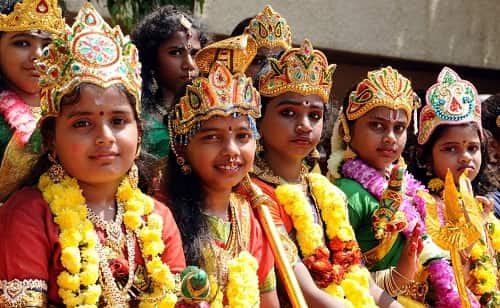
The Langa Voni — also known as a half saree — is the traditional dress of girls and young unmarried women in Andhra Pradesh, serving as the intermediate garment between the child’s dress and the fully draped saree of a married woman. It consists of three separate pieces: the Langa (a long, flared skirt reaching the ankles), a fitted blouse covering the upper body, and the Voni (a dupatta or stole-like cloth) that is draped over the shoulder and wrapped partially around the waist. The Langa Voni is a deeply significant garment in Telugu culture because it plays a central role in the half-saree ceremony — the Langa Voni Panduga or Ritu Kala Samskara — a coming-of-age ritual celebrated when a girl reaches puberty. At this ceremony, the girl’s maternal grandparents present her with her first Langa Voni, and the event is celebrated with the same scale and family significance as a wedding in many Telugu families. This ritual centrality gives the Langa Voni a cultural weight far beyond its function as a garment.
10. Lambadi (Banjara) Women’s Traditional Dress
The Lambadi or Banjara are a semi-nomadic tribal community with a significant presence across Andhra Pradesh, and Lambadi women maintain one of the most visually distinctive and most elaborately embroidered traditional dress traditions in the entire state. Unlike the Telugu mainstream’s preference for sarees and elegant restraint, the Lambadi woman’s dress is an explosion of colour and craft — a long, ankle-length skirt in deep, vibrant colours (deep red, orange, green, and black are characteristic), a fitted blouse, and a ghunghat or dupatta of matching colour. What makes the Lambadi dress immediately recognisable is its embellishment: the skirts and dupattas are decorated with intricate mirror work (shisha), coloured beads, metal rings, stone work, and embroidery in geometric patterns that can take months to complete for a single garment. Lambadi women further complete this elaborate dress tradition with heavy jewellery — bangles covering the arms from wrist to elbow, layered necklaces, anklets, and earrings — making the complete traditional Banjara ensemble one of the most ornate traditional dress traditions in South India.
Wedding Dress Traditions
At a traditional Telugu wedding, dress follows deeply established conventions that have remained consistent for generations. The bride wears a Dharmavaram silk saree in red — the most auspicious colour in Telugu tradition — decorated with heavy gold brocade borders and a deeply embroidered pallu. She completes the look with extensive gold jewellery: bangles covering the wrists and lower arms, a maang tikka (a gold head ornament that rests on the forehead), heavy gold necklaces in traditional Telugu designs, gold earrings, and payal (anklets). The groom wears a full-length white or cream silk dhoti with a matching silk kurta, draped in the formal style with the excess cloth folded in an overlapping pattern at the front and the angavastram draped over one shoulder. He wears head jewellery — traditionally a gold chain worn across the forehead — and completes the ensemble with formal footwear. Both bride and groom use traditional flower decoration (jasmine for the bride, typically) as an essential element of wedding dress.
Footwear
Traditional footwear in Andhra Pradesh reflects the climate’s demands. For everyday use, open-toed sandals or rubber slippers are worn by both men and women. For formal, religious, and ceremonial occasions, decorated leather footwear — mojdis or juttis — are worn by men, while women choose embroidered leather sandals that complement their sarees. During temple visits and religious ceremonies, both men and women traditionally remove footwear entirely as a mark of reverence.
FAQs
Q1. What is the most famous traditional saree of Andhra Pradesh?
The Dharmavaram silk saree and the Pochampally Ikat saree are the most internationally famous traditional sarees of Andhra Pradesh. Dharmavaram silk is the quintessential bridal saree, while Pochampally Ikat is celebrated for its distinctive geometric patterns and resist-dye technique.
Q2. What is the Nivi style of draping a saree?
The Nivi style is the most common saree draping method in India, and it originated in Andhra Pradesh. The saree is wrapped around the lower body, pleated neatly at the front, and the pallu is drawn across the body and placed over the left shoulder. It is now the standard draping style across most of India.
Q3. What is the Langa Voni and why is it important?
The Langa Voni is a three-piece half saree comprising a skirt (Langa), blouse, and dupatta (Voni), worn by young girls and unmarried women. It holds deep cultural significance because it is the central garment of the Langa Voni Panduga, a coming-of-age ceremony celebrating a girl’s transition to womanhood, gifted by her maternal grandparents.
Q4. What do men traditionally wear at weddings in Andhra Pradesh?
The groom at a traditional Telugu wedding wears a full-length white or cream silk dhoti in the formal draped style, paired with a silk kurta and an angavastram draped over one shoulder. He also wears gold head jewellery in the traditional form of a chain worn across the forehead.
Q5. What is Kalamkari fabric and where is it produced?
Kalamkari is a hand-painted or block-printed fabric using natural dyes, depicting mythological stories, deities, and floral patterns. It is produced in Srikalahasti (using hand-drawn kalam technique) and Machilipatnam (using block printing) in Andhra Pradesh, and is used to make sarees, dupattas, and ethnic wear garments.