Bihar — the Land of Buddha, the ancient heartland of the Maurya and Gupta empires, the soil that gave the world Buddhism and Jainism, and the state that produced some of India’s most powerful intellectual and spiritual traditions — carries an equally rich material culture in its traditional dress. Called by some the Land of Ancient Learning and by others the heartland of the Gangetic plain, Bihar’s traditional clothing reflects the cultural confluence of Maithil, Bhojpuri, and Magahi regional identities, the religious traditions of Hinduism and Islam that coexist across the state’s districts, and the practical requirements of life in the subtropical climate of the middle Ganga basin.
Bihar’s traditional dress is characterised by an emphasis on handwoven textiles — particularly the extraordinary Tussar silk of Bhagalpur, known internationally as Bhagalpuri silk — combined with a clothing philosophy that prizes modesty, elegance, and ease of movement. The women’s saree tradition in Bihar carries the state’s most distinctive regional marker: the Seedha Anchal draping style, unique to the region, in which the pallu is brought to the front rather than the back, creating a specific visual signature that immediately identifies Bihar’s clothing culture. The state is also celebrated for its Madhubani painting tradition, which has crossed from the walls of Mithila’s villages onto fabric to create garments of remarkable artistic power.
Traditional Dress of Bihar for Men
1. Dhoti Mirjai
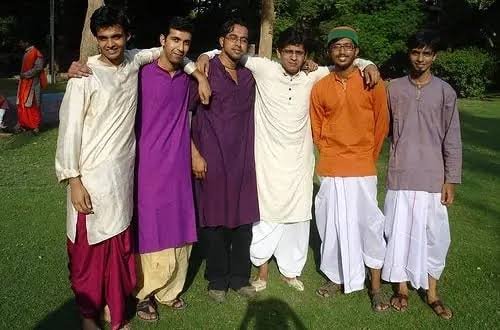
The Dhoti Mirjai is the most iconic and most culturally significant traditional male dress of Bihar — the combination that represents Bihar’s masculine dress identity most completely. The Dhoti is the lower garment: a rectangular piece of unsewn cloth, typically white or cream-coloured and made from cotton, wrapped around the waist and legs in the traditional Indian manner. The Mirjai refers to a specific jacket-like upper garment worn over the dhoti, giving the ensemble its name. Together, the Dhoti Mirjai is the everyday dress of elder men across Bihar’s villages and small towns, the formal dress for religious ceremonies, and the ceremonial garment for important social functions.
For daily use, the Dhoti is made from plain cotton — comfortable, breathable, and appropriate for the work demands of agricultural and domestic life in Bihar’s warm climate. For weddings, festivals, and religious occasions, the Dhoti becomes more elaborate: fancy Dhotis with embroidered or zari borders, made from silk or fine cotton, are worn alongside matching Kurtas or formal shirts. The Dhoti is tied differently by different men depending on their region within Bihar — in Mithila, specific tying styles reflect the Maithil cultural tradition, while in Bhojpuri and Magahi regions, the styles vary slightly but the garment’s fundamental form and cultural significance remain constant.
2. Kurta-Pyjama
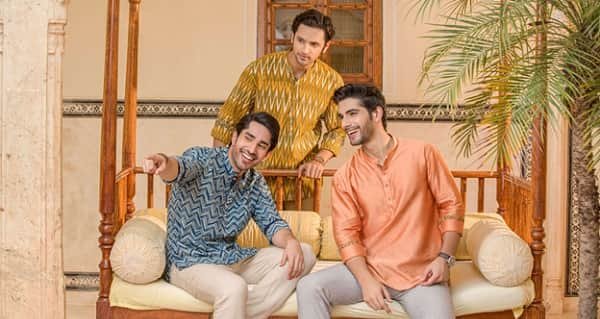
The Kurta-Pyjama combination has become Bihar’s most practically worn traditional ensemble across all age groups, demographic categories, and occasions from daily life to formal events. The Kurta is a loose, long shirt falling to or just above the knee, made from cotton for daily wear and from silk or embroidered fabric for special occasions. Bihar’s Kurtas for everyday use feature minimal embroidery and simple designs appropriate for agricultural work, office settings, and household life. For festivals, weddings, and formal functions, Kurtas are elevated with Chikan work embroidery, zari borders, and silk fabric that transforms the humble daily garment into a formal statement piece.
The Pyjama paired with the Kurta is a loose, comfortable trouser of matching fabric, completing an ensemble that has remained one of the most comfortable and most culturally appropriate traditional options for Bihari men across generations.
3. Lungi
The Lungi is the casual everyday lower garment worn particularly in rural Bihar and by working men in domestic and informal settings. A piece of cloth typically in checked or striped patterns — often in blue, green, or brown checks — the Lungi is tied around the waist below the navel and provides the maximum comfort and freedom of movement required for the physical demands of daily rural life. In urban and semi-urban settings, the Lungi tends to be reserved for home use, while the Dhoti or Kurta-Pyjama is worn for public settings.
4. Sherwani
The Sherwani is Bihar’s premier ceremonial male garment, worn principally at weddings, major festivals, and the most formal social occasions. A long coat-like garment extending to the knees or calves, the Sherwani is worn over a Kurta and paired with either Dhoti pants, churidar (tight-fitted pyjamas), or loose pyjamas. Bihar’s Sherwanis are available in an extraordinary variety of colours — deep maroon, royal blue, ivory, gold, and embroidered black are all popular choices — and the most elaborate ceremonial Sherwanis feature heavy embroidery, zari work, and intricate decorative patterns that reflect the cultural richness and artisanal heritage of the state. The Sherwani is to Bihar’s groom what the Dharmavaram silk saree is to an Andhra bride — the garment that communicates the most significant social occasion of a person’s life.
5. Gamchha
The Gamchha is a thin cotton towel-cloth, typically in checkered or striped patterns, used by Bihari men as a practical accessory for wiping sweat, covering the head against the sun, drying the body after bathing, and draping casually around the shoulder or neck. In the villages of Bihar, the Gamchha hanging around the neck or shoulder of a working man is as characteristic an image as the dhoti itself. The Gamchha has become in many representations a symbol of the Bihari working man — a marker of honest labour and unpretentious practicality that carries a kind of cultural pride in its simplicity.
6. Paag — Mithila Turban
In the Mithila region of Bihar, encompassing the cultural heartland of the Maithil community, the Paag is a distinctive turban worn by men at weddings, ceremonial occasions, and during the most important social events. The colour of the Paag carries social meaning: in Mithila’s traditional social hierarchy, the turban’s colour communicates the wearer’s social position and the nature of the occasion. The Paag is not merely headwear — it is a sign of dignity, honour, and the depth of tradition that the Maithil cultural community has maintained across centuries.
Traditional Dress of Bihar for Women
1. Saree — Seedha Anchal Style
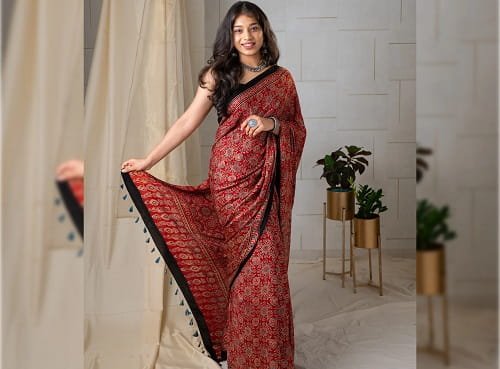
The saree is the primary traditional garment of Bihar’s women, worn across age groups from young married women to elderly grandmothers, and across economic categories from the simplest cotton sarees worn daily in the fields to the most elaborate silk sarees worn for weddings and major festivals. What distinguishes Bihar’s saree tradition from other Indian states is the Seedha Anchal draping style — a specific regional method of wearing the saree in which the pallu (the decorative trailing end) is brought forward over the right shoulder rather than the left shoulder, and draped to cover the front of the upper body. This style is both elegant and highly practical — the forward-covering pallu provides greater modesty, can be brought over the head to cover the hair when respectfully appropriate, and allows for ease of movement in daily household and agricultural work.
Older women in parts of Bihar also wear a Dhoti-style saree where the saree is tied in a manner resembling the male Dhoti around the lower body — a style that reflects the region’s deepest agricultural roots and the practical dress requirements of women working in the fields.
2. Tussar Silk Saree (Bhagalpuri Silk)
Bihar’s most celebrated and most distinctive saree is the Tussar silk saree from Bhagalpur, the ancient weaving city on the banks of the Ganga in eastern Bihar that has given its silk a global reputation as Bhagalpuri silk. Tussar silk is produced from the silk of Antheraea mylitta silkworms that feed on Arjun, Sal, and Asan trees in Bihar’s forests, producing a coarser but extraordinarily rich silk with a characteristic natural earth-gold sheen and texture. Unlike the smooth, lustrous finish of mulberry silk, Tussar has a slight roughness of texture and a natural irregular slub that gives it an organic warmth and individuality impossible to replicate industrially.
Bihar’s Tussar silk sarees are woven with traditional designs that draw on the region’s visual heritage — motifs from the Ganga’s aquatic life, nature-inspired geometric patterns, and increasingly, elements of Bihar’s famous Madhubani visual tradition. For weddings, festivals like Chhath Puja, and important family occasions, the Tussar silk saree is the garment of choice for Bihar’s women — simultaneously luxurious and distinctly regional in character.
3. Ghagra Choli (Lehenga Choli)
The Ghagra Choli — known interchangeably as Lehenga Choli in Bihar — is the festive and bridal women’s garment worn for weddings, major festivals, and important celebrations. Consisting of a long, full flared skirt (the Ghagra or Lehenga), a fitted upper blouse (the Choli), and a dupatta that completes the ensemble, the Ghagra Choli is the alternative to the saree for women who prefer a more structured, separately stitched garment for celebratory occasions. Bihar’s Ghagra Cholis are typically made in vibrant reds, oranges, greens, and golds — colours that reflect the celebratory context in which they are worn — with embroidery, zari work, gota patti, and mirror work that give the bridal and festive versions their elaborate visual character.
4. Salwar Kameez
The Salwar Kameez has become an important part of Bihar’s women’s everyday dress vocabulary, particularly in urban areas and among younger women in semi-urban settings. Consisting of a tunic (Kameez), loose trousers (Salwar), and a dupatta, the Salwar Kameez offers a practical, comfortable, and culturally appropriate alternative to the saree for daily work and office settings. Bihar’s urban women wear Salwar Kameez in cotton and silk blends for everyday purposes, with more elaborate embroidered versions for festivals and family occasions.
5. Madhubani Print Garments
Madhubani painting — the extraordinary visual art tradition of the Mithila region of Bihar, in which intricate natural and mythological scenes are painted using fingers, twigs, and brushes dipped in natural dyes — has crossed from the walls of Mithila’s women’s inner rooms onto fabric to create one of India’s most distinctive and most internationally celebrated textile art forms. Madhubani-print sarees, dupatta, and kurta sets feature the characteristic bold outlines, fish and bird motifs, geometric patterns, and mythological scenes from the Ramayana and Mahabharata that define the Madhubani visual tradition. These garments are particularly favoured for cultural festivals, literary events, and occasions where the wearer wishes to express pride in Bihar’s artistic heritage. In 2015, Madhubani painting received Geographical Indication status, recognising its unique origin and cultural significance.
Wedding Dress Traditions
At a traditional Bihari wedding, the bride wears either an elaborate Tussar silk saree in red or a heavily embroidered Lehenga in deep red, gold, or maroon — both reflecting the auspiciousness of red in Bihar’s wedding colour tradition. She is adorned with traditional gold jewellery including the Hansuli (thick neck band), Chandrahar (long gold necklace with floral lockets), Panchlari (five-layered pearl and gemstone necklace), and the Sita Haar (a long gold necklace reaching the waist). The Maang Tikka (forehead ornament) and sindoor in the hair parting mark her married status. The groom wears either a silk Sherwani in maroon, ivory, or gold with churidar pyjamas, or the formal Dhoti Mirjai in silk with an elaborate angavastram. In the Mithila region, the groom wears the characteristic Paag turban as an essential element of his wedding attire.
FAQs
Q1. What is the Seedha Anchal style of wearing a saree?
The Seedha Anchal is Bihar’s distinctive regional saree draping style in which the pallu (the decorative trailing end) is brought forward over the right shoulder rather than the left, covering the front of the body. It allows for ease of movement and additional modesty, and is the definitive marker of Bihar’s saree tradition.
Q2. What is Bhagalpuri Tussar silk and why is it famous?
Bhagalpuri Tussar silk — also called Bhagalpuri silk — is produced from Antheraea mylitta silkworms that feed on forest trees in Bihar, producing a rich, earth-toned silk with a distinctive natural texture and golden sheen. It is woven in Bhagalpur, an ancient weaving city on the Ganga, and is internationally celebrated for its organic beauty and durability.
Q3. What is the Paag and who wears it?
The Paag is a traditional turban worn by men in Bihar’s Mithila region, particularly during weddings and ceremonial occasions. Its colour communicates the wearer’s social position in Maithil tradition, and wearing it is a mark of cultural dignity and respect.
Q4. What is the significance of Madhubani art on Bihar’s traditional dress?
Madhubani painting — the ancient visual art tradition of Mithila women — has been transferred onto fabric in the form of printed and hand-painted sarees, dupattas, and kurtas. These garments express Bihar’s artistic heritage and have received Geographical Indication protection recognising their unique cultural origin.
Q5. What does a traditional Bihari bride wear?
A traditional Bihari bride wears either a Tussar silk saree or a heavily embroidered Lehenga in red or deep festive colours, paired with extensive gold jewellery including the Hansuli necklace, Chandrahar, Panchlari, and Maang Tikka. The sindoor applied by the groom in her hair parting is the formal marker of her new married status.