Uttar Pradesh — the most populous state in India, the cradle of the Gangetic civilisation, the seat of the Mughal Empire at Agra and Fatehpur Sikri, the capital of the Nawabs of Awadh at Lucknow, the sacred heartland of Hindu pilgrimage at Varanasi, Mathura, Vrindavan, Prayagraj, and Ayodhya — is a state whose traditional dress carries the accumulated weight of more than a thousand years of royal patronage, artistic refinement, religious devotion, and cultural synthesis. Nowhere else in India have so many distinct civilisational traditions layered themselves into a single state’s clothing culture — the ancient Sanskrit tradition’s simple white dhoti, the Mughal court’s opulent silk brocade and Zardozi embroidery, the Nawabi Lucknow court’s ethereal Chikankari on fine muslin, and the devout Brahmin’s sacred thread and plain white kurta all coexist in a state where a thirty-kilometre drive can take you from a village wearing handwoven cotton dhotis to a city where Banarasi silk is woven on computerised Jacquard looms but the old patterns remain unchanged.
The two textile traditions that put Uttar Pradesh on the global textile map — Banarasi silk weaving and Lucknow Chikankari embroidery — represent entirely opposite aesthetic philosophies, yet both emerged from the same cultural soil. Banarasi silk is maximalist: heavy, opulent, gold-heavy, loaded with brocade motifs in silk and real zari, the woven equivalent of a Mughal miniature painting. Chikankari is minimalist: white thread on white or pastel fabric, the delicate floral patterns creating surface texture through shadow rather than colour, the embroidered equivalent of a poet’s restraint. That both exist with equal honour in the same state tells you something essential about Uttar Pradesh’s cultural character — it contains multitudes, and it has always been large enough to hold them.
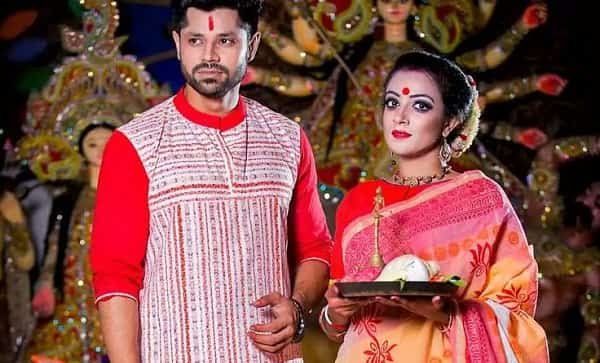
Traditional Dress of Uttar Pradesh Quick Comparison
| Garment | Worn By | Fabric / Tradition | Occasion |
| Dhoti-Kurta | Men | Cotton, Silk | Daily (rural), Religious |
| Kurta-Pajama | Men | Cotton, Silk, Chikankari | Daily, Festivals |
| Sherwani | Men (grooms) | Silk, Brocade, Velvet | Weddings, Formal events |
| Angarkha | Men | Silk, Cotton | Formal, Ceremonies |
| Pagri / Topi | Men | Cotton, Silk | Religious, Formal |
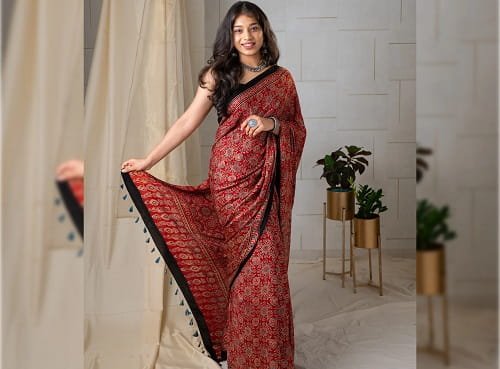
| Banarasi Silk Saree | Women | Pure Silk with Zari | Weddings, Major festivals |
| Chikankari Saree | Women | Cotton, Muslin | Festivals, Semi-formal |
| Salwar Kameez | Women | Cotton, Silk, Georgette | Daily, Festivals |
| Lehenga Choli | Women | Silk, Brocade | Weddings, Major festivals |
| Ghagra Choli | Women (rural) | Cotton, Silk | Festivals, Rural daily |
UP’s Two Great Textile Traditions
Banarasi Silk — Varanasi’s Woven Legacy
Varanasi — the oldest continuously inhabited city in the world, the sacred city of Lord Shiva, the city where the Ganga flows northward in defiance of geography — is also the home of India’s most celebrated silk weaving tradition. Banarasi silk sarees are woven in Varanasi (and in the surrounding weaving centres of Mau, Azamgarh, and Mirzapur) in a tradition that derives from Mughal patronage of the sixteenth and seventeenth centuries, when the Mughal courts’ demand for the finest silk brocades available attracted weavers from Persia, Central Asia, and across the subcontinent to Varanasi’s workshops. The Persian and Mughal influence on Banarasi motifs is visible in the characteristic kalga (mango-paisley) motifs, the jangla (dense foliage) backgrounds, the buti (small repeat motifs scattered across the body), and the elaborate kadhwa (woven-in) borders that define the saree’s most traditional design vocabulary.
Banarasi sarees are available in several distinct fabric variants. Pure silk (Katan) is the most traditional and most expensive — a tightly woven pure silk ground into which real zari (gold thread, traditionally pure gold twisted with silk, though silver and artificial zari are now more common at lower price points) is incorporated through the weaving process itself. Organza (Kora) is a lighter, more transparent variant. Georgette Banarasi uses the lighter georgette weave to create a softer-draping saree with the same brocade patterns. Shattir (tussar-silk blend) is another variant. All carry the GI tag that protects authentic Varanasi weaving.
Chikankari — Lucknow’s Court Embroidery
Chikankari is the hand embroidery tradition of Lucknow — one of the most refined, most technically sophisticated, and most internationally admired embroidery traditions in India, developed under the patronage of the Nawabs of Awadh in the eighteenth and nineteenth centuries to clothe the court of the most cultured and most aesthetically sophisticated princely state of its era. The word Chikankari means “embroidery work,” and its origins are traced in popular legend to Nur Jahan, the Mughal queen, who is said to have introduced the art — though it reached its definitive form under Awadhi patronage in Lucknow.
The defining characteristic of Chikankari is its subtlety — white or cream thread embroidered on white, cream, or pastel fabric in floral and vine patterns so fine that the embroidery creates surface texture visible primarily as light and shadow rather than colour contrast. The technique incorporates thirty-two distinct stitches, each with its own name and function within the overall design — including flat stitches, raised stitches, open-work stitches (where threads are withdrawn and the remaining threads whipped together to create a lace-like effect), and shadow stitches visible through the sheer fabric from the reverse. The most demanding Chikankari work is done on the finest muslin — fabric so sheer that the needle must pass through it without disturbing the weave. The most elaborate Chikankari garments take multiple skilled artisans weeks to complete.
Chikankari is applied to kurtas, sarees, salwar kameez, dupattas, and increasingly to a wide range of contemporary garments — it has arguably become the most fashion-forward of India’s traditional embroidery traditions, adopted by designers nationally and internationally as an embellishment that works equally on traditional and contemporary silhouettes.
Traditional Dress of Uttar Pradesh for Men
1. Dhoti-Kurta
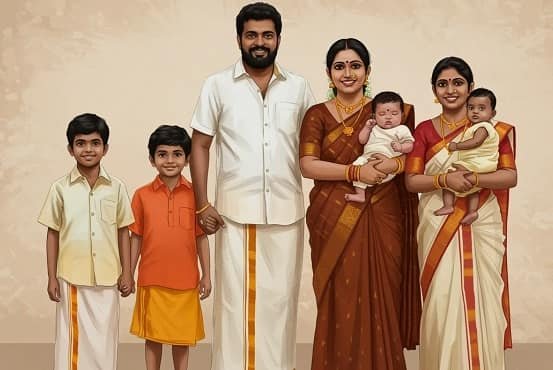
The Dhoti-Kurta remains the most widely worn traditional male garment across rural Uttar Pradesh — a simple white or cream cotton dhoti wrapped around the waist and legs in the standard North Indian manner, paired with a straight, collarless white cotton kurta. In the villages and smaller towns of Purvanchal (eastern UP), Bundelkhand, and Awadh, older men wear the Dhoti-Kurta as their daily dress with the same naturalness as younger men wear jeans. At religious ceremonies, temple visits, and family pujas, the Dhoti-Kurta is the expected dress for Hindu men regardless of age, communicating respect for the sacred through the simplicity of unstitched cotton against the body. For the most formal religious occasions — Satyanarayana Puja, wedding rituals, thread ceremony (Upanayana) — silk Dhotis replace cotton.
2. Kurta-Pajama — The Everyday Favourite
The Kurta-Pajama is the most universally worn traditional outfit across urban and semi-urban Uttar Pradesh — a long cotton or silk kurta paired with loose, comfortable pajama trousers. The Lucknowi Kurta specifically — a kurta in fine cotton or cotton-silk with Chikankari embroidery worked around the collar, placket, cuffs, and sometimes across the entire front panel — is arguably the single most iconic garment associated with UP’s urban male identity. Light, elegant, and understatedly beautiful, the Lucknowi Chikankari kurta is the garment that Lucknow’s historically literary, musically sophisticated, and culturally refined culture chose as its sartorial expression. It pairs with white cotton pajama for the purist look, with churidar for a more tailored silhouette, and increasingly with jeans for the Indo-Western fusion that characterises urban India’s daily dress.
3. Sherwani
The Sherwani is the definitive formal garment of UP men at weddings, festivals, and important social ceremonies — a long, elegant coat-like outer garment worn over a kurta and churidar or pajama, originating in the Mughal court and refined through two centuries of Nawabi Lucknow’s extraordinarily cultivated attention to detail. UP Sherwanis at weddings are among the most elaborate in India — the heavy silk or brocade fabric embroidered with Zardozi (gold wire embroidery of Persian origin, in which real gold or silver wire is stitched onto the fabric to create three-dimensional metallic embellishments) around the collar, placket, cuffs, and hem creates a garment of genuine opulence that reflects the Mughal-Nawabi heritage directly.
The UP groom at a traditional wedding typically wears a cream or ivory Sherwani in Banarasi brocade or silk velvet with Zardozi embroidery, a matching churidar pajama, embroidered Jutis, and a Sehra (a decorative face veil of flowers or beads) completing the ensemble. The wedding pagri (turban) in the specific style of the groom’s community completes the look.
4. Angarkha
The Angarkha is the more historical formal outer coat worn by UP men at cultural events and traditional ceremonies — particularly in regions like Vrindavan and Mathura where Vaishnava traditions maintain historical dress conventions, and among communities in western UP where Rajput and aristocratic dress traditions are still observed. The Angarkha’s overlapping chest panels tied with strings are the most immediately distinctive element of this historically rich garment, connecting its wearer visually to the courtly traditions of Mughal India and pre-Mughal Rajputana.
5. Pagri and Topi
Head coverings for UP men range from the simple white topi (cap) worn by men with religious or political identity to the elaborate silk Pagri (turban) worn at weddings and important ceremonies. The specific style of turban varies by community and region — Rajput communities in western UP wear large, boldly coloured turbans, while Brahmin and other communities have their own conventions. The white topi is particularly associated with political figures and religious observance in UP, carrying a specific cultural weight in a state where cloth caps have been political symbols since the nationalist movement.
Traditional Dress of Uttar Pradesh for Women
1. Banarasi Silk Saree
The Banarasi silk saree is the definitive ceremonial garment for UP women — the saree that every family in the state aspires to own, the bridal gift that communicates the groom’s family’s respect and prosperity, and the garment that has defined the high-water mark of Indian silk weaving for four hundred years. At every important occasion in a UP woman’s life — her own wedding, her children’s weddings, Diwali, Eid, Navratri, and the major festivals of the Hindu and Muslim calendars — the Banarasi silk saree is the expected and the most admired choice.
The visual richness of the Banarasi saree comes from the combination of the silk’s natural sheen and the complexity of the zari brocade patterns. The kadhwa border — where the pattern is woven directly into the border cloth using individual weft threads — creates a border design that is technically more demanding and more valuable than printed or embroidered alternatives. The pallu, typically featuring the most complex motifs — meena (enamel-like coloured patterns in the zari), large floral medallions, Mughal garden patterns — is the focal point of the entire garment. A heavy Banarasi katan silk saree with real zari is a garment of such weight and richness that wearing it for hours requires physical endurance alongside aesthetic pleasure.
2. Chikankari Saree and Salwar Kameez
The Chikankari saree — the same embroidery tradition of Lucknow applied to saree fabric rather than kurta cloth — is the lighter, more ethereal alternative to the Banarasi’s opulent weight. Made typically on muslin, georgette, or fine cotton, the Chikankari saree in white or pastel with its intricate white thread embroidery creates a garment of almost otherworldly delicacy — the opposite of the Banarasi’s maximalism yet equally distinctive as a product of UP’s cultural tradition.
Chikankari salwar kameez sets — particularly the Lucknowi kurta in fine cotton or georgette with Chikankari embroidery worn with matching or contrasting churidar — are among the most universally popular and most fashion-forward traditional garments in contemporary India. Worn by government officials, academics, and urban professionals across the country as festival and semi-formal dress, the Lucknowi Chikankari kurta has transcended its regional identity to become one of India’s most nationally adopted traditional garments.
3. Lehenga Choli
The Lehenga Choli — a heavily embellished flared skirt, fitted blouse, and matching dupatta — is the definitive bridal and wedding guest dress of UP women, worn for the most elaborate celebratory occasions. UP Lehengas are among the most ornate in India, reflecting the state’s Mughal and Nawabi heritage of unrestrained decorative richness: heavy Banarasi brocade or silk velvet with dense Zardozi embroidery, sequences of mirror work, Mukaish (silver wire embroidery), and Gota-Patti (gold ribbon) work create garments of extraordinary visual complexity. Bridal Lehengas in UP are frequently in deep red, the auspicious colour of North Indian Hindu brides, with contrasting gold embroidery.
4. Ghagra Choli
The Ghagra Choli — the long flared skirt with fitted blouse and Odhani head covering — is the traditional dress of women in UP’s rural communities, particularly in the Bundelkhand, Vrij, and western UP regions where the Rajasthani and Braj cultural traditions create a specific regional aesthetic distinct from the more Lucknowi-Awadhi traditions of the east. Village women in Bundelkhand still wear the Ghagra with printed or embroidered cotton fabric for daily work, while the Ghagra in silk with embroidery appears at festivals and weddings.
5. Salwar Kameez
The salwar kameez is the daily dress of choice for urban women throughout UP — practical, adaptable, and made infinitely more distinctively Uttar Pradeshi when embellished with Chikankari, mirror work, or Zardozi embroidery. In Lucknow specifically, the salwar kameez with Chikankari kurta is the professional and social dress of choice for women across class lines — teachers, civil servants, shopkeepers, and college students all wear Chikankari kurtas as a daily expression of the city’s deeply embedded embroidery culture.
Zardozi — The Third Great Tradition
Zardozi embroidery — the technique of stitching gold or silver wire (zari) directly onto fabric to create three-dimensional metallic embellishments — is Varanasi and Agra’s contribution to UP’s embroidery heritage alongside Lucknow’s Chikankari. Used primarily for the most formal and most celebratory garments — bridal lehengas, Sherwanis, evening wear — Zardozi work in UP is among the most elaborate in India, reflecting the Mughal tradition of using actual precious metals in court embroidery.
FAQs
Q: What are the two most famous traditional textile traditions of Uttar Pradesh?
A: Banarasi silk weaving from Varanasi — producing the country’s most celebrated silk brocade sarees in pure silk with real gold zari — and Chikankari embroidery from Lucknow — producing delicate white-on-white or pastel floral embroidery on fine cotton and muslin. Both hold GI tag protection and both have profoundly influenced Indian fashion nationally.
Q: What makes Chikankari embroidery distinctive?
A: Chikankari uses thirty-two distinct stitches including flat, raised, open-work, and shadow stitches to create white thread embroidery on white or pastel fabric, with the design visible primarily as light and shadow rather than colour. The most demanding work is done on sheer muslin fabric, where the needle must pass through without disturbing the weave.
Q: What is a Banarasi silk saree made of?
A: An authentic Banarasi saree is woven in Varanasi from pure mulberry silk (Katan) with zari (gold or silver thread) brocade patterns woven directly into the fabric using the kadhwa technique. The motifs — kalga paisley, jangla foliage, buti patterns — reflect Mughal court aesthetic traditions. It carries GI tag protection.
Q: What does the UP groom traditionally wear at a wedding?
A: A cream or ivory Sherwani in Banarasi brocade or silk velvet with Zardozi embroidery, matching churidar pajama, embroidered Jutis, a Sehra flower veil covering the face, and a community-specific turban (Pagri) together form the traditional UP groom’s wedding ensemble.
Q: What is Zardozi embroidery?
A: Zardozi is the embroidery technique in which real gold or silver wire (zari) is stitched onto fabric to create three-dimensional metallic patterns. Originating in Persia and brought to India through Mughal patronage, it is concentrated in Varanasi, Agra, and Lucknow, and used primarily for the most formal and celebratory garments including bridal lehengas and Sherwanis.