Boys’ fancy dress competitions and themed celebrations offer a canvas of extraordinary richness in the Indian context — a country whose history, mythology, literature, and cultural heritage provide an unending supply of powerful, visually spectacular, and educationally meaningful character inspiration. From the mightiest heroes of the Mahabharata and Ramayana to the revolutionary figures who shaped India’s independence movement, from the valiant historical warriors who defended their kingdoms to the beloved animated characters that dominate contemporary Indian childhood entertainment, the choices available to Indian boys are as diverse as the country itself.
The best fancy dress costumes for boys combine visual impact that creates an immediate impression on judges and audiences with substantive character knowledge that the boy can demonstrate through speech, movement, or performance. Parents and boys who invest time in researching the character — memorising a key speech, learning a characteristic gesture or pose, or preparing a brief biographical presentation — consistently outperform competitors whose costumes are visually elaborate but whose knowledge of the character is superficial. This guide presents five of the most popular, most visually impressive, and most culturally meaningful fancy dress ideas for Indian boys.
| Rank | Character/Theme | Difficulty | Approximate Cost | Best For |
| 1 | Lord Krishna | Low–Medium | ₹400–₹1,800 | Janmashtami, school events |
| 2 | Chhatrapati Shivaji Maharaj | Medium | ₹700–₹2,500 | Republic Day, cultural events |
| 3 | Mahatma Gandhi | Low | ₹300–₹1,000 | Independence Day, Republic Day |
| 4 | Bhagat Singh | Low–Medium | ₹400–₹1,500 | Independence Day, school events |
| 5 | Lord Hanuman | Medium | ₹600–₹2,500 | Hanuman Jayanti, school events |
1. Lord Krishna — The Divine Favourite
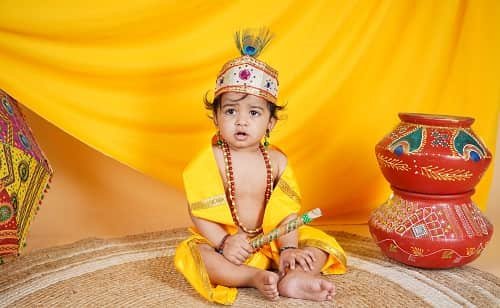
Dressing as Lord Krishna is the most universally beloved and most frequently chosen fancy dress option for Indian boys across all age groups — from toddlers at their first fancy dress event to teenagers participating in Janmashtami celebrations. Krishna’s iconography is immediately recognisable worldwide — the dark complexion, the yellow pitambar (silk cloth), the peacock feather crown, the flute, and the characteristic smile that expresses the divine delight at the heart of Krishna’s personality. The costume’s visual appeal is extraordinary, and Krishna’s narrative — combining divine love, cosmic wisdom, extraordinary courage, and irresistible playfulness — provides endless character depth for performance.
Costume elements — A yellow or golden silk dhoti worn in the traditional style, a peacock feather crown (morpankh mukut), a flute as the most essential prop, a blue body paint option for those who want maximum authenticity (water-based theatrical body paint works well), a garland of flowers (vaijayanti mala), gold jewellery including a necklace, armlets, and anklets, and a small peacock feather tucked behind the ear.
Character performance — Playing a short tune on a flute (even a beginner-level melody works beautifully in context), reciting a verse from the Bhagavad Gita in Sanskrit, or performing a brief enacted scene from Krishna Leela creates a performance dimension that elevates this costume from visually lovely to genuinely memorable. Krishna’s universal recognition across India ensures that judges at any school, in any state, from any background will respond warmly to this presentation.
2. Chhatrapati Shivaji Maharaj — The Great Warrior King
Chhatrapati Shivaji Maharaj — the founder of the Maratha Empire whose military brilliance, administrative sophistication, and cultural vision created one of India’s most powerful kingdoms in the 17th century — is one of India’s most inspiring historical figures and one of the most visually spectacular fancy dress subjects available. Shivaji’s warrior aesthetic — the royal armour, the distinctive sword (Bhavani Talwar), the royal turban, and the iconic image of a king who combined personal courage with political wisdom — makes for a costume of extraordinary visual power.
Costume elements — A royal kurta and dhoti combination in saffron or royal colours, a kavach (body armour) made from craft materials, thermocol, or purchased as a costume prop, a royal Maratha-style turban, the Bhavani Talwar (sword prop), arm guards, and royal jewellery appropriate to a warrior king. Some costume presentations include a tiger — referencing Shivaji’s famous battle against the tiger — as an additional prop or drawn element.
Performance component — A brief speech about Shivaji’s establishment of Hindavi Swaraj (self-rule), his naval innovations, his philosophy of governance, or his famous dialogue with Afzal Khan creates the historical depth that transforms this from costume competition to genuine historical education. This choice is particularly powerful for Maharashtra and Karnataka-based events where Shivaji’s legacy has deepest cultural resonance.
3. Mahatma Gandhi — The Father of the Nation
Mahatma Gandhi is one of the world’s most recognisable figures — whose simple, distinctive appearance (the round-framed glasses, shaved head, white khadi dhoti and shawl, wooden walking stick, and the famous pocket watch) paradoxically makes for one of India’s most immediately recognisable and easiest-to-execute fancy dress costumes. The simplicity of Gandhi’s personal aesthetic — chosen deliberately as a philosophical statement about solidarity with India’s poor — means that the costume requires minimal expenditure while creating maximum recognition impact.
Costume elements — A white khadi dhoti (or plain white cotton wound dhoti-style), a white or natural-coloured khadi shawl draped over the shoulder, round-framed glasses (available at stationery shops for ₹50–₹100 as props), a wooden walking stick (danda), and if available, a replica pocket watch (though this is optional). The bald head can be created with a bald cap (available from costume shops or Amazon) or simply implied without — most audiences recognise Gandhi even with a child’s full hair visible.
Character performance — Reciting Gandhi’s famous quotes in Hindi or English — “Be the change you wish to see in the world”, “An eye for an eye will make the whole world blind”, or the Vaishnav Jan prayer that was Gandhi’s favourite bhajan — creates the character depth that makes this simple costume genuinely powerful. This is one of the few fancy dress choices where the character’s wisdom is as important as the visual presentation, and boys who prepare a thoughtful speech about Gandhi’s philosophy consistently win competitions with this choice.
4. Bhagat Singh — The Revolutionary Hero
Bhagat Singh — the revolutionary freedom fighter who sacrificed his life at age 23 for India’s independence and became the symbol of fearless patriotic courage for generations of young Indians — is one of the most powerful and emotionally resonant fancy dress characters available for Indian boys. Bhagat Singh’s iconic appearance — the black nehru-style round hat (topi), the formal sherwani or coat, and the determined, confident expression — is immediately recognisable across India and carries profound emotional significance for every Indian audience.
Costume elements — A black or navy topi (the hat most associated with Bhagat Singh’s iconic photograph), a formal sherwani or suit jacket in dark colours, a white kurta and pajama underneath, a scarf or stole draped over the shoulder in tricolour or plain, and if desired, a toy gun as a prop (appropriate for specific presentation contexts). The iconic photograph of Bhagat Singh — the one taken in Lahore where his determined expression and angular hat have become the definitive image of Indian revolutionary spirit — is the reference point for the costume’s accuracy.
Character performance — Reciting Bhagat Singh’s famous quote — “They may kill me, but they cannot kill my ideas. They can crush my body, but they will not be able to crush my spirit” — or speaking about his philosophy of non-violent and later revolutionary resistance to British colonialism creates the patriotic depth that makes this costume genuinely moving for judges and audiences. This choice is particularly powerful for Independence Day events.
5. Lord Hanuman — The Devotion and Strength Ideal
Lord Hanuman — the devotee of Rama whose extraordinary physical power, absolute loyalty, and selfless service make him one of India’s most beloved and most widely worshipped divine figures — provides one of the most physically impressive and most visually dynamic fancy dress costume options for energetic Indian boys. Hanuman’s association with strength, courage, devotion, and intelligence makes him a character that resonates with boys’ natural enthusiasm and creates performance opportunities for physical demonstrations of the divine monkey’s legendary capabilities.
Costume elements — Orange or saffron coloured body paint (optional), an orange or white dhoti, a crown (mukut) appropriate for Hanuman’s divine status, a gada (mace) as the most essential prop (available as a toy weapon or crafted from thermocol and paint), a tail (can be created from wire and orange fabric), the sacred thread (janeu) across the chest, and the characteristic Hanuman chest ornament showing Ram and Sita. The iconic image of Hanuman tearing open his chest to reveal Ram and Sita within is a powerful performance gesture.
Character performance — Reciting the Hanuman Chalisa’s opening dohas, demonstrating yoga asanas that reference Hanuman’s physical prowess (the Anjaneya Asana / crescent lunge is directly named after Hanuman), or enacting the moment of Lanka Dahan creates the mythological engagement that elevates costume to character portrayal.
Frequently Asked Questions (FAQs)
Q: Which fancy dress is best for Republic Day for boys?
A: Chhatrapati Shivaji Maharaj and Bhagat Singh are the most impactful choices for Republic Day, combining visual spectacle with patriotic historical significance.
Q: What is the easiest fancy dress costume to make for boys?
A: Mahatma Gandhi requires the fewest costume components and the least expense — essentially a white dhoti, round glasses, and a walking stick — while creating maximum recognition impact.
Q: Which fancy dress wins school competitions most often?
A: Characters with strong performance components — Krishna (flute playing), Gandhi (quotes), and Bhagat Singh (patriotic speeches) — consistently receive higher scores because they demonstrate preparation and character knowledge beyond the visual costume alone.