Odisha — the ancient Kalinga, the land of the magnificent Jagannath temple of Puri, the exquisite Sun Temple of Konark, the Chilika Lake, the classical Odissi dance tradition, and one of India’s greatest concentrations of handloom textile heritage — is a state where clothing is inseparable from spirituality. The Khandua saree — Odisha’s most sacred textile — is the garment in which Lord Jagannath himself is robed at the Puri temple. The Ikat dyeing technique (called Bandhakala or Bandha in Odisha) that defines the state’s most celebrated saree traditions — Sambalpuri, Pasapali, and Khandua — was reportedly known in this region as early as the 7th century CE, when the Chinese scholar-monk Huen Tsang is said to have been presented with a saree at the weaving village of Maniabandha, packed in a hollow bamboo pipe for safe transport.
Odisha’s traditional dress occupies a specific and distinguished position in India’s textile hierarchy because of its extraordinarily refined and technically demanding Ikat weaving tradition. The Sambalpuri Ikat — produced across the western districts of Sambalpur, Bargarh, Boudh, and Subarnapur — is India’s most celebrated double Ikat saree production centre outside of Patan in Gujarat. The technique requires the weaver to tie-dye both the warp and weft threads separately before weaving begins, then align them perfectly during weaving so that the resist-dyed patterns match precisely on both thread systems simultaneously — a technical achievement of considerable difficulty that produces the characteristic hazy, feather-edged quality of Ikat patterns that no other dyeing technique can replicate.
Quick Comparison Table
| Garment | Worn By | Fabric / Technique | Occasion |
| Dhoti | Men | Cotton, Silk (Khandua) | Daily, Religious, Festivals |
| Kurta | Men | Cotton, Silk | Daily, Festivals |
| Sambalpuri Kurta | Men | Sambalpuri Ikat fabric | Festivals, Formal |
| Gamucha | Men | Cotton | Daily accessory |
| Khandua Pata | Men (priests) | Silk Ikat | Temple rituals, Ceremonies |
| Sherwani | Men | Silk, Brocade | Weddings |
| Sambalpuri Ikat Saree | Women | Cotton / Silk (Ikat) | Daily, Festivals, Weddings |
| Khandua Silk Saree | Women | Silk Ikat | Weddings, Religious festivals |
| Pasapali (Saktapar) Saree | Women | Silk / Cotton (double Ikat) | Weddings, Family occasions |
| Bomkai (Sonepuri) Saree | Women | Silk / Cotton | Weddings, Festivals |
| Berhampuri Patta Saree | Women | Silk | Festivals, Ceremonies |
| Kotpad Saree | Tribal Women | Natural-dyed Cotton | Cultural events, Daily |
| Pattachitra Saree | Women | Cotton, Silk | Festivals, Cultural Events |
| Uttariyo | Women | Cotton, Silk with Zari | Weddings (head covering) |
Odisha’s Ikat Heritage — Bandhakala
The Bandhakala (also called Bandha) technique is Odisha’s supreme textile achievement — the tie-and-resist dyeing of threads before weaving that creates the Ikat patterns characterising the state’s most celebrated sarees. Three towns form the heart of Odisha’s Ikat tradition: Sambalpur (for Sambalpuri Ikat), Nuapatna and Maniabandha (for Khandua and related silk Ikat), and Bargarh-Sonepur (for Pasapali double Ikat). Each produces sarees with specific visual characters that have become internationally associated with Odisha’s textile identity.
The dyeing process involves tying specific sections of the thread with resistant material before immersing the thread in dye — the tied sections resist the dye and remain lighter, while the untied sections absorb colour. When the thread is untied and woven, the dyed and undyed sections create the characteristic patterns. In double Ikat (used for Pasapali and the finest Sambalpuri), both the warp and weft threads are independently tie-dyed and then aligned during weaving to create patterns that appear identical on both sides of the finished cloth — a technical achievement requiring both mathematical precision in the tying stage and extraordinary skill in the weaving stage.
Traditional Dress of Odisha for Men
1. Dhoti
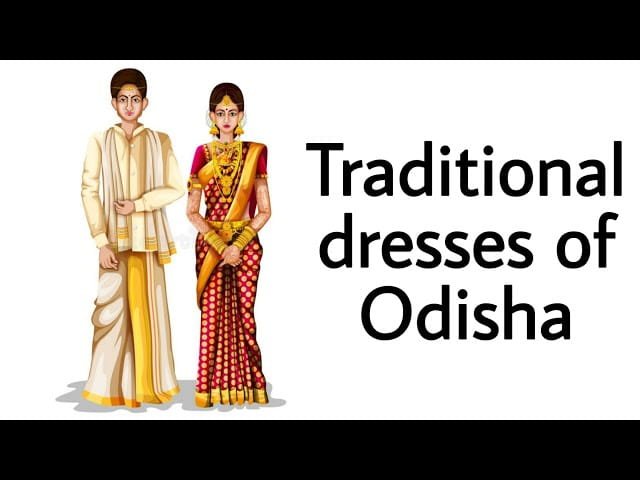
The Dhoti is the primary traditional lower garment for men in Odisha — a long piece of white or cream cotton cloth wrapped around the waist and legs in the manner universal across India’s Hindu dress traditions. What distinguishes the Odia Dhoti from other regional variants is its characteristic brick-red or maroon border — a colour combination of white cloth with deep red border that is immediately recognisable as distinctively Odia. This white-and-brick-red aesthetic is as characteristic of Odisha’s male dress as the white-and-gold Kasavu combination is of Kerala.
For everyday use, the Dhoti is plain cotton; for religious ceremonies, festivals like Rath Yatra, and important family occasions, silk Dhotis replace the cotton version. The distinction between cotton and silk Dhotis signals the formality of the occasion even more clearly than colour or design. Temple priests in Puri traditionally wear Khandua silk Dhotis — the same sacred silk fabric offered to Lord Jagannath — during temple ritual performance, in brilliant red or orange, with woven patterns that connect the wearer’s dress directly to the divine.
2. Gamucha
The Gamucha is the indispensable daily accessory of Odia men — a thin cotton towel-cloth used as a body towel, head covering in sun, neck drape for sweat absorption, and informal turban during outdoor work. In the agricultural and labouring communities of rural Odisha, the Gamucha is as essential as the Dhoti itself — a man without his Gamucha is considered incompletely dressed for outdoor work. Like the Assamese Gamosa, the Odia Gamucha has transcended its purely practical function to become a cultural symbol, its specific checked or striped patterns reflecting regional handloom weaving traditions.
3. Kurta and Sambalpuri Kurta
The traditional upper garment paired with the Dhoti is the Kurta — a long, loose cotton tunic falling to the knee. For religious ceremonies and festivals, white or cream cotton Kurtas in plain or lightly embroidered styles are preferred. The Sambalpuri Kurta — a specific style made from Sambalpuri Ikat fabric with the characteristic square motif border design of western Odisha’s weaving tradition — is worn at festivals and formal gatherings as a specifically Odia cultural garment that immediately communicates the wearer’s regional identity. The Sambalpuri Kurta’s ikat-fabric construction makes it a wearable example of Odisha’s most celebrated handloom tradition.
4. Khandua Pata — The Sacred Silk Dhoti
The Khandua Pata is the sacred silk cloth produced in Nuapatna and Maniabandha villages in the Cuttack district — the textile most directly connected to the worship of Lord Jagannath. Khandua cloth is characterised by its rich red or yellow base colour (both colours sacred in the Jagannath tradition), with verses from the Gita Govinda woven into the border in traditional Odia script — a unique feature found in no other Indian textile tradition. The Khandua is the garment in which Lord Jagannath is dressed at the Puri temple, and its use by priests and devotees at major religious functions makes it the most spiritually significant textile in Odisha’s entire dress tradition.
Traditional Dress of Odisha for Women
1. Sambalpuri Ikat Saree — The Pride of Odisha
The Sambalpuri Ikat saree — produced across the western districts of Sambalpur, Bargarh, Boudh, and Subarnapur using the Bandhakala technique — is Odisha’s most famous and most widely recognised traditional textile, celebrated nationally and internationally for the precision and beauty of its Ikat weaving. The sarees are produced in both cotton (for daily wear and working dress) and silk (for weddings and the most important festivals), and both variants share the characteristic nature-inspired motifs: the Shankha (conch shell), Chakra (wheel), Phul (flower), Rudraksha (sacred bead), and Peacock are among the most common designs woven into both the body of the saree and its borders.
The colour combination most traditionally associated with the Sambalpuri saree — red and black — carries a specific spiritual reference to Lord Jagannath’s own sacred colours, connecting the garment’s aesthetic to the deep Jagannath devotional culture that pervades all of Odisha’s traditional artistic expression. Other colour combinations are also produced, but the red-black combination remains the most characteristically Sambalpuri.
The Sambalpuri saree is both a daily garment in its cotton form and a festive and ceremonial saree in its silk form. Working women, teachers, and government employees in Odisha frequently wear cotton Sambalpuri sarees as their standard professional dress — a garment that simultaneously serves practical daily purposes and expresses cultural pride in one of Odisha’s finest achievements.
2. Khandua Silk Saree
The Khandua silk saree — produced from the same sacred silk fabric as the Khandua Pata Dhoti for men — is among the most revered traditional sarees in Odisha. Typically in red or yellow with black border and the characteristic Gita Govinda verse woven into the fabric, the Khandua saree connects its wearer directly to the Jagannath devotional tradition that has defined Odia culture since at least the 12th century CE. Brides at traditional Odia Hindu weddings frequently wear yellow Khandua silk sarees with red borders as the definitive sacred bridal garment. At major religious festivals — particularly Rath Yatra, when the Jagannath chariot procession draws millions of devotees to Puri — women wear Khandua sarees as an expression of devotion that connects their dress directly to the deity’s own sacred clothing.
3. Pasapali (Saktapar) Saree — The Chessboard Ikat
The Pasapali saree — also called Saktapar — is produced primarily in Bargarh district using the double Ikat technique, creating a striking checkerboard pattern in contrasting colours: black and white, red and black, or deep blue and white are the most characteristic combinations. The name Pasapali derives from Pasa — the traditional dice game whose board’s geometric pattern inspired the saree’s distinctive checkerboard design. This specific visual connection between a traditional game’s board pattern and a saree design is found nowhere else in Indian textile traditions, making the Pasapali a uniquely conceptually interesting garment.
The Pasapali’s double Ikat checkerboard is mathematically precise — the checks must align perfectly across both warp and weft threads — and its production requires the highest level of Ikat weaving skill. For this reason, truly authentic Pasapali sarees command premium prices and are typically reserved for the most significant family occasions, particularly weddings, where the saree’s association with prosperity and equilibrium (the balanced checkerboard) makes it particularly auspicious.
4. Bomkai (Sonepuri) Saree
The Bomkai saree — also known as Sonepuri, named after Sonepur town to which the design was historically brought from Bomkai village in Ganjam district — represents a distinct tradition from Odisha’s Ikat weaving in that it combines Ikat weaving techniques with supplementary weft embroidery, particularly in the border and pallu. The body of a Bomkai saree may contain small Ikat motifs, while the pallu is woven with highly elaborate patterns in a different thread colour, creating a contrast between the restrained body and the opulent end piece. The motifs on Bomkai sarees — fish, lotus, tortoise, birds, and geometric tribal-inspired forms — reflect the influence of Odisha’s southern tribal communities on the Ganjam region’s weaving tradition.
Bomkai sarees are produced in both silk and cotton, with the silk version (featuring softer texture and richer colour) reserved for weddings and major celebrations. Their combination of Ikat and supplementary weaving makes them among the most technically complex of Odisha’s saree traditions.
5. Berhampuri Patta Saree
Berhampur (or Brahmapur) in Ganjam district is known as the Silk City of Odisha — a weaving centre whose Patta (silk) sarees have been celebrated since at least the 14th century CE, when the Mohuri kingdom’s silk weaving tradition was first documented. The Berhampuri Patta saree is characterised by its strong silk fabric, a distinctive temple border (the kumbha pattern depicting the Odishan temple spire), and its characteristically minimal but elegant design — the saree body is typically plain or very simply patterned, with the visual interest concentrated in the border and the pallu’s temple-inspired motifs.
The Berhampuri saree’s specific silhouette — its Odissi dance associations (Odissi dance costumes frequently feature Berhampuri or Bomkai sarees with special pleats for movement) — gives it a specifically Odishan aesthetic identity that connects clothing directly to the state’s celebrated classical dance tradition.
6. Kotpad Saree — The Natural-Dyed Tribal Textile
The Kotpad saree from Kotpad town in Koraput district is one of Odisha’s most culturally distinctive tribal textiles — produced by the Mirgan weaver community using cotton handwoven on pit looms and dyed exclusively with natural dyes from the Aal plant (Indian Madder, Morinda citrifolia), producing a characteristic deep brick-red to maroon-brown colour that cannot be precisely replicated by synthetic dyes. The Kotpad saree’s visual character — its natural-dyed warm earthen reds against undyed cream cotton — immediately distinguishes it from all of Odisha’s other saree traditions, giving it an organic, earthy aesthetic that reflects the tribal forest ecology of the Koraput highlands where it is produced. Kotpad sarees received Geographical Indication protection recognising their unique origin and production method.
7. Pattachitra Saree
The Pattachitra painting tradition — Odisha’s ancient cloth-painting art form depicting mythological narratives from the Ramayana, Mahabharata, and the life of Lord Jagannath — has been applied to silk and cotton saree fabric to create wearable artworks whose painted surfaces carry the same visual vocabulary as the famous Pattachitra scroll paintings of Raghurajpur and Puri. Each Pattachitra saree is individually hand-painted by trained artists, making every saree unique. The characteristic black outline, deep mineral and vegetable colour palette, and dense narrative imagery of Pattachitra make these sarees among the most visually distinctive and most artistically significant garments in Odisha’s textile tradition.
Tribal Dress Traditions
Odisha’s tribal communities — including the Santhal, Gond, Oraon, Khond, Juang, Bonda, and Dongria Kondh among others — maintain entirely distinct dress traditions that pre-date and exist independently from the mainstream Odia saree tradition. Santhal women wear simple handwoven cotton sarees in vibrant stripes or checks, frequently without a blouse in the oldest tradition, while Santhal men wear dhotis with turbans. The Dongria Kondh women of the Niyamgiri hills wear a distinctive shawl-like draped garment called the Kapadaganda, paired with extraordinarily heavy beadwork jewellery and metal nose rings. The Bonda women of Malkangiri — one of India’s most isolated and most culturally distinct tribal communities — wear short handwoven skirts of coarse cloth called Ringa, along with heavy metal necklaces and headbands that cover the entire neck and head area with overlapping ornamental rings.
FAQs
Q1. What is Bandhakala (Ikat) and why is it significant in Odisha?
Bandhakala is Odisha’s traditional tie-and-resist thread dyeing technique, in which threads are tied in specific patterns before dyeing so that the tied sections resist colour. When woven, the dyed and undyed sections create patterns with characteristic hazy, feather-edged qualities. In double Ikat (Sambalpuri, Pasapali), both warp and weft are separately tie-dyed and aligned during weaving — a highly technical achievement.
Q2. What is the Khandua saree and why is it spiritually significant?
The Khandua is a silk Ikat saree produced in Nuapatna and Maniabandha featuring Gita Govinda verse text woven into the fabric in Odia script, in sacred red or yellow colours. It is the fabric in which Lord Jagannath is dressed at the Puri temple, and its use by devotees and brides connects the garment directly to Odisha’s deepest spiritual tradition.
Q3. How does the Pasapali saree get its name?
Pasapali is named after the traditional Odia dice game Pasa, whose checkerboard playing surface inspired the saree’s characteristic double Ikat checkerboard pattern in contrasting colours. It is produced primarily in Bargarh district.
Q4. What makes the Bomkai saree distinct from other Odia sarees?
The Bomkai saree combines Ikat weaving with supplementary weft thread embroidery in the border and pallu — a technique that creates richer, more visually elaborate borders than pure Ikat can produce. Its motifs (fish, lotus, tortoise, birds) reflect both Odia temple art and southern tribal design influences.
Q5. What is the Kotpad saree and what makes its dyeing process unique?
The Kotpad saree from Koraput district is produced by the Mirgan community using only the Aal plant (Indian Madder) for dyeing, producing a distinctive brick-red to maroon-brown that cannot be precisely replicated by synthetic dyes. It holds GI tag protection recognising its unique origin and natural-dye production method.