Maharashtra — the land of the Maratha Empire, the Peshwas, the rock-cut caves of Ajanta and Ellora, the magnificent hill forts of Shivaji, and the cosmopolitan energy of Mumbai — is a state where traditional dress carries the dual imprint of warrior heritage and artistic sophistication. The clothing traditions of Maharashtra tell the story of a society that valued physical strength and freedom of movement in its women’s dress, dignified simplicity and social pride in its men’s attire, and the highest standards of handwoven textile artistry in its ceremonial garments.
Two garments define Maharashtra’s traditional dress identity more completely than any others. The Nauvari saree — the extraordinary nine-yard dhoti-style draping that allowed Maratha women complete freedom of movement, historically essential for women who participated in farm work and even in warfare alongside their men — is the most distinctive and most culturally resonant women’s garment in the state. And the Paithani saree — the handwoven silk masterpiece from the ancient town of Paithan in Aurangabad, with its characteristic oblique border, magnificent peacock-motif pallu, and centuries of royal patronage — is the most celebrated and most internationally recognised textile from Maharashtra’s remarkable craft tradition. These two sarees together define Maharashtrian womanhood in dress.
Quick Comparison Table
| Garment | Worn By | Fabric | Occasion |
| Dhoti (Dhotar) | Men | Cotton, Silk | Daily, Religious, Festivals |
| Kurta | Men | Cotton, Silk | Daily, Festivals |
| Pheta (Turban) | Men | Cotton, Silk | Weddings, Festivals, Ceremonies |
| Bandi / Sadara (Waistcoat) | Men | Cotton, Silk | Festivals, Formal |
| Sherwani / Achkan | Men | Silk, Brocade | Weddings |
| Nauvari Saree (Kashta / Lugade) | Women | Cotton, Silk | Daily (rural), Festivals, Weddings |
| Paithani Saree | Women | Silk with Zari | Weddings, Major Festivals |
| Choli (Blouse) | Women | Cotton, Silk | Worn with Saree |
| Himroo / Mashru Fabric | Women | Silk-Cotton blend | Festivals (Aurangabad region) |
| Ghagra Choli | Women | Cotton, Silk | Tribal, Rural Festivals |
Maharashtra’s Textile Heritage — The Paithani and Beyond
Before describing the garments individually, understanding Maharashtra’s most celebrated textile contribution is essential. The Paithani saree originates from Paithan (ancient Pratishthan), the capital of the Satavahana Empire on the banks of the Godavari river in what is today Aurangabad district. Paithani weaving dates back over two thousand years to the Satavahana period, making it one of India’s oldest documented luxury textile traditions. The saree is characterised by its pure silk fabric with real gold or silver zari work, its distinctive oblique interlocking border design, and most spectacularly its broad pallu — typically eighteen to twenty-five inches wide — featuring peacocks with spread tails, lotus flowers, and traditional Maharashtrian motifs in colours of extraordinary richness and jewel-like intensity.
The Paithani’s weaving process is extraordinarily labour-intensive. Each saree is woven on traditional pit looms using a technique where the pallu’s multicoloured motifs are created by individually inserting coloured silk and zari threads into specific warp positions — a process that requires experienced artisans working continuously for weeks to months. The saree received Geographical Indication protection, confirming its origin in the Paithan and Yeola centres of Maharashtra.
Aurangabad also produces two other distinctive traditional fabrics. Himroo is a luxurious silk-cotton blend whose name derives from the Persian word for “silk” (Hirim) and which was originally created as a more accessible alternative to the costly pure silk brocades of the Mughal court. Mashru is a shiny satin-weave fabric combining silk and cotton that produces a surface resembling silk while maintaining cotton’s breathability — making it practical for the warm Maharashtra climate while appearing ceremonially opulent.
Traditional Dress of Maharashtra for Men
1. Dhoti (Dhotar)
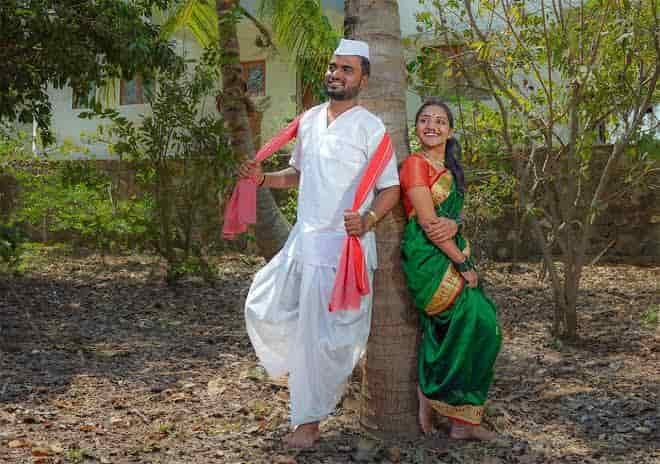
The Dhoti — called Dhotar in Marathi — is the primary traditional lower garment for men across Maharashtra, a single piece of white or cream cotton cloth wrapped around the waist and legs in five characteristic tucks on each side, then pulled through between the legs to create a trouser-like bifurcated arrangement that allows complete freedom of movement. This specific Maharashtrian dhoti draping style — with its characteristic double-tuck system — distinguishes it immediately from the dhoti draping conventions of other Indian states and reflects the state’s historically active, physically engaged male lifestyle.
White and cream are the most traditional colours for daily and religious wear, though saffron, cream, and vibrant colours appear at festivals. Silk dhotis are worn for weddings and the most formal occasions, while cotton serves for daily life and general festivals. In rural Maharashtra, elderly men continue wearing the Dhotar as their daily dress, paired with a simple white kurta.
2. Kurta
The Kurta paired with the Dhotar is the traditional upper garment of Maharashtrian men — a loose, long-sleeved cotton tunic falling to the knee. For daily use in villages and agricultural communities, the Kurta is plain white or cream cotton. For festivals and important social occasions, the Kurta may be embroidered at the collar, cuffs, and placket, or made from silk in richer colours that complement the Dhotar’s formal appearance.
3. Pheta — The Maharashtrian Turban
The Pheta is the traditional male headgear of Maharashtra and one of the most culturally charged elements of Maharashtrian male dress — a long piece of cloth wound around the head in a specific manner that varies distinctively by region, community, and occasion. The Pheta is not merely decorative; it carries profound symbolic weight as a marker of pride, honour, social standing, and respect. Presenting a Pheta to a guest or dignitary is one of Maharashtra’s highest forms of social honour, equivalent to the Karnataka Mysore Peta tradition.
Different cities and regions of Maharashtra have developed their own characteristic Pheta styles that are immediately identifiable to locals. The Puneri Pheta of Pune is tied in a flat, fan-shaped style at the front with the cloth spread wide to create a broad fan of fabric — dignified, slightly formal, and associated with the Maratha aristocratic tradition of Pune. The Kolhapuri Pheta of Kolhapur is more tightly wound and differently shaped. The style varies again in Nashik, Aurangabad, and Vidarbha. All Phetas are tied with expertise that is passed through families, and many men who are not regular Pheta wearers have the turban tied by their fathers or community elders at weddings and major ceremonies.
Bright colours are characteristic of Maharashtrian Phetas — saffron, deep red, vibrant yellow, and orange are particularly associated with festival contexts, while white or cream turbans appear in some formal and religious settings.
4. Bandi and Sadara — Traditional Jacket
The Bandi is a sleeveless waistcoat worn over the Kurta as a semi-formal addition to the traditional male ensemble, adding both warmth and visual formality to the Dhotar-Kurta combination. The Sadara is a similar traditional jacket, sleeveless and made from richer fabrics like silk or brocade for festival contexts. Together, these jacket-style garments complete the Maharashtrian male festive look — Dhotar, Kurta, Bandi or Sadara, and Pheta — that is the definitive visual expression of Maharashtrian male cultural identity at weddings, festivals like Ganesh Chaturthi and Gudi Padwa, and important religious ceremonies.
5. Sherwani and Achkan — Wedding Attire
For weddings and the most formal social occasions, Maharashtrian grooms and their families wear Sherwanis or the Achkan — long, elegant coat-like garments worn over the Kurta and Pyjama or Dhotar. Maharashtrian wedding Sherwanis are typically in silk, brocade, or embroidered fabric in rich cream, ivory, or saffron, complemented by the Pheta in a colour and style that reflects the groom’s regional tradition. The Mundavalya — a string of pearls or flowers tied across the forehead — is worn by both bride and groom at traditional Maharashtrian weddings and is one of the state’s most distinctive wedding adornments.
Traditional Dress of Maharashtra for Women
1. Nauvari Saree (Kashta / Lugade)
The Nauvari saree — Nauvari meaning “nine yards” in Marathi, also called Kashta saree or Lugade — is the most iconic, most historically significant, and most culturally resonant traditional garment of Maharashtrian women. Unlike the standard six-yard saree worn across most of India, the Nauvari is nine yards long and is draped in a completely different manner — tucked in the dhoti style that creates a bifurcated arrangement between the legs rather than leaving the garment as a single flowing wrap. The lower portion of the Nauvari is pulled through between the legs and tucked at the back, creating what is essentially a trouser-like configuration that allows completely unrestricted movement of both legs.
This freedom of movement was not merely an aesthetic choice but a historical necessity. Maharashtrian women of the Maratha warrior communities participated actively in agricultural work, household management, and historically even in military support roles — activities that require physical agility impossible in a flowing six-yard saree. The Nauvari’s dhoti-style draping solved this practical requirement while maintaining the full dignity and elegance of a traditional saree. The pallu is draped over the shoulder and sometimes brought across the head for modesty during religious occasions.
The Nauvari is worn without a petticoat underskirt — another practical design feature that reduces the heat and weight of the garment in Maharashtra’s warm climate. The draping is maintained by skill and the cloth’s natural weight rather than by the petticoat that most sarees rely on for structural support. Wearing the Nauvari well requires practice and technique that most Maharashtrian women learn from mothers and grandmothers.
In rural Maharashtra, particularly in Konkan and among Maratha communities, the Nauvari remains daily wear. In urban contexts, it appears at festivals, cultural performances like Lavani dance — where the Nauvari’s freedom of movement is essential for the vigorous dance steps — and at weddings and family ceremonies where women wear silk Nauvaris with full traditional jewellery to express their cultural heritage with pride.
2. Paithani Saree
The Paithani saree is Maharashtra’s supreme ceremonial garment and the definitive choice for the most important occasions in a woman’s life — weddings, major festivals, and significant family celebrations. Among Maharashtrian families, a fine Paithani saree is often considered the most important investment in a woman’s trousseau, and these sarees are frequently kept for decades and passed from mothers to daughters as family heirlooms whose value increases with age.
The Paithani’s visual character is defined by three elements. The border — woven in an oblique interlocking manner that creates an angled line of geometric or floral design along the saree’s edge — appears unlike any other Indian saree border. The pallu — typically eighteen to twenty-five inches of dense, multicoloured peacock, lotus, and floral motifs worked entirely in pure silk and zari thread — is the most elaborate and most costly element of the weaving. And the body — typically in a single rich colour (deep wine, royal blue, vibrant green, golden yellow, or rich purple are characteristic Paithani colours) with tiny intricate woven motifs scattered across it.
The Paithani is produced in two primary centres: Paithan in Aurangabad district (the original historic centre) and Yeola in Nashik district (which has become the larger contemporary production centre). Authentic Paithani production involves multiple skilled weavers working simultaneously on a single saree, with the process taking weeks to months depending on the complexity of the design.
3. Choli (Blouse)
The traditional Choli worn with the Nauvari or Paithani saree in Maharashtra is a fitted blouse typically in a contrasting colour to the saree, sometimes matching the saree’s border colour. For the Nauvari, traditional Cholis are short-sleeved and simply cut, practical for the active movements the saree’s draping style enables. For the Paithani at weddings and festivals, the Choli becomes more elaborate — embroidered, made from matching silk, or decorated with zari — contributing to the complete bridal ensemble.
4. Himroo and Mashru Fabric Garments
Women in the Aurangabad and Marathwada regions also wear sarees and shawls made from Himroo and Mashru fabric — the distinctive silk-cotton blend textiles that carry the legacy of Aurangabad’s Mughal-period weaving heritage. Himroo shawls and sarees are characterised by their rich, warm texture and elaborate woven patterns that include geometric, floral, and Mughal-inspired motifs worked in the supplementary weft technique, while Mashru’s satin weave surface gives it a distinctive visual lustre.
Wedding Dress Tradition
At a traditional Maharashtrian Hindu wedding, the bride wears either a Paithani saree or a richly embroidered silk Nauvari in the colours that her family tradition favours. The most characteristic bridal colour combination in Maharashtra is green-and-gold or the Paithani’s purple-and-gold or red-and-gold. Her jewellery includes the Nath (a distinctive large nose ring, often in a paisley or crescent shape set with pearls and gemstones that is one of Maharashtra’s most recognisable traditional ornaments), the Kolhapuri Saaj (a traditional multi-pendant gold necklace from Kolhapur), the Mangalsutra (tied by the groom at the ceremony as the formal mark of marriage), green glass bangles (the characteristic Maharashtrian married woman’s bracelet), and the Mundavalya (forehead flower-string). The groom wears a silk Dhotar with a Kurta and Pheta or a Sherwani with a Pheta, completing the Maharashtrian wedding with the Mundavalya tied across his own forehead as well.
Kolhapuri Chappals — Traditional Footwear
No discussion of Maharashtra’s traditional dress is complete without the Kolhapuri Chappal — the handcrafted leather sandal produced in Kolhapur whose history extends to the 13th century CE. Open-toed, T-strap leather sandals worked with intricate tooled designs and coloured with vegetable dyes, Kolhapuri Chappals are among the most internationally recognised Indian handicraft footwear items and have received GI tag protection. Their durability, craftsmanship, and distinctive aesthetic make them suitable for both traditional and contemporary wear.
FAQs
Q1. What makes the Nauvari saree unique compared to other Indian sarees?
The Nauvari is nine yards long rather than the standard six yards, and is draped in a dhoti-style manner with the cloth pulled between the legs and tucked at the back — creating a trouser-like configuration that allows complete freedom of movement. It is worn without a petticoat underskirt.
Q2. What is the Paithani saree and why is it special?
The Paithani is a handwoven silk saree from Paithan (Aurangabad) with over two thousand years of history. It is characterised by a pure silk body with zari work, an oblique interlocking border, and a broad pallu woven with peacock and floral motifs in multiple coloured silk and gold threads. Each saree takes weeks to months to weave and is often kept as a family heirloom.
Q3. What is the Pheta and what makes different regional styles distinct?
The Pheta is Maharashtra’s traditional male turban wound around the head in styles that vary by region — the Puneri Pheta has a distinctive flat fan shape, while Kolhapuri and Nashik styles differ. Presenting a Pheta to a distinguished guest is one of Maharashtra’s highest social honours.
Q4. What jewellery completes the traditional Maharashtrian woman’s bridal look?
The Nath (large pearl-set nose ring), Kolhapuri Saaj (traditional gold necklace), Mangalsutra, green glass bangles (characteristic of married Maharashtrian Hindu women), and Mundavalya (forehead flower-string) together form the traditional Maharashtrian bridal jewellery ensemble.
Q5. What is Himroo fabric and where does it come from?
Himroo is a silk-cotton blend fabric from Aurangabad with origins in the Mughal-period weaving tradition of the Deccan. Its name derives from the Persian word for silk, and it was originally created as an accessible alternative to pure silk brocades. It features elaborate woven patterns and is used for sarees and shawls.