Nagaland — the Land of Festivals, a state of extraordinary biodiversity tucked into the northeastern hills of India bordering Myanmar — is home to sixteen major indigenous tribes, each maintaining a completely distinct language, cultural tradition, and clothing system. What unites all sixteen tribes’ dress traditions under the category of “Naga traditional dress” is not shared garment forms but a shared philosophy: that clothing is the primary visible language of identity, that what you wear communicates precisely who you are, what you have done, and what status you hold within your community. In Naga culture, a garment is never merely covering — it is a credential.
The Naga shawl is the most internationally famous expression of this philosophy — a handwoven cloth whose specific colour combination, pattern, and motifs function as an identity card readable by any Naga who knows the tribal codes. The right to wear a specific shawl pattern was historically earned, not assumed. Warriors who had demonstrated courage in battle wore shawls with specific motifs — human heads (attesting to headhunting accomplishment in historical practice), tigers, and elephants — that men of lesser achievement were not permitted to wear. Men who had organised specific community feasts earned the right to progressively more elaborate shawl patterns. Women who had mastered weaving to specific levels wore blouses and skirts of specific designs. This system of dress-as-credential was enforced by social custom rather than law, but its force was absolute — violating clothing norms was considered a grave social offence.
Nagaland’s major tribes — the Angami, Ao, Konyak, Lotha, Sumi (Sema), Chakhesang, Chang, Sangtam, Phom, Yimchunger, Pochury, Rengma, Khiamniungan, Zeliang, Kuki, and Kachari — each have their own complete and internally complex dress traditions, and doing full justice to all sixteen would require a book-length treatment. This article describes the major shared elements and highlights the most distinctive traditions of the largest tribes.
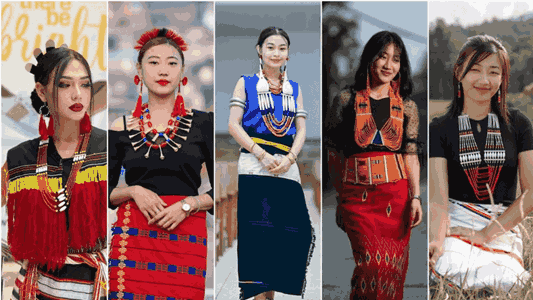
Quick Comparison Table
| Garment / Element | Tribe | Worn By | Significance |
| Tsungkotepsu Shawl | Ao | Men (warriors) | Elephant, tiger, human-head motifs — bravery |
| Alungstu | Ao | Men | Sleeveless blue/black — prosperity |
| Rhikho Shawl | Various | Men (non-warriors) | White with 4 black bands — basic status |
| Lungpensu Shawl | Lotha | Men (feast-givers) | Dark blue, 5 light blue stripes |
| Phangrhup → Ethasu | Lotha | Men (progressive feasts) | Progressive shawl system |
| Angami Warrior Shawl | Angami | Men (warriors) | Black, bold embroidered animal motifs |
| Lohe Shawl | Angami | Men | Red and yellow bands |
| Phichu-pfe | Angami | Priests | Priest’s exclusive garment |
| Ratapfe Shawl | Chang | Men | Black, daily wear |
| Akemhei Shawl | Sumi | Men | Status and achievement marker |
| Rongkhim Shawl | Yimchunger | Warriors | Red-black with grey bands |
| Konyak Warrior Ensemble | Konyak | Men | Brass ornaments, hornbill headgear |
| Neikhro | Ao, Angami Women | Women | Petticoat-like undergarment |
| Azu Jangnup Su | Ao | Women | Red, black, yellow striped skirt |
| Mechala | All Women | Women | Draped cloth over skirt and shawl |
| Angami Women’s Skirt | Angami | Women | Blue and white, black marginal bands |
| Vatchi | Angami | Women | Sleeveless upper top |
| Neikhro + Pfemhou | Angami | Women | Petticoat + white skirt ensemble |
| Moyer Tusk | Women | Women | Dark blue, zigzag pattern |
| Mekhela | All Women | Women | Wraparound skirt, tribal-specific |
The Naga Shawl — The Universal Tribal Identity Marker
The Naga shawl is the single most important and most internationally celebrated garment type in all of Nagaland’s dress traditions. It serves a function unlike any other Indian textile — not merely as a garment for warmth or modesty, but as the primary communication system through which a Naga man declares his tribal identity, his social status, his personal achievements, and his standing within the community’s warrior and social hierarchy. Every Naga from any of the sixteen tribes can, in principle, identify a fellow Naga’s specific tribe by looking at the colour combinations and patterns on their shawl. And within each tribe, community members can read the further information about the shawl’s wearer encoded in the specific design variants.
The Naga shawl is woven on narrow loin looms from cotton with a rayon weft, and decorated with woven figures that include elephants, tigers, roosters, circles representing human heads (in pre-headhunting-era symbolic language), and geometric patterns. The primary colour palette across most tribes is red, black, and white, though the specific proportions and arrangements vary enormously between tribes. Cowrie shells are sewn onto many warrior-status shawls and kilts — their attachment to a garment historically required to be done by the man himself, no one else being permitted to perform this act.
Traditional Dress of Nagaland for Men
The Major Shawl Traditions by Tribe
Ao Tribe — Tsungkotepsu and Alungstu: The Ao tribe of Mokokchung district produces two of Nagaland’s most celebrated named shawls. The Tsungkotepsu is the warrior’s shawl — black and red with woven figures of elephants, tigers, and spears that declare the wearer’s bravery, physical strength, and accomplishment in battle. The elephant symbolises strength, the tiger represents ferocity, and the historically woven human-head motifs attested to headhunting accomplishment. Only a man who had proven himself in battle could legitimately wear the Tsungkotepsu. The Alungstu is a sleeveless black or dark blue cotton garment worn as a status symbol of prosperity among Ao men who have achieved social standing through wealth and community generosity rather than warrior accomplishment — a parallel status system to the warrior shawl tradition.
Lotha Tribe — The Progressive Feast Shawl System: The Lotha tribe of Wokha district maintains one of Nagaland’s most sophisticated textile-status systems, in which a man’s shawl design directly records the number and scale of community feasts he has organised. The first feast earns the right to wear the Phangrhup — a basic shawl with a narrow stripe. As successive feasts are organised and completed, the stripe on the shawl broadens — the Ethasu follows the second genna, and eventually the successful man who has organised stone-dragging ceremonies earns the right to wear the Lungpensu: a dark blue cloth with five stripes of light blue and thin marginal stripes on either side. A man’s shawl in the Lotha tradition is thus literally a textile CV of his social achievements, readable by any Lotha community member.
Angami Tribe — Warriors and Priests: The Angami tribe of the Kohima area maintains a warrior shawl tradition in which a bold black cloth with thick embroidered animal motifs is worn specifically by warriors. The Lohe is a further Angami shawl with red and yellow bands whose specific symbols tell the story of the wearer’s victories. The Angami priestly garment — the Phichu-pfe — is exclusively worn by Angami priests and represents the only Angami garment whose social restriction is based on religious role rather than warrior achievement.
Sumi Tribe — Akemhei: The Sumi (Sema) tribe of Zunheboto district produces the Akemhei shawl — a garment characterised by vibrant, bold red and black stripes that denote its wearer’s status and achievements within the Sumi community. Related Sumi shawls include the Tsungkotepsu (shared naming with the Ao’s similar shawl type) whose depictions of elephants, tigers, and human heads signal the affluence and warrior accomplishment of the owner.
Yimchunger Tribe — Rongkhim: The Yimchunger tribe produces the Rongkhim — a red and black shawl with narrow grey bands at the two edges, worn only by warriors of recognised standing. It is described as one of the most beautiful shawls of the entire Naga shawl tradition.
Chang Tribe — Ratapfe: Chang men’s everyday shawl is the Ratapfe — a black shawl designed for daily wear and durability, reflecting the practical ethos of the Chang’s dress tradition for ordinary occasions.
Konyak Tribe — The Warrior Ensemble: The Konyak tribe of Mon district are among Nagaland’s most culturally distinctive people — historically the most ferocious warriors among the Nagas, known for their facial tattoos (awarded for accomplishments in war) and their extraordinary brass ornament ensemble. Konyak men at cultural events wear heavy brass ornaments on the chest, earrings made from animal bones and shells, and spectacular headgear featuring hornbill beaks and feathers, boar tusks, and bear fur. Their shawls are marked with distinctive red, black, and white patterns. The Konyak warrior’s complete ceremonial ensemble — including facial tattoos, brass chest ornaments, hornbill headgear, and warrior shawl — is among the most visually striking in all of India’s tribal cultural traditions.
The Kilt and Loincloth
Below the shawl, Naga men traditionally wear a kilt — typically black in colour and embroidered with cowrie shells. The cowrie shells sewn onto the kilt are a symbol of success in both love and war, and as noted above, the attachment of shells to a garment must be performed by the wearer himself. The Rhikho is the most basic male cloth — a white cloth with four black bands worn by men who have not yet achieved warrior or feast-organiser status — the minimal male garment that signals a man who is still accumulating the social achievements that would entitle him to more elaborate dress. The Alungstu and the Moyer Tusk (a dark blue cloth with zigzag patterns at the edge) represent additional variants of the male working and daily dress.
Headgear and Accessories
Naga men’s headgear is among the most spectacular in the world’s tribal dress traditions. Traditional headpieces incorporate materials whose cultural significance is precise: hornbill beaks and feathers (the hornbill being a protected species specifically because of its cultural importance to the Naga), boar tusks, bear fur, beads, and bamboo framework. Each element has a specific symbolic meaning within the specific tribe’s tradition — hornbill feathers among some tribes are specifically rewards for brave acts, while among others they signify a man’s overall social achievement. These headpieces appear primarily at the Hornbill Festival (Nagaland’s annual showcase of all sixteen tribes’ traditions) and at each tribe’s specific major festivals.
Traditional Dress of Nagaland for Women
1. Mekhela — The Wraparound Skirt
The primary female garment across all Naga tribes is the Mekhela — a wraparound skirt worn from the waist downward, equivalent in structure to the Manipuri Phanek and the Assamese Mekhela but with tribe-specific colours, patterns, and dimensions. Naga women’s Mekhela designs are among the most varied and most visually complex traditional skirts in the northeast, with each tribe’s version featuring specific colour combinations, stripe arrangements, and woven motifs that identify community membership. The Ao women’s skirts, for example, include the Azu Jangnup Su (mostly red and black stripes with yellow in the black stripes), the Ngami Su (fish-tail skirt), and the Yongzujangau (cucumber seed pattern woven in red on black) — specific named variants whose visual differences communicate immediately to Ao community members.
Angami women traditionally wear a skirt of blue and white cloth with thick black bands at the margins — the band widths varying and the specific arrangement varying between clans and villages within the Angami community. The underlying principle is consistent across tribes: within each tribal system, the specific design of a woman’s skirt communicates her community membership, clan affiliation, and in some traditions her social status.
2. The Angami Women’s Full Dress System
Angami women’s traditional dress is one of the most completely documented of all Naga women’s dress systems. The casual daily ensemble includes three elements: the Neikhro (a petticoat-like undergarment), the Vatchi (a sleeveless top), and the Pfemhou (a white outer skirt). The Neikhro is described as a petticoat-like undergarment in design — not visible in its entirety but providing the structural underpinning for the skirt layer above. The Vatchi covers the upper body without sleeves. The Pfemhou is the white outer skirt that covers the lower body, and the Mechala is draped over and around the skirt and shoulder, adding the shawl layer to complete the ensemble.
3. Mechala — The Shoulder Drape
The Mechala (also spelled Mechela) is a draped cloth worn by Naga women of multiple tribes, typically arranged around the skirt and draped over the shoulder to complete the traditional women’s ensemble. It adds the shawl layer to the women’s dress in a manner analogous to the male shawl’s function, and like the male shawl, the specific Mechala design varies by tribe and communicates community identity.
4. Neikhro — The Petticoat-Style Undergarment
The Neikhro worn by Ao and Angami women is described as a petticoat-type undergarment, providing both modesty and structural support for the outer skirt layers. It is notable for its distinctive combination of colours and patterns that reflect the wearer’s tribal clan or phratry affiliation — making even the innermost layer of women’s dress a community identity statement.
5. Moyer Tusk — The Dark Blue Cloth
The Moyer Tusk is a dark blue cloth with zigzag patterns at the edge — available to both men and women but often worn by women as part of the layered ensemble. Its deep blue colour and the restraint of its single zigzag border pattern make it a garment of quiet dignity rather than the bold visual declaration of warrior shawls or festival dress.
Jewellery and Accessories
Naga women’s jewellery is among the most elaborate and most culturally loaded in all of India’s tribal traditions. Large, multi-layered bead necklaces in specific bead types and arrangements communicate tribal membership, marital status, and social standing. Cowrie shells appear in both jewellery and as garment embellishment. Brass and bronze ornaments — particularly among the Konyak women — create heavy, sculptural jewellery ensembles. Head ornaments incorporate animal bones, shells, and plant materials. The totality of a Naga woman’s jewellery ensemble at a major festival, combined with her tribe-specific dress, constitutes the most complete expression of cultural identity available in visual form.
FAQs
Q1. Why are Naga shawls considered much more than ordinary garments?
Naga shawls function as the primary communication system for tribal identity, social status, and personal achievement. The specific colour combinations, patterns, and motifs of each shawl identify the wearer’s tribe and communicate their specific status achievements — warrior accomplishments, feast-organising history, or social standing. Wearing a shawl pattern one has not earned through the appropriate social achievement was historically a grave social offence.
Q2. How do the Lotha tribe’s shawls record a man’s social achievements?
The Lotha tribe’s progressive shawl system assigns increasingly elaborate shawl designs to men who have organised successively more significant community feasts. Each feast earned gives the man the right to a progressively broader stripe on his shawl — from the narrow Phangrhup to the Ethasu to the Lungpensu — making the shawl a literal textile record of the wearer’s generosity and community leadership.
Q3. What is the Hornbill Festival and why is it significant for Nagaland’s traditional dress?
The Hornbill Festival, held annually in Kohima at the Kisama Heritage Village in December, brings all sixteen Naga tribes together for a week of cultural performances where each tribe displays their traditional dress, dance, music, and crafts. It is the single most comprehensive showcase of Naga traditional dress traditions accessible to visitors, where the full ceremonial dress of each tribe — including warrior headgear, tribe-specific shawls, and elaborate jewellery — is displayed simultaneously.
Q4. What is the significance of cowrie shells in Naga traditional dress?
Cowrie shells sewn onto kilts and shawls symbolise success in love and war. The attachment of shells to a garment must be performed by the wearer himself — no one else is permitted to do it — making the shell-decorated garment a personal achievement marker that the wearer has literally constructed with his own hands.
Q5. How does the Konyak tribe’s traditional dress differ from other Naga tribes?
The Konyak tribe of Mon district is distinguished by its use of facial tattoos (earned for war accomplishments), heavy brass chest ornaments, earrings from animal bones and shells, and spectacular hornbill-feather-and-boar-tusk headgear. Their ceremonial warrior ensemble is among the most visually dramatic in all of Nagaland’s tribal traditions.