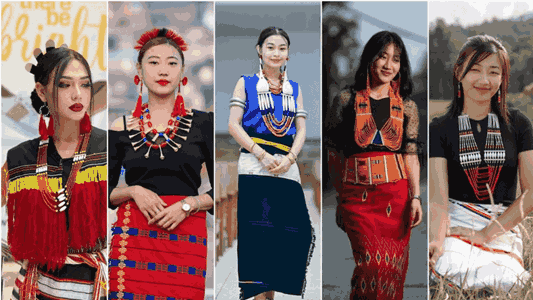
Uttarakhand — Devbhoomi, the Land of Gods, a state of Himalayan pilgrimage routes and high-altitude meadows, ancient temples at Kedarnath and Badrinath, the source of the Ganga at Gangotri and the Yamuna at Yamunotri, deep valley forests, and a population of extraordinary cultural resilience — is a state where traditional dress was shaped by the mountain itself. The altitude, the climate, the terrain, and the specific conditions of pahadi (mountain) life created clothing needs radically different from the plains below: wool for warmth in the high reaches, cotton and lighter fabrics in the valleys, layering systems for shifting Himalayan weather, and the specific social markers that identify whether a person is Garhwali, Kumaoni, Jaunsari, Bhotia, or Rajji. Two distinct but closely related cultural traditions — the Garhwali of the western hills and the Kumaoni of the eastern hills — form the main trunk of Uttarakhand’s dress tradition, with several tribal communities creating their own very different branches.
The most immediately striking observation about Uttarakhand’s traditional dress system is how fundamentally it is shaped by altitude and season. The same community might dress in light cotton in the valley summer and heavy handwoven wool in the upper village winter. The Bhotia community of the highest altitudes — who historically migrated seasonally between their high-altitude summer pastures and lower-altitude winter quarters — wove their own woollen garments from yak and sheep wool, creating clothes whose primary purpose was survival against temperatures that could kill unprotected human beings. Their dress is functionally and aesthetically entirely different from the cotton and silk garments of the valleys below.
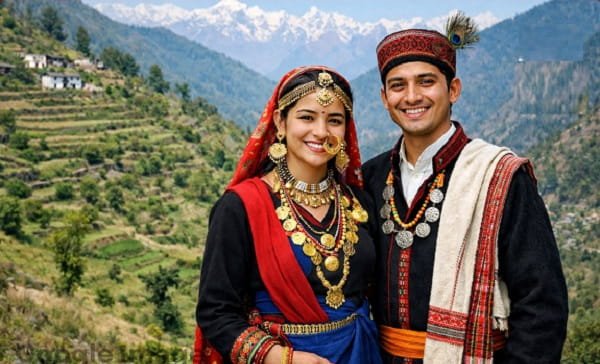
Dress of Uttarakhand Quick Comparison Table
| Garment | Community / Region | Worn By | Occasion |
| Dhoti-Kurta | Garhwali, Kumaoni | Men | Daily (rural), Religious |
| Kurta-Pajama | Both regions | Men | Daily, Festivals |
| Yellow Kurta-Dhoti | Garhwali, Kumaoni | Men (grooms) | Weddings |
| Pagdi / Topi | Both regions | Men | Formal, Festivals |
| Woollen Jacket / Sweater | Both regions | Men | Winter |
| Digwa (woollen cap) | Jaunsari | Men | Daily |
| Ghagra-Choli | Both regions | Women | Daily, Festivals |
| Pichora / Rangwali | Kumaoni | Women | Weddings, Ceremonies |
| Odhni / Orni | Both regions | Women | Daily, Ceremonies |
| Angra / Jhoga (long blouse) | Garhwali | Women | Daily, Festival |
| Ghagra Pichora | Kumaoni | Women | Weddings |
| Woollen coat / Lohia | Jaunsari | Women (Jaunsari) | Winter, Festivals |
Garhwali and Kumaoni — Two Hills, One Dress Ethos
The Garhwal division covers the western districts of Uttarakhand — Dehradun, Haridwar, Pauri, Chamoli, Rudraprayag, Tehri, and Uttarkashi — while the Kumaon division covers the eastern districts — Nainital, Almora, Pithoragarh, Bageshwar, Champawat, and Udham Singh Nagar. The two regions speak different dialects, maintain some distinct cultural practices, and have subtle differences in their dress traditions — yet visitors from outside are often unable to distinguish between Garhwali and Kumaoni attire without insider knowledge. The mountain life that shaped both communities imposed similar requirements and similar solutions, creating a family resemblance that underlies the regional distinctions.
One difference that does consistently surface: Kumaoni men are more likely to wear traditional jewellery — necklaces, earrings, and kadas (thick bangles) — than Garhwali men, who tend toward simpler, less adorned dress. Kumaoni women’s wedding dress is distinguished by the Pichora — a sacred cloth specific to the Kumaon tradition — while Garhwali weddings have their own specific textile conventions.
Traditional Dress of Uttarakhand for Men
1. Dhoti-Kurta
The Dhoti-Kurta remains the standard traditional dress of Uttarakhand’s pahadi men at religious ceremonies, temple visits, and important family occasions — a cotton dhoti wrapped at the waist and legs, paired with a white or plain-coloured cotton kurta. In the pahadi context, the dhoti is sometimes worn slightly shorter than in the plains, practical for movement on mountain terrain. The combination of cotton dhoti and kurta is also the standard dress for men performing agricultural work in warmer valley communities, where the dhoti’s ventilation is a practical advantage.
2. Kurta-Pajama
The Kurta-Pajama is the most universally adopted daily dress for men across both Garhwal and Kumaon — comfortable for the constant walking on mountain paths that pahadi life requires, practical in both warm and cool weather (the pajama’s loose fit allows movement, and layering with a woollen jacket provides cold-weather protection), and dignified enough for most social occasions. In the Garhwal region, men wear Kurta-Pajama or Kurta-Churidar depending on age and personal preference. Older men lean toward pagdi (turban) with the kurta-pajama; younger men wear topis (caps), often the white cotton pahadi topi that is a signature Uttarakhand accessory.
3. Yellow Kurta and Dhoti — The Wedding Groom’s Dress
The most distinctively Uttarakhand element of men’s traditional dress is the yellow Kurta-Dhoti worn by grooms at traditional Garhwali and Kumaoni weddings. Yellow is the most auspicious colour in the Pahadi Hindu tradition — associated with turmeric, with the sun, with prosperity — and the groom’s yellow kurta and dhoti at a traditional mountain wedding is one of the most visually immediate signals of regional cultural specificity. This yellow-wedding convention is shared across both Garhwali and Kumaoni communities and distinguishes Uttarakhand’s bridal dress conventions from the predominantly red or cream traditions of UP and Rajasthan.
4. Pagdi and Topi
Head coverings are an essential element of traditional male dress in Uttarakhand. The Pagdi — a turban wound from a long cloth — is worn primarily by older men for formal and religious occasions, communicating seniority and the occasion’s gravity. The white round cotton topi (cap), by contrast, is the everyday head covering of younger men and is practically universal in rural Uttarakhand as protection against the mountain sun and, in higher altitudes, as a modest barrier against cold. The Pahadi topi has become a cultural symbol of Uttarakhand identity nationally, worn proudly by migrants from the state living in Delhi, Mumbai, and other cities as a visible declaration of their mountain heritage.
5. Woollen Jackets, Sweaters, and Winter Wear
In higher altitude communities and during the long Uttarakhand winter (October to March), traditional dress inevitably incorporates wool. Handknitted or handwoven woollen jackets, sweaters, and waistcoats are layered over the standard kurta-pajama ensemble, with the specific wool garments — produced from locally reared sheep and goats in many communities — being the practical expression of the mountain environment’s demands. The Bhotia communities of the highest altitude districts (particularly the Niti and Mana valleys of Chamoli district) weave extraordinarily fine wool from their own herds into blankets, shawls, and garments of a quality that has made “Bhotia wool” a mark of excellence in the regional craft market.
Jaunsari Men’s Traditional Dress
The Jaunsari community of Jaunsar-Bawar in the Chakrata tehsil of Dehradun district claim descent from the Pandavas of the Mahabharata and maintain a significantly distinct cultural tradition from their Garhwali neighbours. Jaunsari men wear bold jewellery — earrings, kadas, and necklaces — that would be unusual in mainstream Garhwali or Kumaoni male dress. Their traditional head covering is the Digwa — a distinctive woollen cap specific to the Jaunsari community. For festivals, Jaunsari men wear a long woollen coat called Thalka or Lohiya, which along with their colourful jewellery and the Digwa creates an ensemble immediately identifiable as Jaunsari in the broader Uttarakhand context.
Traditional Dress of Uttarakhand for Women
1. Ghagra-Choli — The Core Ensemble
The Ghagra-Choli is the primary traditional dress of women across both Garhwal and Kumaon — a long, flared skirt (Ghagra or Ghagri) falling to the ankle, worn with a fitted blouse (Choli) and complemented by the Odhni or Orni (a head-covering cloth or dupatta). The Garhwali Ghagra is distinguished by specific construction details — traditional Garhwali ghagras made by Auji and Bajgi tribal weavers have many creases (over sixty in the traditional nine-piece version, which stands five feet tall when fully constructed), with a specific border at the bottom called the Lavaan. The Kumaoni Ghagra has its own construction conventions, and blue and pink are the preferred wedding colours in Kumaon while bolder or more austere choices appear in Garhwal.
In the warmer valley communities, the Ghagra is made from cotton; in higher altitude communities and during winter, wool Ghagras replace cotton. The Rajput women of the Garhwal hills wear light woollen Angoras (fitted upper garments) with cotton Pagras (head coverings) and colourful Lehengas through most months of the year.
2. Pichora (Rangwali Pichora) — The Sacred Kumaoni Wedding Cloth
The Pichora — also called Rangwali Pichora or Pinchhauda — is the most culturally specific and most emotionally significant garment in the Kumaoni women’s dress tradition. A dupatta-like cloth traditionally handprinted using natural dyes in yellow, red, or saffron tones, decorated with silver or gold lace, gota work, or embroidery along its borders, the Pichora is the sacred cloth worn by Kumaoni women at their wedding ceremony and at the most important religious occasions of married life. Traditionally, the Pichora was made and dyed at home using vegetable dyes, giving each piece a specific handmade character. Contemporary Pichoras are produced by specialist makers in Haldwani and Almora in a wide range of quality and price points — from simple cotton versions to elaborate silk Pichoras with pearl embroidery and designer prints.
The Ghagra-Pichora combination — the full traditional Kumaoni bridal dress — pairs the wedding Ghagra with the sacred Pichora in a combination that is the definitive expression of Kumaoni cultural identity for women at their most important life occasion. The Pichora’s yellow and gold colouring connects to the same auspicious colour sensibility that makes the Kumaoni and Garhwali groom’s yellow kurta-dhoti the wedding standard.
3. Odhni (Orni) — The Head Covering
The Odhni — called Orni in the local Pahadi dialect — is the cloth draped over the head and shoulders that completes the traditional Uttarakhand woman’s ensemble. For daily use, a simple cotton or light wool Odhni in plain or printed fabric serves practically. For festivals and ceremonies, the Odhni becomes more elaborate — in Bandhani printed cotton or georgette with gold-thread borders for festivals, in the specific Pichora form for weddings. The Odhni serves simultaneously as a modesty covering (married women in Uttarakhand’s traditional communities keep their head covered in the presence of elders and in-laws), as sun and dust protection on mountain paths, and as a head-carrying pad for the significant loads many pahadi women carry.
4. Angra / Jhoga — The Traditional Blouse
The Angra (Garhwal) or Jhoga (some Garhwal communities) is the traditional long blouse or upper garment worn by women in the Garhwali tradition — a long-sleeved shirt in cotton for summer and wool for winter that covers the upper body more fully than the shorter Choli of the plains tradition. The full-sleeved Angra in light wool for the cool Garhwali climate creates a practical and elegant upper garment adapted to mountain conditions. Garhwali women wearing the traditional Ghagra with an Angra upper garment represent the most specifically Garhwali female aesthetic in traditional dress.
Bhotia Women’s Traditional Dress
The Bhotia community of Uttarakhand’s highest altitude districts — primarily in the Niti, Mana, and Milam valleys of Chamoli and Pithoragarh — dress in a manner entirely shaped by the practical requirements of life at altitudes above 3,000 metres. Traditional Bhotia women’s dress consists of a wool skirt, a wool shirt or blouse, a wool waistcoat, and a coat — all layers of handwoven or hand-stitched wool that together create the insulation required for temperatures that can drop below minus twenty degrees Celsius in winter. Bhotia women traditionally adorn themselves with heavy silver and gold jewellery — large rings, nose rings, and bead necklaces — and their dress is immediately distinguishable from the lowland Garhwali and Kumaoni dress by its heavier fabrics, stronger colours, and more substantial construction.
Jaunsari Women’s Traditional Dress
Jaunsari women dress in the most colourful and most heavily jewelled manner among Uttarakhand’s distinct communities — a combination of Ghagra, woollen coat, and Dhantu (scarf) in vivid colours, accompanied by the most elaborate jewellery in Uttarakhand’s traditional female dress vocabulary. For special occasions, Jaunsari women wear the Lohia — a long, colourful woollen coat that is the most festive and most formally significant garment in the Jaunsari women’s wardrobe. The overall impression of Jaunsari women’s traditional dress — colourful, heavily jewelled, with both textile and metalwork ornament — reflects the community’s proud claim to a specifically ancient lineage.
Traditional Jewellery
Uttarakhand’s traditional jewellery is overwhelmingly in gold for Kumaoni women and silver for Garhwali women, reflecting slightly different regional material preferences. Kumaoni married women wear the large gold Nath (nose ring, often so large it covers the cheek), the Hansuli (a rigid neck ornament), the Chareu (a black-beaded necklace), and the Bichuye (silver toe rings) as mandatory markers of married status. The Garhwali Nath — a distinctive nose ring specific to the Garhwal tradition — is nationally celebrated for its characteristic form and is considered the most recognisable jewellery element of Uttarakhand’s female dress heritage.
FAQs
Q: What is the difference between Garhwali and Kumaoni traditional dress?
A: Both traditions share the Ghagra-Choli as their primary garment form. Kumaoni women have the distinctive Pichora (sacred yellow wedding cloth with gold border) as their most specific cultural garment, while Garhwali women wear the Angra or Jhoga long-sleeved blouse and have the characteristic Garhwali Nath as their most recognised jewellery. Kumaoni men are more likely to wear traditional jewellery. Both communities’ grooms wear yellow kurta-dhoti.
Q: What is the Pichora and why is it significant?
A: The Pichora (Rangwali Pichora) is the sacred cloth worn by Kumaoni women at their wedding ceremony — traditionally handprinted in yellow, red, or saffron using natural dyes, decorated with gold or silver border work. It is the most culturally specific garment in Kumaoni women’s dress and the essential component of the traditional Kumaoni bridal ensemble.
Q: Why do grooms in Uttarakhand wear yellow at weddings?
A: Yellow is the most auspicious colour in Pahadi Hindu tradition — associated with turmeric, the sun, and prosperity. The yellow Kurta-Dhoti for grooms at traditional Garhwali and Kumaoni weddings is the specific Uttarakhand bridal convention, distinguishing mountain wedding aesthetics from the predominantly red or cream conventions of other North Indian states.
Q: What is the Bhotia community’s traditional dress and why is it so different?
A: The Bhotia community of Uttarakhand’s highest altitude districts (above 3,000 metres) dress entirely in handwoven wool — wool skirt, blouse, waistcoat, and coat — because their environment requires insulation against temperatures as low as minus twenty degrees Celsius. Their heavy-fabric, layered dress is functionally and aesthetically entirely different from the cotton-and-lighter-wool garments of the lower-altitude Garhwali and Kumaoni communities.
Q: Who are the Jaunsari and how does their traditional dress differ from mainstream Uttarakhand dress?
A: The Jaunsari of the Jaunsar-Bawar area in Dehradun district claim descent from the Pandavas and maintain a distinctly colourful, heavily jewelled dress tradition — men wearing bold jewellery (earrings, kadas, necklaces) unusual in mainstream Pahadi male dress, and the Digwa woollen cap; women wearing the Ghagra-Coat-Dhantu combination in bright colours with the Lohia festive coat. Their aesthetic is more exuberant and more ornamented than the relatively restrained Garhwali and Kumaoni mainstream.