Sikkim — the youngest state in the Indian Union, the former kingdom of the Namgyal dynasty, the only state where Buddhism is practised by a majority of the original inhabitants, the most biodiverse small territory in the world, nestled in the eastern Himalayas between Nepal, Tibet, Bhutan, and West Bengal — is a state whose traditional dress is as pluralistic and as quietly magnificent as its landscape. Unlike most Indian states where a dominant mainstream dress tradition exists with regional variations, Sikkim presents three entirely distinct, equally important, and mutually respectful clothing traditions that coexist within its small borders — the Bhutia tradition of the Tibetan-descended community, the Lepcha tradition of Sikkim’s original indigenous people, and the Nepali tradition of the numerically dominant community who migrated to Sikkim over the past two centuries.
All three communities live in the harmonious diversity that Sikkim has historically maintained as a state where different ethnic groups, languages, religions, and cultures have coexisted without the erasure of any one tradition by the others. This cultural philosophy is most visible in the state’s dress traditions: on any significant festival day in Gangtok or in the villages of East or West Sikkim, you may simultaneously see a Bhutia woman in her Bakhu, a Lepcha woman in her Dumvum, and a Nepali woman in her Pharia — three completely distinct garment systems, each beautiful in its own way, each communicating a specific cultural identity, all existing side by side in the same geographic space with no suggestion that any one is more legitimate or more “Sikkimese” than the others.
Traditional Dress of Sikkim Quick Comparison
| Garment | Community | Worn By | Occasion |
| Bakhu / Kho | Bhutia | Both Men and Women | Daily, Festivals, Weddings |
| Jya Jya (waistcoat) | Bhutia | Men | Formal, Festivals |
| Yenthatse (shirt) | Bhutia, Lepcha | Men | Daily, Festivals |
| Kera (cloth belt) | Bhutia | Men | With Bakhu |
| Shambo (cap) | Bhutia, Lepcha | Men | Daily, Festivals |
| Hanju / Chaubandi Cholo | Bhutia, Nepali | Women | With Bakhu / Daily |
| Honju (apron-blouse) | Bhutia | Women | With Bakhu |
| Pangden (striped apron) | Bhutia, Lepcha | Married Women | Daily, Festivals (marital marker) |
| Majetro (shawl) | Bhutia, Nepali | Women | With Bakhu |
| Kushen (jacket) | Bhutia | Women | Formal, Festivals |
| Thokro-Dum | Lepcha | Men | Daily, Festivals |
| Dum Praa (waistcoat) | Lepcha | Men | Festivals, Ceremonies |
| Gyatomu (waistband) | Lepcha | Men | With Dum Praa |
| Dumvum / Dumyam | Lepcha | Women | Daily, Festivals |
| Tago (blouse) | Lepcha | Women | With Dumvum |
| Nyamrek (belt) | Lepcha | Women | With Dumvum |
| Taro (cap) | Lepcha | Women | Daily, Festivals |
| Gorey (scarf) | Lepcha | Women | Head covering |
| Daura-Suruwal | Nepali | Men | Daily, Festivals, Ceremonies |
| Bhoto (waistcoat) | Nepali | Men | With Daura-Suruwal |
| Gunyu-Cholo / Pharia | Nepali | Women | Daily, Festivals |
| Hembari | Nepali | Women | Upper body cloth with Pharia |
| Pachauri | Nepali | Women | Dance performances |
The Bhutia Community — Tibetan Heritage in the Himalayas
The Bhutia (also spelled Bhotia or Bhutiya) are descendants of Tibetan migrants who settled in Sikkim centuries ago, bringing with them the Buddhist faith, the Tibetan language, and the Tibetan-influenced clothing traditions that still define their cultural identity. The Bhutia community was politically dominant during the Namgyal dynasty’s rule of Sikkim as an independent kingdom, and their dress tradition carries the specific character of courtly refinement combined with the practical requirements of Himalayan mountain life.
Bhutia Men’s Traditional Dress
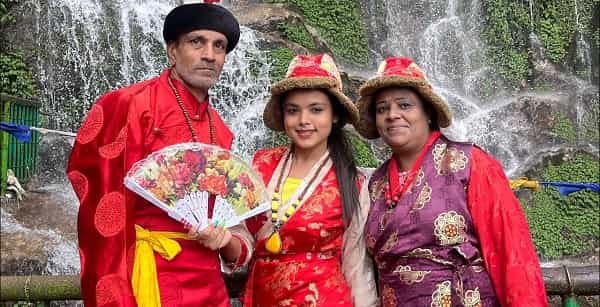
Bakhu (Kho): The Bakhu — known as Kho in the Bhutia community’s own Tibetan-derived dialect — is the primary traditional outer garment for Bhutia men: a loose, sleeveless cloak-like garment that is tied at the neck on one side and tightened around the waist with a silk or cotton belt. It closely resembles the Tibetan Chuba but is specifically Sikkimese in its proportions and finishing. The Bakhu hangs to approximately knee length when belted, allowing freedom of movement for the active highland lifestyle while providing substantial warmth in Sikkim’s cool mountain climate. The belt creates a pouch-like fold above the waist that can carry small objects — a practical feature reflecting the garment’s origins in pastoral and trading lifestyles where carrying capacity without separate bags was valued.
For daily wear, the Bakhu is made from cotton or wool in earthy, relatively subdued colours. For festivals and ceremonies — particularly the Losar (Tibetan New Year) celebrations and major Buddhist festivals at the state’s gompas — the Bakhu is made from silk or brocade in more vibrant colours, worn with the full complement of accessories. For weddings, the Bakhu is made from the finest available silk, produced in rich colours with elaborate embellishment, paired with leather boots.
Jya Jya, Yenthatse, Kera, and Shambo: Completing the Bhutia male ensemble are specific accessories that have their own names and their own specific cultural functions. The Jya Jya is a waistcoat worn over the Bakhu for added formality. The Yenthatse is a shirt worn beneath the Bakhu. The Kera is the cloth belt that holds the Bakhu at the waist. The Shambo is the traditional embroidered cap worn on the head.
Bhutia Women’s Traditional Dress
Bakhu / Kho for Women: Bhutia women wear the same basic Bakhu garment as men, but with modifications specific to women’s dress. The women’s Bakhu is typically made from more colourful and finer fabrics, and is paired with a full-sleeved silk blouse called the Hanju (also spelled Honju) underneath. The Hanju’s silk fabric and full sleeve design provide both warmth and elegance.
Pangden — The Married Woman’s Apron: The Pangden is the most culturally significant garment accessory in Bhutia women’s traditional dress — a colourfully striped apron worn over the Bakhu by married women as the explicit marker of their married status. The Pangden’s bold, colourful horizontal stripes — typically woven from wool or silk in a combination of red, green, yellow, blue, and black — make it the most visually vibrant element of the Bhutia female ensemble and serve as an immediate social identifier communicating the wearer’s married state to any community member. The Pangden is worn over the Bakhu at festivals, cultural ceremonies, and daily activities by married Bhutia women, appearing in its finest silk version at weddings and the most important occasions.
Majetro and Kushen: The Majetro is a shawl draped over the shoulders as part of the Bhutia women’s complete ensemble. The Kushen is a jacket worn for additional warmth and formality. Together with the Chaubandi Cholo blouse style and the Shambo cap, these accessories complete the full traditional Bhutia women’s ensemble for formal occasions.
The Lepcha Community — Sikkim’s Indigenous People
The Lepchas are the original indigenous inhabitants of Sikkim — the community that occupied this Himalayan territory before the Namgyal dynasty’s establishment of the Chogyals (Buddhist kings) or the Nepali migration. In Lepcha language, Sikkim is known as “Nye-mae-el” — paradise — and the Lepcha people’s relationship to their homeland is one of the most intimate ecological and spiritual relationships between a human community and its environment found anywhere in the world. Their traditional dress reflects this rootedness in the natural landscape through its materials, colours, and specific garments.
Lepcha Men’s Traditional Dress
Thokro-Dum: The Thokro-Dum is the most iconic traditional garment of Lepcha men — an ensemble consisting of a white pyjama that reaches to the calves (distinctively shorter than most Indian trousers), worn with the Yenthatse (a Lepcha-style shirt), and the Shambo (embroidered cap). The calf-length of the pyjama is culturally significant, historically connected to life in the marshy lowland areas that the Lepcha traditionally inhabited — short enough to keep clean in wet ground conditions. The Thokro-Dum’s coarse texture reflects the practical demands of men’s outdoor work in forests and fields.
Dum Praa: The Dum Praa is a multicoloured, handwoven striped cloth worn by Lepcha men as a waistcoat-like outer garment, fastened at one shoulder with a waistband called the Gyatomu. The Dum Praa comes in specific design variants whose names reflect the patterns — Tagaap (flowery motifs), Khemchu (scissors patterns), and Tamblyoak (butterfly designs) — each carrying its own specific aesthetic identity within the Lepcha handweaving tradition.
Lepcha Women’s Traditional Dress
Dumvum (Dumyam): The Dumvum is the primary traditional garment of Lepcha women — a saree-like cloth that is smooth, silky in texture, and reaches the ankle, draped around the body in a manner that resembles a saree while being structurally distinct from the standard Indian saree tradition. The Dumvum’s smooth, graceful texture contrasts explicitly with the coarser material of Lepcha men’s traditional dress — a deliberate aesthetic distinction between the genders that reflects the Lepcha community’s specific gender roles. Below the Dumvum, a loose-fitting blouse called the Tago in a contrasting colour provides the upper body covering, and the combination is completed by the Nyamrek belt, the Taro cap, and the Gorey scarf for head covering.
The Dumvum is made from locally woven silk or fine cotton in the colours that identify Lepcha women’s dress — typically deeper, richer tones than the white or cream of other communities’ more restrained palette. It is a garment of quiet, assured elegance — not the visual exuberance of Rajasthani or Punjabi dress but the dignified beauty of a community at peace with its specific aesthetic identity.
The Nepali Community — The Majority’s Himalayan Heritage
The Nepali community (also called Gorkhali) forms the numerical majority of Sikkim’s contemporary population — the result of substantial migration from Nepal over the past two centuries, bringing the specific clothing traditions of the Nepali hill communities into Sikkim’s cultural landscape. The Nepali community’s traditional dress in Sikkim is closely related to the national dress traditions of Nepal, with specific adaptations to Sikkim’s climate and cultural context.
Nepali Men’s Traditional Dress
Daura-Suruwal: The Daura-Suruwal is the national dress of Nepal and the primary traditional dress of Nepali men in Sikkim — consisting of two garments. The Daura is a long, high-necked shirt with a double-breasted fastening using pairs of strings along the chest rather than buttons — creating the characteristic front panel arrangement that gives the Daura its distinctive visual character. The Suruwal is the accompanying trouser — comfortable and somewhat loose-fitting through the body but tapering toward the ankle. Together, the Daura-Suruwal creates a dignified, formal ensemble that Nepali men in Sikkim wear for festivals, official functions, and all significant social occasions.
The Bhoto is a waistcoat worn over the Daura-Suruwal for added formality. The complete ensemble of Daura-Suruwal with Bhoto and Dhaka fabric (a traditional handwoven cotton specific to the Nepali community, typically in fine stripes and geometric patterns) is the most formally correct Nepali male traditional dress.
Nepali Women’s Traditional Dress
Gunyu-Cholo (Pharia): Nepali women in Sikkim wear two terms for their primary traditional dress — Gunyu-Cholo for the complete ensemble name and Pharia for the wrapped lower garment itself. The Pharia is a saree-like wrapped cloth in vibrant colours — bright reds, yellows, greens — that is draped around the lower body, paired with the Chaubandi Cholo (a long blouse stitched on four sides that ties at the neck and waist), and completed with the Hembari — a printed cloth wrapped around the upper body for modesty and decoration.
The Nepali women’s complete ensemble is notably more colourful than either the Bhutia Bakhu tradition or the Lepcha Dumvum — reflecting the Nepali community’s preference for vibrant festival colours, particularly the reds and yellows that are most auspicious in the Hindu and Nepali Buddhist traditions.
Pachauri: The Pachauri is a colourful cloth that Nepali women in Sikkim hang from their head to their waist during traditional dance performances — particularly the Maruni folk dance, which is the most celebrated Nepali folk dance tradition in Sikkim. The Pachauri’s colourful vertical descent from head to waist creates a dramatic visual effect during the dance, and it has become one of the most immediately recognisable elements of Nepali women’s dance dress in Sikkim.
Tilhari: The Tilhari is the most culturally significant accessory for married Nepali women — a necklace consisting of a green bead with an elongated gold pendant, worn exclusively by married Hindu women as the primary marker of their married status. It is the Nepali equivalent of the Mangalsutra worn in other Hindu communities across India, but in its specifically Nepali form of green bead and gold pendant.
Wedding Dress
Sikkimese weddings across all three communities create the state’s most elaborate traditional dress occasions. Bhutia brides wear the finest silk Bakhu/Kho — rich in colour and brocade — with the Pangden apron, Pangkham (large multicoloured head scarf), and pure gold jewellery including Namchok (earrings), Lyak (necklace), and Gyar (bracelets). The groom wears the silk Bakhu with baggy trousers and leather boots. Lepcha brides wear a silk Dumvum in richer colours than everyday, with the full Tago, Nyamrek, and Taro ensemble and gold and silver jewellery. Nepali brides wear an elaborate Pharia-Cholo in red, the most auspicious bridal colour, with the Tilhari and the full complement of traditional Nepali bridal jewellery including Sir-Bandi (jewelled tiara), Naugeri (pearl necklace), and Kalli (silver anklets).
FAQs
Q: What are the three major communities of Sikkim and how do their dress traditions differ?
A: The Bhutia (Tibetan-descended) wear the Bakhu/Kho cloak for both men and women with Pangden apron for married women. The Lepcha (indigenous) men wear the Thokro-Dum and Dum Praa; women wear the Dumvum saree-like cloth. The Nepali (majority community) men wear the Daura-Suruwal; women wear the Gunyu-Cholo (Pharia). Each tradition is entirely distinct in form and cultural origin.
Q: What is the Bakhu and how is it worn?
A: The Bakhu (Kho in Bhutia dialect) is a sleeveless, loose, cloak-like garment worn by both Bhutia men and women, tied at the neck and belted at the waist with a silk or cotton belt. It resembles the Tibetan Chuba but is sleeveless and specifically Sikkimese. For women, it is paired with the Hanju full-sleeved silk blouse beneath.
Q: What is the significance of the Pangden in Bhutia women’s dress?
A: The Pangden is a colourfully striped woven apron worn by married Bhutia women over the Bakhu as the explicit marker of married status — its bold horizontal stripes in multiple colours making it the most immediately visible social identifier in Bhutia women’s traditional dress.
Q: What is the Dumvum and how does it differ from a saree?
A: The Dumvum is the Lepcha women’s traditional garment — a smooth, silky ankle-length cloth draped in a saree-like manner but structurally distinct from the standard Indian saree tradition, worn with the Tago blouse, Nyamrek belt, and Taro cap. Its smooth texture contrasts deliberately with the coarser material of Lepcha men’s traditional dress.
Q: What is the Daura-Suruwal and why is it significant for Sikkim’s Nepali community?
A: The Daura-Suruwal is the national dress of Nepal — a long double-breasted string-fastened shirt (Daura) with accompanying loose-to-tapered trousers (Suruwal). It is the primary traditional formal dress of Sikkim’s Nepali community, worn for festivals, official occasions, and all significant social events, maintaining the community’s connection to their Nepali cultural heritage within their Sikkimese context.