India’s women’s traditional dress heritage is one of the world’s richest and most diverse — a living textile and fashion culture shaped by thousands of years of regional artistic tradition, religious practice, social custom, and the extraordinary diversity of India’s geography, climate, and communities. From the snow-covered Himalayas to the tropical coasts of Kerala and Tamil Nadu, from the desert landscapes of Rajasthan to the river deltas of Bengal, each region of India has developed its own distinctive traditional women’s dress forms — in fabrics, silhouettes, colours, and ornamentation patterns that reflect specific ecological and cultural contexts.
What makes Indian women’s traditional dress particularly remarkable is that it is not museum-preserved history but living, daily practice — hundreds of millions of Indian women wear traditional dress not as a cultural performance or special occasion costume but as their everyday clothing, choosing from traditions that are simultaneously ancient and contemporary, unchanged in essential form yet constantly refreshed in design interpretation. This guide celebrates five of India’s most important, most loved, and most widely worn traditional women’s dress forms.
1. Saree — India’s Timeless Icon
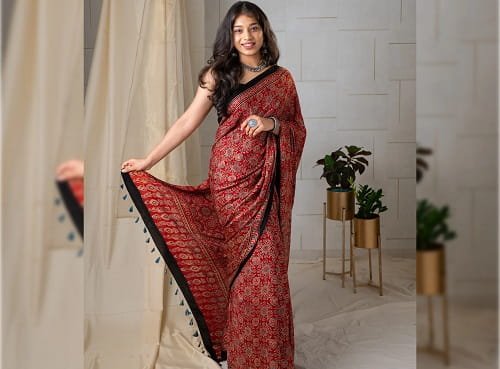
The saree is India’s most universally recognised and most culturally significant traditional garment — a single piece of unstitched fabric between five and nine metres long that is draped around the body in any of over 80 documented regional draping styles. Its origins are traced back to the Indus Valley Civilisation — making it possibly the world’s oldest continuously worn garment form, with an unbroken tradition of use spanning at least 5,000 years. The saree’s genius lies in its philosophical rejection of cutting and stitching fabric — treating the textile as a complete, sacred object that is shaped by the body wearing it rather than by a tailor’s shears.
India’s saree traditions are extraordinary in their diversity — the Kanjivaram silk saree of Tamil Nadu with its heavy mulberry silk body and contrasting silk and zari border represents the pinnacle of South Indian weaving art. The Banarasi silk saree of Varanasi — with its gold and silver brocaded motifs derived from Mughal art traditions — is the premier North Indian festive and bridal saree. The Chanderi of Madhya Pradesh offers a translucent, gossamer-light silk-cotton weave ideal for summer wearing. The Pochampally ikat of Telangana creates geometric patterns through the extraordinary resist-dyeing technique of tying threads before weaving. The Baluchari silk of West Bengal depicts mythological narratives in its woven borders. Each is a distinct artistic tradition, each is a form of the same garment.
The saree’s remarkable adaptability — appropriate across every occasion from daily household chores to state ceremonies, from village festivals to corporate boardrooms — and its ability to be draped in ways that flatter every body type have sustained its relevance across millennia of fashion change. The modern Indian professional woman who drapes her saree every morning before stepping into a contemporary urban workplace is participating in a tradition as old as Indian civilisation itself.
Worn predominantly in: All states across India, with specific regional styles predominant in Tamil Nadu, Andhra Pradesh, Telangana, Karnataka, West Bengal, Maharashtra, Rajasthan, and Uttar Pradesh.
2. Salwar Kameez — The Versatile National Dress
The salwar kameez — comprising a long tunic (kameez) worn over loose trousers (salwar) with a dupatta (scarf) — is arguably India’s most widely worn women’s traditional dress form across the broadest geographic range, transcending the regional specificity of most traditional dress forms to serve as an effectively national garment worn by Indian women across virtually every state, religion, and social background. Its origins in the Punjab region and the broader Mughal-influenced North Indian sartorial tradition have spread through India’s entire social fabric over centuries of cultural exchange.
The salwar kameez exists in extraordinary regional and stylistic diversity — the heavily embroidered Phulkari of Punjab with its silk thread floss embroidery covering entire fabric surfaces in vibrant floral patterns, the Lucknowi chikankari kameez with its delicate white-on-white shadow embroidery, the mirror-worked Kutchi salwar kameez of Gujarat, the printed cotton suits of Rajasthan, the silk and georgette combinations of festive occasion wear. Each reflects a regional aesthetic and craft tradition while maintaining the essential three-piece silhouette that is recognisable across all variants.
The practical virtues of the salwar kameez — comfortable across India’s diverse climates, modest by the social standards of most Indian communities, adaptable to every occasion through fabric and embellishment variation, and accessible in terms of both cost and availability — have made it the wardrobe staple of the majority of Indian women regardless of region. School uniforms, office wear, casual daily dress, and festival finery all find expression within the salwar kameez form. The churidar kameez variant — with its tightly gathered churidar trouser — and the palazzo variant with its wide-leg contemporary trouser reflect the form’s ongoing evolution in response to changing aesthetic preferences without departing from its essential traditional identity.
Worn predominantly in: Punjab, Haryana, Himachal Pradesh, Jammu & Kashmir, Uttar Pradesh, Uttarakhand, Delhi-NCR — and widely across all Indian states as everyday dress.
3. Lehenga Choli — The Grand Festive Silhouette
The lehenga choli — a full-length flared skirt (lehenga) paired with a cropped fitted blouse (choli) and a dupatta — is India’s quintessential bridal and festive women’s dress, the garment of choice for the country’s most important celebrations and ceremonies. Its origins in the royal courts of Rajasthan and the Mughal empire’s elaborate court dress traditions have given it an inherent association with grandeur, opulence, and ceremonial significance that makes it the natural choice for the occasions that Indian women want to mark most memorably.
The bridal lehenga — typically in deep red, burgundy, ivory, or the pink shades that have become fashionable in contemporary Indian weddings — is one of the most elaborate and expensive garments in Indian culture, often requiring months of skilled artisan work to complete. The finest bridal lehengas from Rajasthani craftspeople feature intricate gota patti (ribbon appliqué), zardozi (gold thread embroidery), and mirror work that transforms the garment into a wearable artwork. Banarasi weave lehengas incorporate the same silk brocade traditions as the most prestigious Banarasi sarees.
Beyond bridal wear, the lehenga choli serves the broader Indian festive calendar — Navratri celebrations in Gujarat (where the garba dance form’s spinning movement is perfectly suited to the lehenga’s wide flare), Diwali parties, wedding guest occasions, and cultural events all find the lehenga choli as the appropriate dress choice. The garment’s modern interpretations — crop-top-style cholis, contemporary silhouettes, and fashion-forward fabric combinations — have kept it continuously relevant to younger Indian women while respecting its traditional roots.
Worn predominantly in: Rajasthan, Gujarat, Madhya Pradesh, Maharashtra, and increasingly across India as bridal and festive wear.
4. Mekhela Chador — Assam’s Living Heritage
The mekhela chador is the traditional two-piece garment of Assamese women — consisting of the mekhela (a cylindrical lower garment wrapped around the waist and tucked in) and the chador (an upper cloth draped over the shoulder). Woven primarily from Assam’s extraordinary natural silk traditions — including the world-exclusive Muga silk (golden silk), Endi silk (end-spun silk), and Pat silk — the mekhela chador represents one of India’s most distinctive and most materially unique traditional dress forms, identifiable at a glance through its characteristic two-piece silhouette and the unmistakable lustre of Assamese natural silk.
Assam’s Muga silk — a golden-coloured silk produced exclusively in the Brahmaputra valley and found nowhere else in the world — gives mekhela chadors a distinctive warm golden sheen that no other textile tradition in the world can replicate. The fabric’s cultural significance is immense — Muga silk mekhela chadors are worn for the most important occasions in Assamese life, from Bihu celebrations to weddings to official state ceremonies, and are considered among India’s most precious traditional textiles.
The woven motifs of the mekhela chador — geometric patterns, animal forms, and stylised natural motifs drawn from Assam’s biodiversity — are produced through intricate supplementary weft weaving techniques that require extraordinary skill and time to execute. The garment’s cultural significance in Assamese identity is so deep that it functions as both a garment and a cultural statement — wearing a mekhela chador of quality Muga silk communicates regional pride, cultural knowledge, and aesthetic discernment simultaneously.
Worn predominantly in: Assam and the broader northeastern states of India.
5. Patiala Salwar — Punjab’s Vibrant Legacy
The Patiala salwar — named after the royal city of Patiala in Punjab — is one of India’s most distinctively shaped and most joyfully exuberant traditional dress forms, characterised by its dramatically gathered, voluminous salwar trouser that is tucked in at the waist to create deep pleats extending to below the knee before tapering to tight anklet sections. The extreme volume of the Patiala salwar — created through the use of as much as 8–12 metres of fabric in the trouser alone — creates a silhouette of extraordinary visual drama that is both deeply traditional and genuinely glamorous.
Originating in the Sikh royal courts of Patiala in the early 20th century, the garment was associated with the royal women of the Patiala state who desired a trouser form that was both culturally appropriate and suitably grand for the maharani aesthetic. Its adoption across Punjab’s broader cultural landscape — and its association with the vibrant, colour-loving, celebratory aesthetic of Punjabi culture — has made it one of India’s most recognised and internationally recognised regional dress forms.
The Patiala salwar worn with a shorter kameez and a neatly pinned dupatta creates one of Indian fashion’s most distinctive complete looks — instantly recognisable, associated with confidence, colour, and the joyful energy that characterises Punjabi cultural expression at its finest. Modern fashion designers have continuously reimagined the Patiala salwar in contemporary fabrics, prints, and pairings, ensuring its ongoing relevance to younger generations of Indian women who want to express regional identity through dress.
Worn predominantly in: Punjab, Haryana, and the broader North Indian Hindi-speaking belt.
| Dress | Region | Fabric | Occasion | Key Feature |
| Saree | Pan-India | Silk, cotton, linen | All occasions | Unstitched drape, 80+ styles |
| Salwar Kameez | North India | Cotton, silk, georgette | Daily, festive | Three-piece, most versatile |
| Lehenga Choli | West/North India | Silk, brocade, net | Bridal, festive | Full flared skirt, opulent |
| Mekhela Chador | Assam (Northeast) | Muga silk, Endi silk | Bihu, weddings | Two-piece, golden silk |
| Patiala Salwar | Punjab | Cotton, phulkari, silk | Festivals, daily | Voluminous pleated trouser |
Frequently Asked Questions (FAQs)
Q: What is the most popular traditional dress for women in India?
A: The saree is India’s most universally worn and culturally significant traditional dress across all states and communities.
Q: Which traditional dress is worn in most states of India?
A: The salwar kameez is worn across virtually all Indian states as daily dress, making it India’s most geographically widespread traditional women’s garment.
Q: What is the most expensive Indian traditional dress for women?
A: Heavily embroidered bridal lehengas from Rajasthani artisans and premium Banarasi silk sarees represent Indian traditional fashion’s highest price points — running into lakhs for the finest examples.
Q: Is the saree worn differently in different states?
A: Yes — over 80 distinct regional draping styles have been documented, from the Nivi style (standard modern drape) to the Kodagu, Madisar, Bengali, and dozens of other region-specific styles.