Tamil Nadu — the land of ancient Dravidian civilisation, of the Chola, Pallava, and Pandya empires, of living temple cities at Madurai, Thanjavur, Kanchipuram, and Chidambaram, of the classical Bharatanatyam dance, of Carnatic music, and of one of the world’s oldest continuously spoken literary languages — is a state where traditional dress is inseparable from temple culture, from the devotional aesthetic that has shaped Tamil life for at least two thousand years. The white Veshti against a silk shirt at the temple entrance, the Kanchipuram silk saree’s heavy zari border catching the lamp-light at a wedding ceremony, the young girl’s first wearing of the half-saree at her puberty ceremony — in Tamil Nadu, clothing is never merely personal style. It is the visible expression of religious observance, family occasion, and cultural identity worn simultaneously.
What defines Tamil Nadu’s traditional dress above all is this relationship to the sacred. The white-and-gold colour combination that dominates Tamil male formal dress — white Veshti with gold Karai border, white shirt or cream silk shirt, cream Angavastram with gold border — reflects the same aesthetic of purified simplicity with auspicious gold accent that characterises Tamil temple architecture and devotional practice. Silk, the most auspicious fabric in the Tamil tradition, is the non-negotiable material for temple visits, weddings, and important rituals. And the Kanchipuram saree — produced in the ancient temple city of Kanchipuram, whose handloom heritage is at least one hundred and fifty years old in its current form and whose textile traditions reach back much further — is the most sacred, most coveted, and most internationally celebrated saree in all of South India.
Traditional Dress of Tamil Nadu Quick Comparison
| Garment | Worn By | Fabric | Occasion |
| Veshti (Dhoti) | Men | Cotton, Silk | Daily, Temple, Ceremonies |
| Lungi | Men | Cotton (checked/striped) | Daily casual |
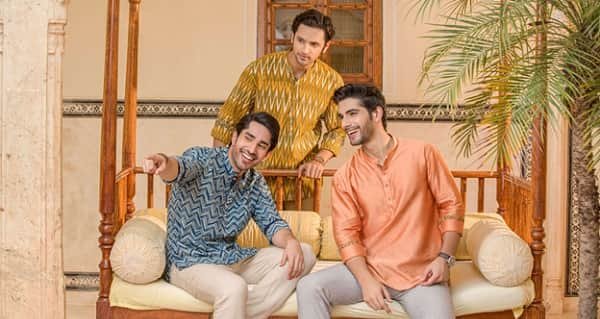
| Silk Shirt | Men | Silk | Festivals, Weddings |
| Angavastram | Men | Cotton, Silk | Temple, Ceremonies, Weddings |
| Panchakacham | Men (Brahmins) | Cotton, Silk | Ritual draping for ceremonies |
| Thalaipagai (Turban) | Men | Cotton, Silk | Formal ceremonies (historical) |
| Kanchipuram Silk Saree | Women | Pure mulberry silk | Weddings, Major festivals |
| Cotton Saree | Women | Cotton (various) | Daily wear |
| Madisar (9-yard draping) | Brahmin Women | Silk | Weddings, Religious ceremonies |
| Pavadai-Davani / Thavani | Girls | Cotton, Silk | Coming-of-age, Festivals |
| Salwar Kameez | Women | Cotton, Silk | Daily, Semi-formal |
Tamil Nadu’s Silk Heritage — Kanchipuram
Kanchipuram — one of the seven sacred cities of Hindu tradition, the seat of Adi Shankaracharya’s most important southern peetham, and the home of South India’s most celebrated silk weaving community — has given India the Kanchipuram saree, a textile that occupies a position in Tamil culture that no other garment in any other Indian state can quite match. A Kanchipuram saree is not bought; it is acquired. Not worn; it is worn for a specific life occasion. Not admired; it is revered.
The Kanchipuram saree’s technical characteristics are as distinctive as its cultural weight. Woven entirely from pure mulberry silk using three shuttles on traditional pit looms — one for the body, one for the border, and one for the pallu — the border and body of an authentic Kanchipuram saree are woven separately in a technique called the interlocked weft, where the border’s weft threads interlock with the body’s warp threads in a joining called the korvai. This interlocking creates a joint so strong that the saree will hold its structure even if the fabric is cut. The zari (gold thread) used in Kanchipuram sarees is traditionally pure gold twisted with silk thread, though silver zari and imitation zari are also used in lower price points. The pallu — typically fifteen to eighteen inches wide — carries the most elaborate motifs: temple towers (gopuram patterns), peacocks with spread tails, lotus flowers, horses and elephants in procession, and geometric checks and stripes in combinations that have specific traditional names.
Kanchipuram sarees are available across a vast price range and quality spectrum, from accessible power-loom versions to handwoven silk sarees costing lakhs of rupees and taking two to four weeks of a master weaver’s work. The Handloom Mark and the Silk Mark certifications, and the GI tag specifically for Kanchipuram silk sarees, help buyers identify authentic handwoven pieces.
Traditional Dress of Tamil Nadu for Men
1. Veshti — The Primary Garment
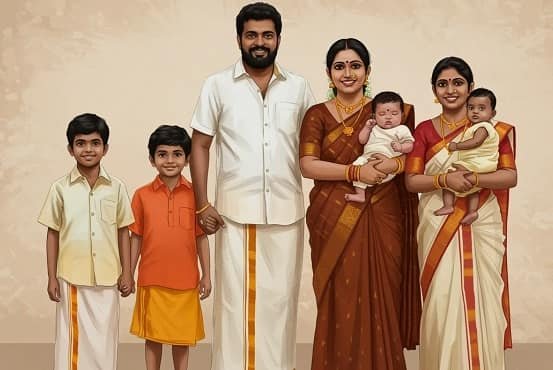
The Veshti (also written Vetti or Dhoti in formal contexts) is the most fundamental traditional garment of Tamil men — a single long piece of white or cream cotton or silk cloth wrapped around the waist and falling to the ankles. Tamil Nadu’s Veshti has several characteristics that distinguish it from the dhoti of other South Indian states. The Karai — the border running along the bottom edge — is its most immediate visual identifier, and its colour carries specific social meaning: a gold Karai denotes festivity; a coloured Karai in red, green, or maroon may indicate specific community affiliation or political identity; a plain white Veshti with minimal border is worn for mourning. The width of the Karai signals the formality of the occasion.
The specific draping method of the Tamil Veshti also varies by occasion and community. In the simplest daily form, the cloth is wrapped around the waist and the surplus tucked in at the front. For temple visits and formal occasions, the standard two-yard double-fold arrangement creates a longer, more dignified drape. The Panchakacham (five-hold drape) is the most elaborate traditional draping style, in which approximately five yards of silk are pleated and passed between the legs in a method specific to Brahmin ceremonial dress during religious rituals — creating a bifurcated lower garment that allows complete freedom of movement while maintaining the cloth’s auspicious quality. At temples like Chidambaram and certain ceremonies in Madurai’s Meenakshi temple, the Panchakacham remains the mandatory dress for male priests and officiant devotees.
The Pattu Veshti — a silk Veshti — is the definitive marker of the Tamil formal occasion. Cream or off-white silk with a gold Karai border is the most traditional pattu veshti for weddings; a Tamil groom at a traditional wedding wears the white or cream pattu veshti with a matching silk shirt and an angavastram as the complete traditional male bridal ensemble.
2. Lungi
The Lungi is the daily casual lower garment of Tamil men — a length of cotton cloth sewn into a tube and worn wrapped around the hips, typically falling to the knee or mid-calf. Unlike the Veshti’s formal white-and-gold aesthetic, the Lungi is characteristically checked or striped in vivid colour combinations — bright greens, blues, and reds in bold check patterns are quintessentially Tamil Lungi aesthetics. The Lungi’s complete practicality for hot, humid weather — easy to wear, easy to wash, cool against the skin — makes it the go-to garment for men at home, at local teashops, at the local market, and for all informal daily movement. Paired with a simple cotton shirt or worn alone above the waist with an angavastram, the Lungi is as Tamil as filter coffee.
3. Angavastram
The Angavastram is a long cloth — silk or cotton depending on the occasion — draped over the shoulders and across the chest, worn by Tamil men as the standard upper body covering for all formal, religious, and ceremonial contexts. Its function is simultaneously practical (covering the upper body) and deeply symbolic — placing the Angavastram over the shoulders is the act that transitions a Tamil man from casual to formal mode. Visiting a temple, attending a religious ceremony, paying respects to elders, or participating in a family occasion all require the Angavastram.
For daily or semi-formal use, a plain white cotton Angavastram serves. For weddings and the most important ceremonies, a silk Angavastram with a gold Karai border — matching the Veshti — completes the Tamil male formal ensemble with a visual unity that is entirely specific to the Tamil tradition. Priests and Brahmin men conducting rituals wear the Angavastram as a mandatory element of their ceremonial dress, and entering a sanctum sanctorum without one would be considered inappropriate.
4. Silk Shirt
The silk shirt — a short-sleeved or long-sleeved shirt in cream, white, or light gold silk — is the characteristic Tamil festive upper garment paired with the Pattu Veshti for weddings and major festivals. Tamil silk shirts have a specific quality: the fabric is heavier and more lustrous than standard cotton dress shirts, and the subtle play of silk’s natural sheen with the Veshti’s matching fabric creates a complete ensemble of quiet opulence. The cream-on-cream or white-on-white combination of silk shirt and silk Veshti with gold borders is the definitive Tamil bridegroom’s look at a traditional Tamil Hindu wedding.
5. Thalaipagai — Traditional Head Covering
The Thalaipagai — essentially a turban or head covering made from cloth — is the historical traditional headgear for Tamil men, worn particularly at formal ceremonies, weddings, and important public occasions in rural communities and among older generations. At traditional Tamil weddings, the groom may wear a Thalaipagai as part of the ceremonial dress. In temple festivals and certain community events, the Thalaipagai remains in use as a marker of the occasion’s formal character. Its specific form and draping style varies by community and region within Tamil Nadu.
Traditional Dress of Tamil Nadu for Women
1. Kanchipuram Silk Saree
At every important moment in a Tamil woman’s life — her wedding, her children’s naming ceremonies and weddings, major festivals, and the most significant temple visits — a Kanchipuram silk saree is the garment of choice. The saree’s weight, the heaviness of the real zari border, the richness of the silk, and the specific motifs of the pallu all signal the occasion’s importance in a visual language that every Tamil family understands. Brides wear Kanchipuram sarees in deep jewel colours — wine red, deep green, royal blue, purple — with contrasting borders and wide zari pallus featuring the classic peacock, temple, and lotus motifs. The saree is often purchased by the groom’s family as a wedding gift to the bride — the Koorai Saree — in a specific colour appropriate to the family’s tradition.
The Kanchipuram saree is also the standard festival dress for Tamil women at Pongal, Diwali, Navratri, and Karthigai Deepam — the major festivals of the Tamil calendar. A Tamil woman who does not own at least one Kanchipuram saree is considered to have a gap in her wardrobe that most Tamil families would find surprising.
2. Cotton Saree — Daily Wear
For daily wear, Tamil women wear cotton sarees from the state’s other major weaving centres — Coimbatore, Madurai, Salem, Tirunelveli, and the Chettinad region each produce cotton sarees with specific characteristics. Coimbatore cotton sarees are known for their fine, smooth texture and subtle patterns. Salem sarees feature distinctive striped designs. Chettinad sarees have bold checks and horizontal stripes in deep colours. These cotton sarees are the practical garments of working Tamil women — teachers, office workers, homemakers — worn daily with a fitted blouse and petticoat in the Tamil Nadu style of neatly tucked pleats and a moderately pinned pallu.
The manner of draping a saree in Tamil Nadu — with the pleats carefully counted and arranged to equal width, tucked crisply into the petticoat at the front left, and the pallu pinned at the left shoulder — creates a distinctive Tamil aesthetic of orderly, geometric precision that differs from the more flowing draping styles of some other Indian states.
3. Madisar — Nine-Yard Sacred Draping
The Madisar is the most sacred and most technically demanding women’s saree draping tradition in Tamil Nadu — a nine-yard length of silk draped in a specific manner that passes the cloth between the legs from back to front, creating a bifurcated lower garment similar in concept to the men’s Panchakacham. The Madisar is traditionally worn by married Brahmin women (Iyer and Iyengar communities in particular) at weddings, temple ceremonies, and the most important religious occasions — it is the dress of the Brahmin bride at a traditional Tamil Brahmin wedding, and seeing an older woman in Madisar at a temple is one of the most immediately recognisable images of traditional Tamil Brahmin religious life.
The Madisar’s draping requires assistance and practice — its nine yards must be arranged correctly to create the proper bifurcation and the correct fall of the pallu over the left shoulder. It is a garment that signals both the occasion’s sanctity and the wearer’s cultural knowledge, since wearing a Madisar correctly is itself a demonstration of connection to the tradition.
4. Pavadai-Davani (Thavani) — The Half Saree
The Pavadai-Davani — also called the half-saree or Thavani — is the traditional dress of young Tamil girls and unmarried women, marking the life stage between a girl’s childhood clothes and the adult saree. The ensemble consists of three pieces: the Pavadai (a long, full-length skirt falling to the ankle), a fitted blouse, and the Davani or Thavani (a long dupatta-like cloth draped diagonally across the shoulder and pinned, resembling a saree’s pallu without the full saree draping). The overall effect is between a skirt-and-blouse and a full saree — marking the transitional social position of a girl who is old enough for formal dress but not yet an adult woman.
At a young woman’s puberty ceremony (Manjal Neerattu Vizha), the formal wearing of the half-saree for the first time is a major social event for the family, celebrated with the same seriousness as a wedding in many Tamil families. The Pavadai-Davani for this ceremony is typically in silk with gold border, in the family’s traditional colours. The girl wears it with flowers in her hair and gold jewellery, marking the occasion as one of the most important ceremonies in her life.
Traditional Tamil Jewellery
Tamil women’s gold jewellery tradition is among the richest and most elaborate in India. The Oddiyanam (waist belt in gold) is the most spectacular piece, visible beneath the saree at the waist. The Vanki (armlet worn on the upper arm) is specifically Tamil in form. The Thodu (a distinctive stud earring style) and hanging Jimikki (bell-shaped earrings) complete the ear jewellery. The Thali (sacred marriage necklace, the Tamil equivalent of the Mangalsutra) is tied by the groom at the wedding’s central moment. The Mangamalai (coin necklace) and various temple jewellery forms — heavy gold pieces specifically inspired by the jewellery depicted on temple sculptures — complete the Tamil bridal jewellery ensemble. Hair decorated with Jasmine flowers (Malligai poo) is the essential final touch of Tamil women’s festive dress, its fragrance as associated with Tamil femininity as the silk saree itself.
FAQs
Q: What is the Kanchipuram saree and what makes it different from other silk sarees?
A: The Kanchipuram saree is woven in pure mulberry silk in the ancient temple city of Kanchipuram using three shuttles — one each for the body, border, and pallu. The border and body are interlocked using the korvai technique, creating a joint so strong the saree holds structure even when cut. The wide zari pallu with temple, peacock, and lotus motifs is its most distinctive feature. It holds GI tag protection.
Q: What is the Panchakacham and who wears it?
A: The Panchakacham is an elaborate ceremonial draping of approximately five yards of silk cloth that is pleated and passed between the legs, worn by Tamil Brahmin men during religious rituals. It allows complete freedom of movement while maintaining the cloth’s sacred quality. It remains mandatory dress for priests at certain major Tamil temples.
Q: What is the Madisar and why is it significant?
A: The Madisar is a nine-yard saree draped in a bifurcated style — the cloth passed between the legs — traditionally worn by married Tamil Brahmin women at weddings and religious ceremonies. Its correct draping requires assistance and practice, and wearing it correctly is itself a demonstration of cultural knowledge and tradition.
Q: What is the Pavadai-Davani ceremony?
A: The Pavadai-Davani (half-saree) ceremony — Manjal Neerattu Vizha — marks a young Tamil girl’s first wearing of the half-saree at her puberty ceremony, one of the most important family events in Tamil culture. The ceremony celebrates her transition from girlhood to womanhood with the same gravity as a wedding in many Tamil families.
Q: What role do flowers play in Tamil traditional dress?
A: Jasmine flowers (Malligai poo) woven into a long braid or arranged in the hair are as essential to Tamil women’s festive dress as the saree itself. No traditional Tamil occasion — wedding, temple festival, or family ceremony — is complete for a woman without flowers in her hair. The fragrance of jasmine is as culturally associated with Tamil femininity as silk or gold.