In today’s competitive business environment, companies rely heavily on data to make decisions. Organizations collect large amounts of information from sales, customers, markets, and operations. However, raw data alone does not provide meaningful insights. This is where Business Intelligence (BI) becomes important.
Business Intelligence refers to the use of technologies, tools, and strategies that help organizations analyze data and transform it into useful information. By using BI systems, companies can study trends, monitor performance, and make better business decisions.
Although Business Intelligence offers many benefits such as improved decision-making and operational efficiency, it also has some limitations like high costs and technical complexity. Understanding the advantages and disadvantages of Business Intelligence helps businesses use it effectively.
What Is Business Intelligence?
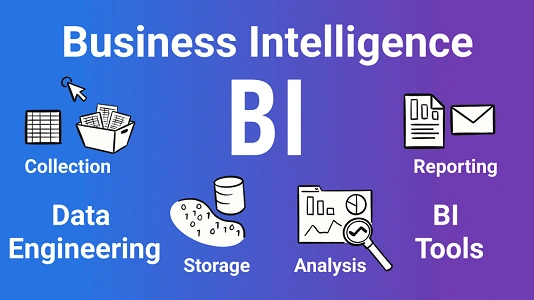
Business Intelligence (BI) is a process that involves collecting, analyzing, and presenting business data to support decision-making.
BI tools gather information from various sources such as databases, spreadsheets, and software systems. The data is then analyzed and displayed through dashboards, charts, and reports.
Some widely used BI platforms include Microsoft Power BI, Tableau, and SAP BusinessObjects.
These tools help managers and business leaders understand patterns, identify opportunities, and improve overall performance.
Advantages of Business Intelligence
Business Intelligence provides several important benefits for modern organizations.
1. Better Decision-Making
One of the biggest advantages of Business Intelligence is improved decision-making.
BI systems analyze large amounts of data and present it in a clear and understandable format. Managers can easily view reports, dashboards, and analytics to make informed decisions.
Instead of relying on guesswork, companies can base their strategies on real data and insights.
2. Improved Business Efficiency
Business Intelligence helps organizations improve operational efficiency.
By analyzing workflows and performance metrics, companies can identify areas where resources are being wasted or processes are inefficient.
For example, BI can reveal:
- slow production processes
- unnecessary expenses
- inventory problems
Once these issues are identified, businesses can take steps to improve efficiency.
3. Better Customer Understanding
BI tools help businesses understand customer behavior and preferences.
Companies can analyze data related to:
- purchasing patterns
- customer demographics
- product popularity
This information helps businesses design better marketing strategies and improve customer satisfaction.
Understanding customers more clearly often leads to increased sales and stronger brand loyalty.
4. Competitive Advantage
Organizations that use Business Intelligence can gain a competitive advantage.
By analyzing market trends and competitor activities, companies can respond quickly to changes in the industry.
BI systems provide valuable insights that help businesses identify new opportunities and stay ahead of competitors.
5. Real-Time Data Monitoring
Modern BI tools allow companies to monitor business activities in real time.
Managers can track performance indicators such as:
- sales figures
- customer engagement
- production output
Real-time monitoring helps organizations react quickly to problems or opportunities.
6. Improved Reporting and Data Visualization
Business Intelligence tools convert complex data into easy-to-understand visual reports.
Dashboards, charts, and graphs help decision-makers understand important information quickly.
Visual reports also improve communication between departments because employees can clearly see how the business is performing.
Disadvantages of Business Intelligence
Despite its many advantages, Business Intelligence also has several challenges.
1. High Implementation Cost
One of the main disadvantages of Business Intelligence is its cost.
Implementing BI systems may require:
- specialized software
- advanced hardware
- skilled professionals
- training for employees
These expenses can be significant, especially for small businesses.
2. Complex System Setup
Setting up Business Intelligence systems can be technically complex.
Companies must integrate data from different sources such as databases, applications, and external platforms.
Without proper planning, the integration process can become difficult and time-consuming.
Organizations may also need technical experts to manage and maintain the system.
3. Data Quality Issues
Business Intelligence relies heavily on accurate and reliable data.
If the data collected by the organization is incorrect, incomplete, or outdated, the analysis produced by BI tools will also be misleading.
Poor data quality can result in incorrect business decisions.
Therefore, companies must ensure proper data management and validation processes.
4. Security Risks
BI systems store large amounts of sensitive business information.
If security measures are weak, there is a risk of data breaches or unauthorized access.
Cybersecurity threats may expose confidential information such as financial records, customer details, or strategic plans.
Businesses must invest in strong security systems to protect their data.
5. Requires Skilled Professionals
Operating Business Intelligence tools requires skilled professionals such as data analysts, IT specialists, and business analysts.
These professionals are responsible for managing data, interpreting results, and generating insights.
Hiring and training skilled employees can increase operational costs.
6. Overdependence on Technology
Sometimes organizations become too dependent on BI tools.
While data analysis is important, business decisions also require human judgment, experience, and creativity.
Relying entirely on automated analysis may cause companies to overlook important qualitative factors.
Conclusion
Business Intelligence has become an essential tool for modern businesses that want to use data effectively. By analyzing large amounts of information, BI systems help companies make better decisions, improve efficiency, and gain a competitive advantage.
The ability to monitor performance, understand customer behavior, and generate visual reports makes Business Intelligence extremely valuable in today’s data-driven economy.
However, businesses must also consider the challenges associated with BI, including high implementation costs, technical complexity, data quality issues, and security risks.
When implemented properly and supported by skilled professionals, Business Intelligence can significantly improve business performance and support long-term growth.