Updating your Aadhaar number in HRMS is not just a profile correction. Aadhaar is now tightly linked with salary processing, biometric attendance (AEBAS), e-signing, pension, GPF/NPS, and DigiLocker integration. Because of this, Aadhaar updates are treated as a high-security change and almost always require verification and approval.
Whether you are a government employee using e-HRMS or a private-sector employee on a company HRMS, the core workflow remains the same: raise a request → upload proof → admin approval → data freeze.
Below is the full, practical process.
Before You Update Aadhaar (Important)
Make sure:
- Your Aadhaar details are already correct on the UIDAI website
- Mobile number is linked with Aadhaar (for OTP)
- Name and DOB in Aadhaar match your HRMS records
- Aadhaar PDF / masked Aadhaar is ready (clear, under size limit)
If name or DOB mismatches exist, fix Aadhaar first, then update HRMS.
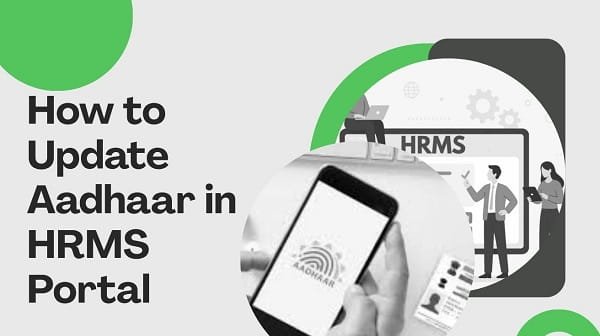
1. How to Update Aadhaar in e-HRMS 2.0 (Central Government)
In Central Government systems, Aadhaar is linked with Service Book, AEBAS, e-Sign, and Bhavishya. Direct editing is usually locked.
Step-by-Step Process
Step 1: Login
- Go to ehrms.gov.in
- Login via e-Parichay (NIC/Gov email + OTP)
Step 2: Navigate to Aadhaar Section
From dashboard:
- My Profile / Employee Details
- Open Personal / Identity Details
- Locate Aadhaar Number
You will usually see the field as Read-Only.
Step 3: Raise Change Request
- Click Raise Change Request
- Select Aadhaar Update / Correction
- Enter:
- Aadhaar Number (12 digits)
- Reason (Correction / Not linked earlier / Mismatch)
Step 4: Upload Aadhaar Proof
Upload one of the following:
- Aadhaar PDF downloaded from UIDAI
- Masked Aadhaar (last 4 digits visible)
File tips:
- PDF or JPEG
- Clear and readable
- Usually under 500 KB – 1 MB
Step 5: Submit & OTP / e-Sign
- Submit the request
- Some portals ask for OTP verification
- Status changes to Pending with Nodal Officer / DDO
Step 6: Approval & Freezing
- Admin verifies Aadhaar
- Aadhaar is seeded and frozen
Data syncs with:
- Attendance (AEBAS)
- Payroll
- Pension & e-Sign modules
You’ll see status as Approved / Updated.
2. State Government HRMS (Manav Sampada / IFMS / HRMS Odisha)
State portals follow a similar but slightly simpler workflow.
Common Steps
1. Login to state HRMS
2. Go to My Profile → Identity Details
3. Click Edit / Raise Request
4. Enter Aadhaar number
5. Upload Aadhaar document
6. Submit for approval
In many states:
- Aadhaar can only be updated once
- Re-correction requires written approval from DDO
3. Private Company HRMS (Keka, greytHR, Darwinbox)
Private HRMS platforms usually allow Aadhaar updates through ESS, but approval is still required due to compliance rules.
Option A: Self-Service
- Me → Profile → Identity / KYC
- Edit Aadhaar
- Upload proof
- Submit
Option B: Helpdesk / Request Hub
- Raise a ticket: “Aadhaar Update / KYC Correction”
- HR verifies and updates backend
4. Common Problems & Solutions
❌ “Field is locked”
✔ Use Raise Change Request
✔ Contact HR / Establishment Section
❌ “Name mismatch”
✔ Aadhaar name must exactly match HRMS
✔ Update Aadhaar first via UIDAI
❌ “OTP not received”
✔ Aadhaar-linked mobile must be active
✔ Retry after some time
❌ “Request rejected”
✔ Check remarks
✔ Re-upload clearer document
5. How Long Does It Take?
| Stage | Typical Time |
| Submission | Immediate |
| Admin verification | 1–5 working days |
| Full system sync | Up to 48 hours |
During this period, avoid biometric re-registration unless instructed.
Important Notes (Do Not Ignore)
- Aadhaar once frozen cannot be edited casually
- Wrong Aadhaar can block:
- Salary
- Attendance
- Pension
- Digital signatures
- Never share Aadhaar OTP with anyone
Final Words
Updating Aadhaar in HRMS is a one-time, high-impact correction. Do it carefully, with clean documents and exact matching details. Once approved, it strengthens your entire digital service record—from attendance to pension.